




The Video Assistant Referee (VAR) regularly stirs up debate in the Premier League. What drives these decisions, and are they accurate?
This season, we’ll delve into key incidents to clarify the decision-making process, focusing on both the VAR protocols and the Laws of the Game.
Photo credit: NBC
 Andy Davies (@andydaviesref) is a former Select Group referee with more than 12 seasons of experience in the Premier League and Championship. His extensive background in elite officiating and VAR implementation provides a unique perspective on matchday processes, rationales, and protocols.
Referee: Darren England
Assistant referee: Akil Howson
VAR: Tim Robinson
Incident: Corner awarded after a ball seemed to leave the field of play
Time: 33 minutes
What transpired: Nottingham Forest defender Nicolò Savona cleared a cross from Bryan Mbeumo. As the ball approached the corner flag and seemed out of play, Savona appeared to have reached it in time to keep it in. However, Assistant Referee Howson disagreed and signaled for a corner kick in favor of United, much to the frustration of Forest players and fans. The ensuing corner led to Casemiro scoring with a header, placing the ball in the Forest net.
Forest fans are FUMING after Manchester United score off a corner given after this ball was ruled out of play 👀
Right call? 🤔 pic.twitter.com/pbXV960SSS
— CBS Sports Golazo ⚽️ (@CBSSportsGolazo) November 1, 2025
Decision review: According to Law 9 of the game, the ball is out of play only when it has entirely crossed the goal line or touchline. The determination of the ball’s status should rely on factual evidence, and video footage confirms that the ball was still in play at the time. Additionally, the assistant’s view of the play was hindered by goalposts and player positioning, leading to a hasty decision.
VAR: Unfortunately, current VAR protocols do not cover the review of incorrect corner decisions that lead directly to a goal. Forest may feel justified in their outrage, especially after suffering from similar incorrect corner calls recently. While last weekend’s corner against them at Bournemouth was a plausible misjudgment, it is important to note that the latest IFAB meeting decided against introducing VAR reviews for such corner incidents.
Verdict: If Casemiro hadn’t scored from the corner, this moment might have been overlooked. However, Assistant Referee Howson lacked the conclusive evidence needed to make an accurate decision, considering his position. Calls involving whether the ball is in play should be based on clear facts, and Howson’s decision was unwarranted for numerous reasons. In situations where vital information is absent, match officials should ideally refrain from making calls.
Referee: Jarred Gillett
VAR: Craig Pawson
Incident: Potential red card for serious foul play (SFP) by Rodrigo Bentancur on Reece James
Time: 45+2
What occurred: Chelsea’s right-back James received a pass from teammate Wesley Fofana and advanced the ball with his first touch. Bentancur, trying to tackle, caught James late on the ankle with notable force. Referee Gillett, who was well-positioned to see the challenge, awarded a free kick and issued a yellow card to Bentancur for the reckless challenge after managing the resulting confrontation from both teams.
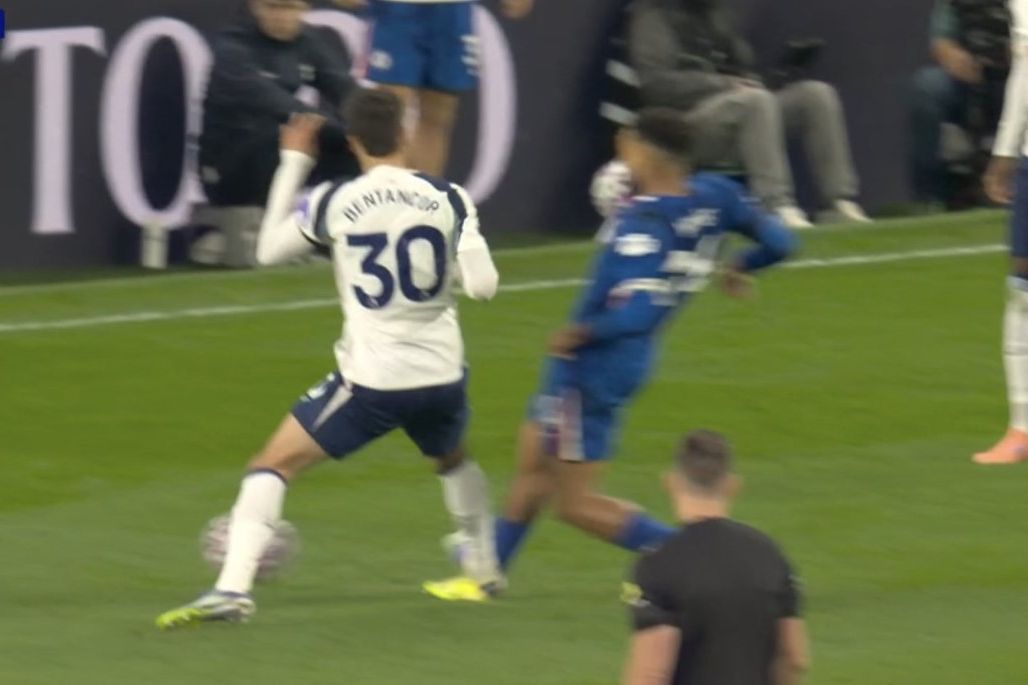
VAR decision: Upon reviewing the incident, VAR Pawson determined that Bentancur’s challenge fell within the category of reckless play rather than Serious Foul Play (SFP), which would warrant a red card. Gillett communicated that the challenge had a degree of force, yet the contact was minimal and primarily on the foot/lower ankle.
VAR review: Some uncertainty persisted for Pawson during the review, but Gillett’s live assessment appeared accurate. However, the point of contact and level of force were essential factors in the evaluation process. Bentancur’s foot dropping down rather than following through onto James’ ankle reduced the impact, although it was still a painful encounter for James. This ultimately led to Pawson confirming Gillett’s initial assessment without recommending an on-field review for a red card.
The VAR process typically starts with the on-field ruling as the reference point. A review is escalated only if the VAR believes the on-field decision might be incorrect based on available footage.
Verdict: I consider this to be a reckless challenge by Bentancur, and Pawson was right not to interfere. However, opinions may vary on this call since it was at the upper limits of recklessness. Watching slow-motion replays can distort the reality of such challenges. Gillett had a clear view of the incident, which enabled him to assess Bentancur’s actions as stepping on James’ ankle rather than striking with his studs. To classify the incident as a red card, evidence would need to indicate greater force and impact than what was captured on camera.
The post-challenge confrontation often aims to pressure the referee, but Gillett managed to remain steadfast and confident in his judgment—an essential quality for premier league referees.
Referee: Rob Jones
VAR: Paul Howard
Incident: Possible penalty overturn: Malick Thiaw was deemed to have fouled Jarrod Bowen
Time: 11th minute
Incident details: West Ham’s Bowen received a pass from teammate Aaron Wan-Bissaka in the Newcastle penalty area when he was challenged by Thiaw, who was attempting to reach the ball. Referee Jones perceived the challenge as a foul and awarded a penalty kick.
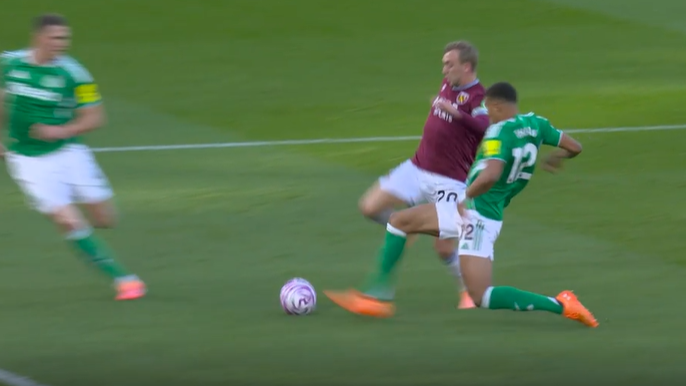
VAR decision: Following a review, VAR Howard suggested that Jones conduct a pitch-side review regarding the potential incorrect penalty call. After consulting the monitor, Jones agreed that, while Thiaw had made contact with Bowen, he also played the ball in the process, making the penalty kick award inaccurate.
VAR review: Clear communication from Jones was vital throughout the review process. Initially awarding the penalty indicated he saw the challenge as a foul, believing the defender had not touched the ball. VAR reviews could quickly confirm, based on the available angles, that Thiaw had, in fact, played the ball—information Jones was unaware of during play.
The review took more than four minutes, which seemed excessive given the evidence at hand. Howard, being new to elite officiating, may have overanalyzed the scenario rather than viewing it straightforwardly.
Verdict: This represented a positive and correct VAR intervention, aligning with recent incidents in the Premier League where defenders, like Thiaw, have been recognized for making legitimate challenges. Initially, Jones’s decision was understandable given his angle during the play; however, the final outcome reinforced the importance of communication and thoroughness in the VAR process.