



The Video Assistant Referee (VAR) has become one of the most debated elements in soccer today. As we approach the 2026 FIFA World Cup, it is set to play a pivotal role, delivering the final verdict on numerous contentious calls throughout the tournament.
So, how does VAR function? What makes it such a polarized technology, and has it enhanced or detracted from the game? Here’s everything you need to know.
 Andy Davies (@andydaviesref) is a former Select Group referee with over 12 seasons of experience in the elite ranks, officiating in both the Premier League and Championship. His extensive experience also includes roles within the VAR system in the Premier League, providing a unique perspective on the processes and protocols observed during matchdays.
What is VAR, and why was it implemented?
VAR is a technological system designed to aid the on-field refereeing crew in cases where they may have missed critical information, leading to a clear error in a key decision. This technology affords referees the chance to review video footage and reassess whether their original decision was correct, allowing them to amend any mistakes.
How does VAR function?
The VAR team meticulously monitors every moment of the match. Upon witnessing a potentially significant incident, they review the relevant footage and replays. If they determine that a clear error has occurred, they notify the on-field referee and recommend that they examine the pitchside monitor for the final decision.
In instances involving factual decisions—such as whether a foul occurred inside the penalty area—the VAR can communicate this information directly to the referee, enabling an immediate change without a review of the incident.
The VAR is connected to the referee, assistant referees, and the fourth official through advanced communication equipment, allowing for individual or group contact.
When is VAR involved, and what decisions can be reviewed?
VAR intervenes in pivotal moments that could impact the outcome of the game. Before this World Cup, its scope was limited to four primary areas:
– Goals: assessing offside, handball, or a foul in the buildup
– Penalties: determining if a penalty was warranted, and whether it occurred within the box
– Red cards: related to serious foul play, violent conduct, preventing obvious goal-scoring opportunities, or abusive behavior
– Mistaken identity: ensuring the correct player is penalized for a card
However, the 2026 World Cup will introduce two new scenarios where VAR can step in:
– Corner kicks: to address incorrectly awarded corner kicks
– Second yellow cards: if a player receives one that is deemed incorrect upon review
Other decisions made by the referee remain outside VAR’s review capability.
What is Semi-Automated Offside Technology (SAOT)?
When a goal is scored with a potential offside in the build-up, SAOT comes into play. It utilizes up to 30 cameras—distinct from VAR cameras—some operating at double the normal frame rate. This technology autonomously detects offside positions and generates 3D graphics to illustrate the decision, enhancing the speed and accuracy of offside assessments.
What does “clear and obvious” signify, and why is it important?
“Clear and obvious” is a term frequently referenced in the context of VAR.
The VAR can only aid the referee in instances of a “clear and obvious error” or a significant missed occurrence. The referee’s original decision can only be altered if the video review clearly meets this standard.
The standard is intentionally set high: the “referee’s call” principle dictates that when subjective decisions are genuinely debatable, the on-field referee’s ruling should be upheld. This means that VAR should not step in merely because a decision could go either way; intervention is warranted only when a clear error is apparent.
What is the significance of the referee visiting the pitchside monitor?
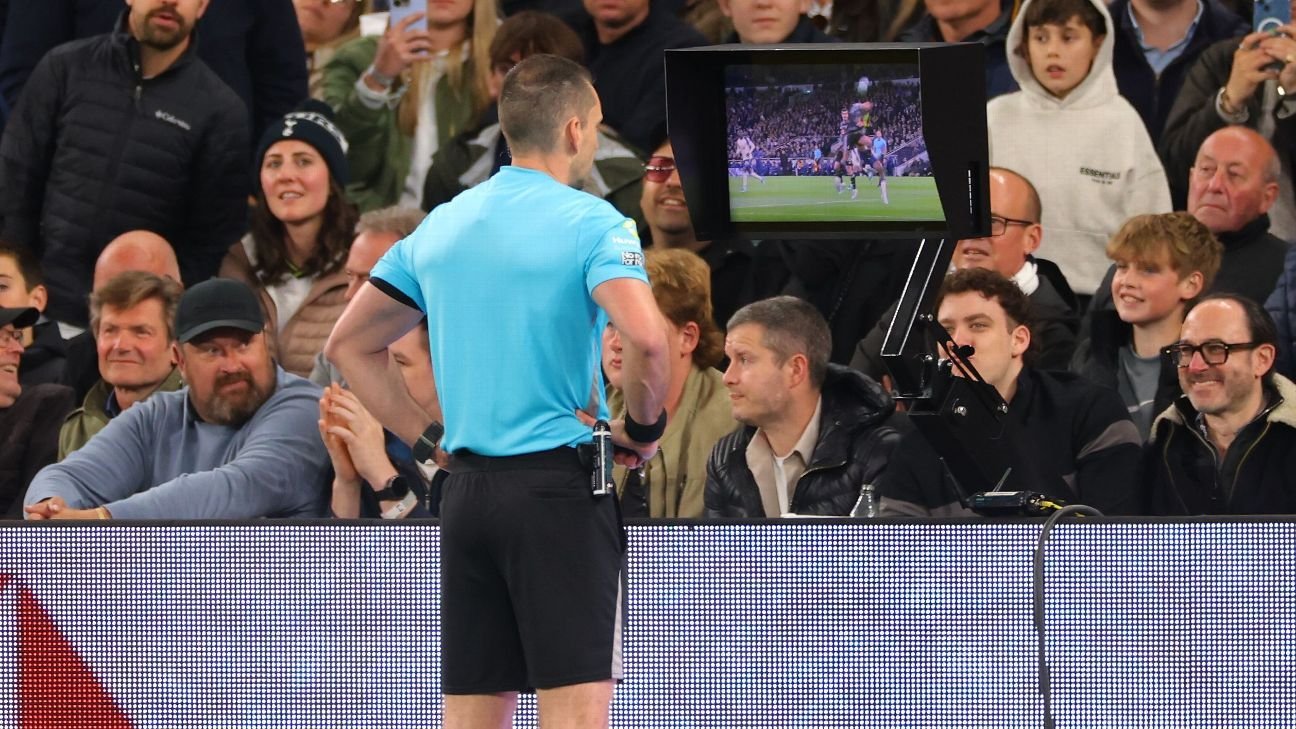
When VAR identifies a clear error in the referee’s subjective on-field decision, it suggests the referee revisit the replays on a pitchside monitor, a process known as an on-field review. The referee will then assess the replay on a touchline screen before either affirming their original decision or making a different call.
Who ultimately decides the calls with VAR?
Beyond offside decisions, which are factual, all subjective decisions that involve VAR are ultimately determined by the on-field referee exclusively.
If the referee is called to review the pitchside monitor, they possess full autonomy to decide on the subsequent course of action and any disciplinary measures that may follow. They can choose to override their initial ruling based on the VAR’s suggestion, although this is typically uncommon.
Most on-field reviews (OFRs) typically lead to the referee altering their original decision or applying varying sanctions (e.g., upgrading a yellow card to a red card) after having the chance to view the replays from different angles or in slow motion. This adjustment occurs primarily because the VAR would recommend a review only when they are confident that a mistake was made in real-time.
However, there are cases where the referee, after reviewing the replays, reaffirms their original call—especially in subjective scenarios like handballs and potential red cards. The VAR is encouraged to intervene only if the replays reveal a narrative that contrasts significantly with the on-field referee’s perception at the time.
What distinguishes checks from reviews?
A check is an automatic, continuous process where the VAR monitors all play and assesses every incident that could fall within reviewable categories. The majority of checks yield no actions, as the VAR verifies the correctness of the referee’s decisions, often without fans even being aware.
A review is a more structured process initiated when the VAR suspects a clear and obvious error may have occurred. The referee is then notified, play could be temporarily halted, and the incident is examined more closely. A review can either result in the reaffirmation of the referee’s original decision or an amendment to it.
Can the referee halt play for a review? Why might the process take time, and is there a time constraint?
When the VAR, after thorough checks, believes an on-field error has occurred while the match is ongoing, they will signal for an on-field review. The referee will then opt to stop play at the nearest opportunity to maintain minimal disruption, ensuring the game is interrupted as little as possible.
The goal of introducing VAR was to enhance the correctness of key decisions. Nevertheless, some situations can be intricate, necessitating the breakdown of various actions in chronological order for assessment, which can lead to frustration among fans. Yet stakeholders have agreed that even if a review takes four minutes, ensuring the correct outcome is far more important than speed.
Can players receive yellow or red cards post-VAR review?
Upon completion of a review on the pitchside monitor, the referee has full discretion to make any necessary adjustments to the initial decision, including issuing or rescinding a yellow or red card, changing a penalty call, or overturning an incorrectly awarded free kick.
How has VAR changed the game, and what are its shortcomings?
VAR was implemented with the aim of making football fairer, and the statistics support this with more match-altering decisions now confirmed as correct through the VAR system. It effectively rectifies clear and obvious errors involving goals, handballs, penalties, and offsides, preventing outcomes that could unfairly dictate match results.
Here’s a summary of the advantages and disadvantages of VAR:
Improvements attributed to VAR
— The rectification of significant errors that could unfairly influence match outcomes
— Reduced allegations of referee bias toward bigger clubs, thanks to the ability to objectively verify decisions
— Enhanced player discipline, as players are aware that incidents are closely monitored
— Increased accuracy over time, with most VAR interventions in recent seasons proving correct, leading to a decrease in errors at both domestic and international levels
Drawbacks associated with VAR
— Disruption of game flow and spontaneity: goal celebrations are often held back as fans await confirmation on whether a goal will be upheld
— Persistence of subjectivity: interpretations of handballs and penalties can still vary among officials, though consistency is improving
— Confusion during play: some goals have been disallowed based on margins too slight for the naked eye, leaving fans perplexed by certain decisions
— Occasional high-profile errors: while VAR aims to improve accuracy, it cannot eliminate all mistakes, especially given the subjective nature of soccer
— Diminished enjoyment: surveys indicate that many fans feel VAR can make match viewing less enjoyable