




Following a contentious VAR decision, numerous fans have voiced their anger at the disallowance of Antoine Semenyo‘s second goal during Manchester City‘s 2-0 victory over Newcastle United in the Carabao Cup semifinals on Tuesday.
The incident displayed the familiar traits of a VAR controversy, marked by debates over “clear and obvious” evidence, a lengthy five-minute delay, and the eventual overturning of a goal.
This season, we will analyze significant incidents to shed light on the VAR process and the applicable Laws of the Game.
So, was VAR justified in disallowing Semenyo’s goal?
Screenshot credit: SkySports
 Andy Davies (@andydaviesref) is a former Select Group referee with over 12 years of experience officiating in the Premier League and Championship. He possesses extensive expertise in VAR operations and provides valuable insights into the protocols and decision-making processes that occur on match days.
Newcastle United 0-2 Manchester City
Referee: Chris Kavanagh
VAR: Stuart Attwell
Time: 62 minutes
Incident: VAR declared Erling Haaland offside, leading to the disallowance of Antoine Semenyo’s goal
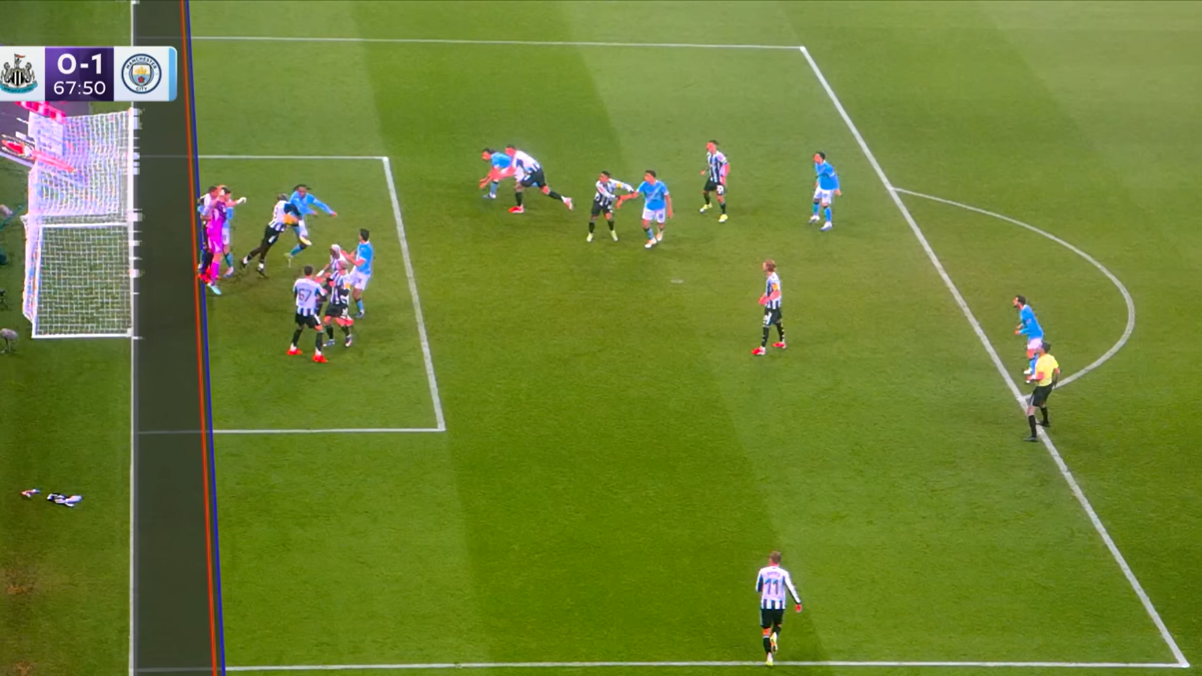
What happened: With City leading 1-0, Tijjani Reijnders took a corner that Semenyo, who had already netted the opening goal, headed in for what would have been his third since signing with City in January. However, VAR ruled it out due to a marginal offside call on Erling Haaland.
VAR decision/review: The review took five minutes as the semi-automated offside technology (SOAT) was malfunctioning. This forced VAR officials to manually draw offside lines, which revealed Haaland was offside by an extremely narrow margin.
Verdict: This scenario presented a significant challenge for VAR Stuart Attwell, who would prefer to avoid intervening in such borderline offside situations, especially with SOAT out of commission. Without this technology, Attwell had to revert to manual line drawing, resulting in a lengthy delay to ascertain if Haaland’s back foot was offside.
Furthermore, Attwell needed to evaluate whether Haaland affected Newcastle defender Malick Thiaw‘s ability to play the ball, which he determined to be the case. Haaland’s position indeed disrupted Thiaw’s play.
After confirming both factors—Haaland’s offside position and his impact on play—Attwell advised Kavanagh to review the incident on the pitch. Such situations are treated subjectively in law, considering the effect of the player’s actions rather than just their positioning in standard offside calls. Kavanagh reviewed the monitor multiple times before siding with Attwell’s VAR recommendation and disallowing the goal.
While the outcome was technically correct, the resulting 5½ minute delay is likely to leave all participants, particularly fans, feeling unsettled.
As I often point out, football does not appreciate ambiguity. Such perceived “anti-goal” rulings only contribute to growing discontent and critique. Nonetheless, the decision made was accurate.
It is unfortunate for Attwell that the SOAT malfunctioned, which has occurred in the past. This incident forced him into a challenging manual review during a critical moment of a semifinal.
However, the length of the delay is indefensible and will surely be a topic of discussion in the post-match evaluations conducted by PGMO.
The focus should not solely be on whether the decision was correct but also on understanding why the technology failed and the implications of such failures.