



The Video Assistant Referee (VAR) creates weekly debates in the Premier League. But how are decisions made, and how accurate are they?
This season, we will scrutinize major incidents to clarify the decision-making process concerning the VAR protocol and the laws of the game.
All screenshots credit: NBC
 Andy Davies (@andydaviesref) is a former Select Group referee with over 12 seasons on the elite list, officiating in both the Premier League and Championship. With a wealth of experience at the highest levels, he provides unique insights into the processes, rationale, and protocols applied on a Premier League matchday.
Referee: Anthony Taylor
VAR: John Brooks
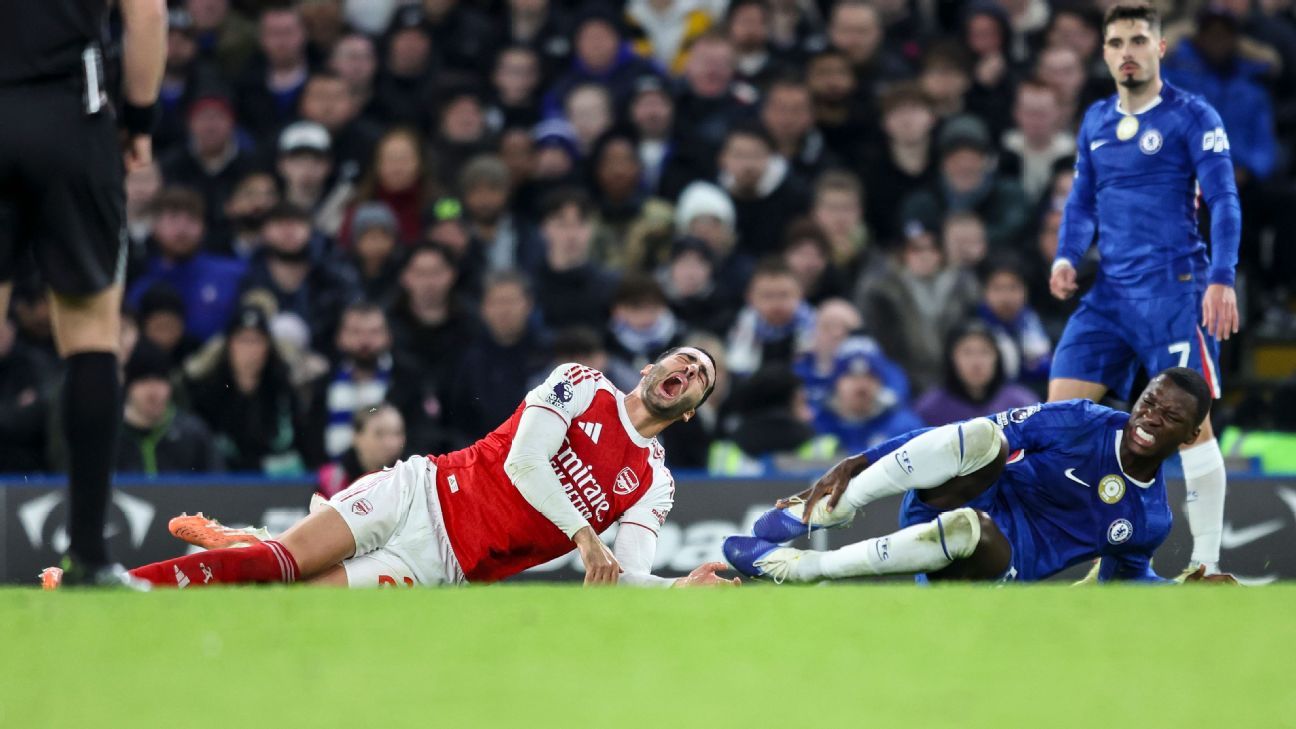
Incident 1: Potential serious foul play, Moisés Caicedo tackle on Mikel Merino.
Time: 34 minutes
What happened: Caicedo committed a late challenge on Merino. Taylor initially allowed play to continue as Arsenal had possession and were in a promising attacking position, but he later halted the game and booked Caicedo for what he deemed a reckless challenge.
STRAIGHT RED CARD SHOWN TO MOISES CAICEDO, AND CHELSEA ARE DOWN TO TEN MEN. 🟥 pic.twitter.com/b6MNOGkE0K
— NBC Sports Soccer (@NBCSportsSoccer) November 30, 2025
VAR decision: After reviewing the footage, Brooks determined that Caicedo's challenge constituted serious foul play that endangered Merino's safety, warranting a red card. He recommended an on-field review (OFR) to Taylor.
VAR review: Brooks, confident in his assessment after a couple of views, recognized the need for intervention. He articulated that the challenge was late, executed at speed with considerable force, and made with a straight leg, impacting Merino well above the ankle — indeed a poor tackle.
After Taylor had issued a yellow card, temporarily pausing for both players to receive treatment, Brooks conveyed his recommendation.
It seemed the entire stadium anticipated the next move, and after watching the footage at full speed and from two clear angles, Taylor concurred. He revoked the yellow card and awarded a red card.
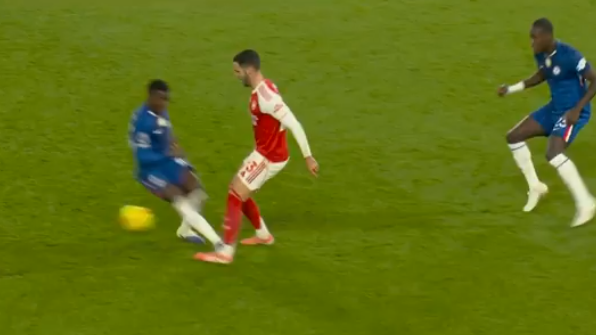
Verdict: A commendable VAR intervention leading to an accurate outcome upon Taylor's review. The challenge endangering an opponent's safety justified Caicedo’s dismissal. Taylor's original decision to issue just a caution was defensible; red card offenses like this can be challenging to assess in real-time. While Taylor likely noted the lateness of the challenge and sensed the speed of impact, the specific factors that classify it as serious foul play—such as the level of force, point of contact, and straight-leg action—may not have been overtly apparent amid the dynamics of play.
Incident 2: Potential serious foul play, Piero Hincapié contesting with Trevoh Chalobah.
Time: 40 minutes
What occurred: Hincapié and Chalobah dueled for a high ball, during which Hincapié inadvertently struck Chalobah’s face with his left arm, leaving the Chelsea defender writhing on the ground. Taylor, who witnessed the incident, awarded a free kick to Chelsea and booked Hincapié for reckless arm use.
VAR decision: The VAR reviewed Hincapié's challenge and found Taylor's interpretation accurate. Brooks agreed it was merely a reckless action from Hincapié and completed the review swiftly.
VAR review: Slow-motion reviews can often skew perceptions, so Brooks ensured to assess the incident in real-time before analyzing Hincapié's actions and contact in greater detail.
Taylor’s on-field communication has been noted as clear and concise regarding what he had observed. The referee explained that Hincapié utilized a leading arm with minimal force and no swinging action while keeping an open fist. This clear depiction, matched by the visuals, made for a straightforward assessment for Brooks.
Trevoh Chalobah appeared to have gotten a bruise after Piero Hincapié made contact with his face using his elbow. Hincapié was only given a yellow card for the play 👀
This came just minutes after Caicedo's red card 😅 pic.twitter.com/VEBBsppfxc
— ESPN FC (@ESPNFC) November 30, 2025
Verdict: The referee made the correct call, issuing a caution for reckless play in his assertive and composed manner. Brooks, as VAR, quickly affirmed the decision since the evidence supported a caution rather than a more severe penalty.
In assessing such scenarios involving arm usage and potential red cards, referees and VAR officials look for distinct characteristics in actions that raise red flags. A deliberate swinging arm, a clenched fist, or a player intentionally looking away from the ball toward an opponent—all of these, compounded by levels of force or brutality—form part of the considerations for sanctions and for VAR reviews.
In this instance, however, none of those criteria were met, leading to a just outcome achieved by Taylor and Brooks.
Referee: Rob Jones
VAR: Matt Donohue
Incident: Re-take of a penalty as Jean-Philippe Mateta inadvertently touches the ball twice during the penalty kick.
Time: 34 minutes
What happened: Crystal Palace was awarded a penalty after Leny Yoro fouled Mateta in the penalty area. Mateta took the penalty himself and scored, giving his team the lead. However, VAR Donohue correctly identified upon review that Mateta inadvertently played the ball twice during the kick, which is not permitted under the rules.
Jean-Philippe Mateta's first penalty attempt was ruled a double touch, but he has no problem with the second as Crystal Palace lead Man United. 🦅 pic.twitter.com/cGyGtPGnIa
— NBC Sports Soccer (@NBCSportsSoccer) November 30, 2025
Verdict: An appropriate VAR intervention; this was a factual situation negating the need for an on-field review.
The law was revised before the season commenced to ensure that accidental double touches during successful kicks are not penalized. Such occurrences can arise if the kicker slips during the run-up and inadvertently plays the ball twice.
However, a defensive indirect free kick will still be issued if a player intentionally touches the ball twice before another player engages with it—e.g., if the ball rebounds off the goalpost and the kicker touches it again.
Referee: Chris Kavanagh
VAR: James Bell
Incident: Goal disallowed. Wolves had an early goal from Jørgen Strand Larsen disallowed for offside.
Time: 16 minutes
What happened: An early goal for Wolves was disallowed for offside by the on-field referee team. Strand Larsen scored from a fine cross delivered from the right, but the assistant referee flagged the goal for offside. Referee Kavanagh and assistant referee Dan Cook concluded that Wolves forward Jhon Arias was interfering with Aston Villa’s goalkeeper Emiliano Martínez as Strand Larsen shot.
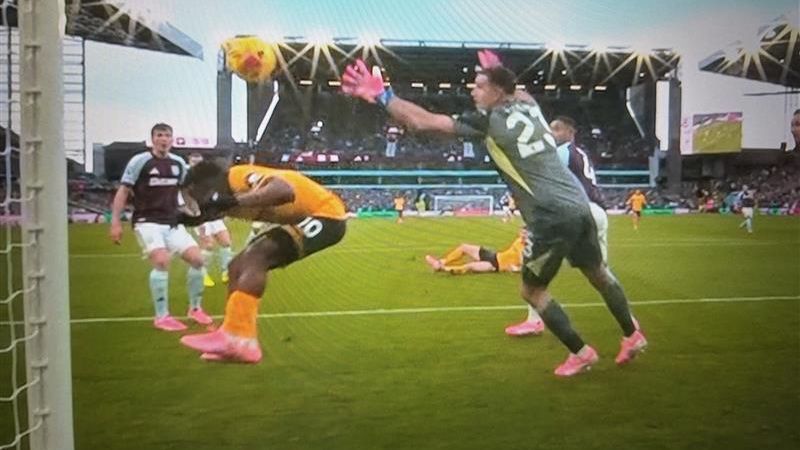
VAR decision: The VAR confirmed the on-field ruling that Arias was indeed offside and influencing the goalkeeper's ability to save Strand Larsen's shot.
VAR review: In this scenario, the VAR's review started with the on-field decision and clear communication between the referee and assistant referee.
As seen in recent weeks, VAR can only intervene if a clear and obvious error has been identified post on-field decision.
Communication from the on-field team was clear and positive. Assistant referee Cook confirmed Arias’ offside status and noted that the striker was close enough to Martínez to impact him as he ducked away from Strand Larsen’s shot. Referee Kavanagh had an excellent view and supported the information provided by his assistant.
The footage reviewed by Bell corroborated the on-field team's real-time descriptions, allowing for a quick clearance of the decision.
Verdict: The outcome was accurate, likely the most straightforward decision of similar cases observed recently in the Premier League.
Arias was clearly offside and significantly impacted Martínez's ability to make a save. His action of ducking, while reminiscent of actions seen in previous matches, distinctly affected his opponent's ability to defend (make a save) the ball effectively.
We've seen a trend involving these situations recently, each presenting slight variations that challenge individual officiating teams. It will be interesting to see if the PGMO considers reviewing and collaborating with Premier League clubs on these subjective incidents to enhance understanding among all parties.