



The video assistant referee (VAR) consistently stirs debate in major competitions such as the Premier League, Champions League, and FA Cup. So how are the decisions reached, and are they accurate?
This season, we’ll explore significant incidents to clarify the VAR protocols and the Laws of the Game.
 Andy Davies (@andydaviesref), a former Select Group referee with over 12 seasons of top-level experience, has worked extensively in the Premier League and Championship. His expertise in the VAR system during match days offers a valuable perspective on the processes and protocols involved.
Referee: Daniel Siebert
Video Assistant Referee: Bastian Dankert
Incident: Potential penalty for PSG due to handball by Bukayo Saka
What Occurred: Saka’s clearance attempt from his penalty area resulted in the ball striking both of his arms after he misjudged its trajectory. PSG called for a penalty, but the referee dismissed the claims.
VAR Decision: The VAR reviewed and upheld the referee’s initial call of no penalty.
VAR Assessment: The VAR confirmed the no-penalty decision quickly, determining that Saka’s arms were in a “normal” position. According to Law 12 on handball, it isn’t considered a foul if a player accidentally plays the ball onto their hand or arm.
Conclusion: The referee’s initial ruling was correct, and VAR appropriately chose not to intervene. The law states that accidental contact with one’s own hand or arm is not a handball, except in instances where the ball directly enters the opponent’s goal, which would result in disallowance of the goal.
Incident: Penalty awarded to PSG after a foul by Arsenal’s Cristhian Mosquera on Khvicha Kvaratskhelia
What Occurred: Mosquera was judged to have tripped PSG’s Kvaratskhelia within the penalty area, prompting the awarding of a penalty. Mosquera already had a yellow card, and PSG argued for a second yellow.
VAR Decision/Assessment: The VAR review was resolved quickly. It found Mosquera did not make contact with the ball during his challenge on Kvaratskhelia and confirmed the serious foul of tripping as the basis for the penalty, validating the referee’s decision.
Conclusion: The referee’s decision to award the penalty was valid and straightforward due to Mosquera’s careless trip. Although there were discussions about a second yellow card, the laws dictate that a yellow card is warranted only when a challenge is deemed reckless by the referee. The advantage of the attacking play that was curtailed is preserved with the penalty restart.
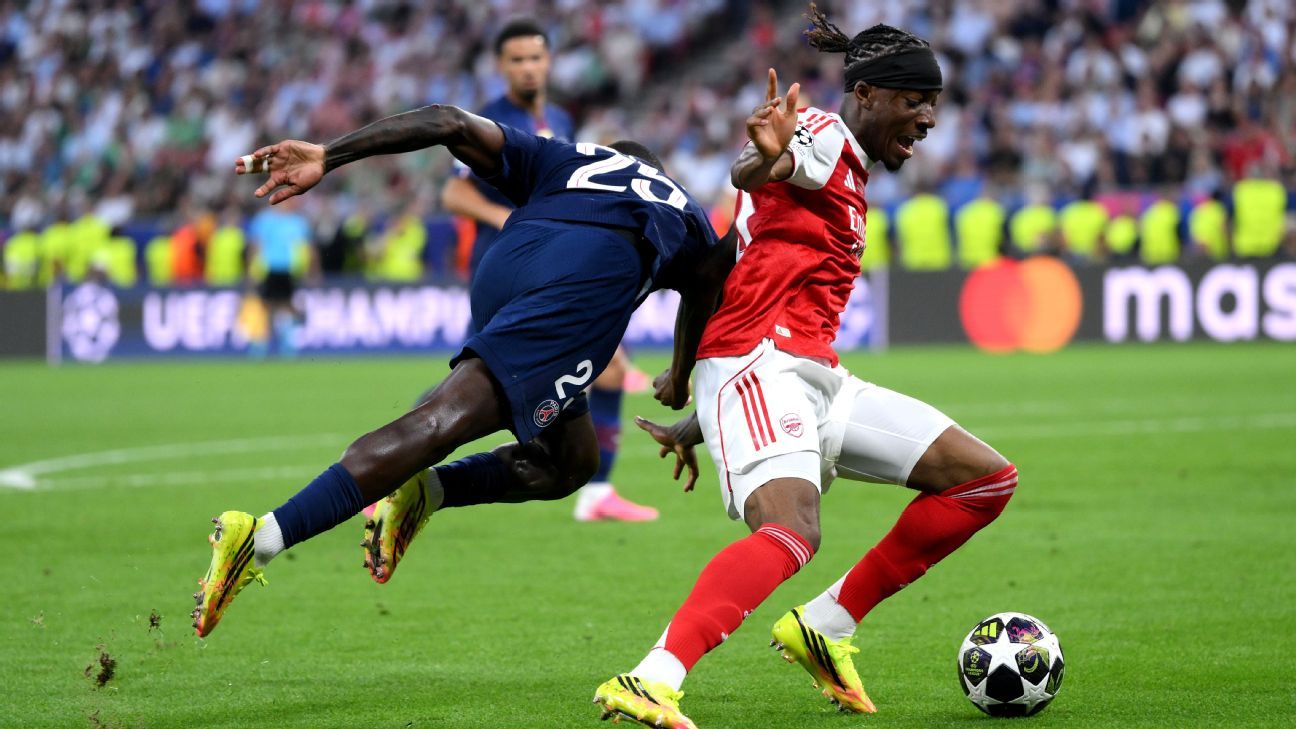
Incident: Possible penalty for Arsenal due to a challenge from PSG defender Nuno Mendes on Arsenal winger Noni Madueke.
What Occurred: As Madueke moved into the PSG penalty area, Mendes made a clumsy challenge from behind that brought Madueke down, leading Arsenal to call for a penalty. However, referee Siebert rejected the claims and allowed play to continue.
VAR Decision: VAR reviewed the play and supported the on-field decision of no penalty.
VAR Assessment: The VAR conducted a thorough review of the contact between Mendes and Madueke, recognizing that while Mendes made a clumsy challenge, he had not committed a clear error. The presence of arm contact initiated by Madueke caused both players to fall, leading to the VAR upholding the non-penalty ruling.
Conclusion: The referee’s decision to not award a penalty was justifiable. Replays illustrated Madueke initiating contact before going down, supporting the idea that the incident was more of a tangle than a foul by Mendes. Nevertheless, Mendes was lucky; his challenge was indeed clumsy, and if Siebert had deemed it a foul deserving of a penalty, VAR likely wouldn’t have intervened to overturn that decision.