



The video assistant referee (VAR) system has sparked controversy week after week in the Premier League. But how are decisions made, and are they accurate?
This season, we will analyze significant incidents to clarify the VAR protocol and its adherence to the Laws of the Game.
Andy Davies (@andydaviesref) is a former Select Group referee with over 12 seasons on the elite list, officiating in both the Premier League and Championship. With rich experience at the highest level, he has worked within the VAR framework in the Premier League, providing valuable insights into matchday processes, rationale, and protocols.
Tottenham Hotspur 1-2 Liverpool
Referee: John Brooks
VAR: Stuart Attwell
Incident: Potential red card
Time: 30th minute
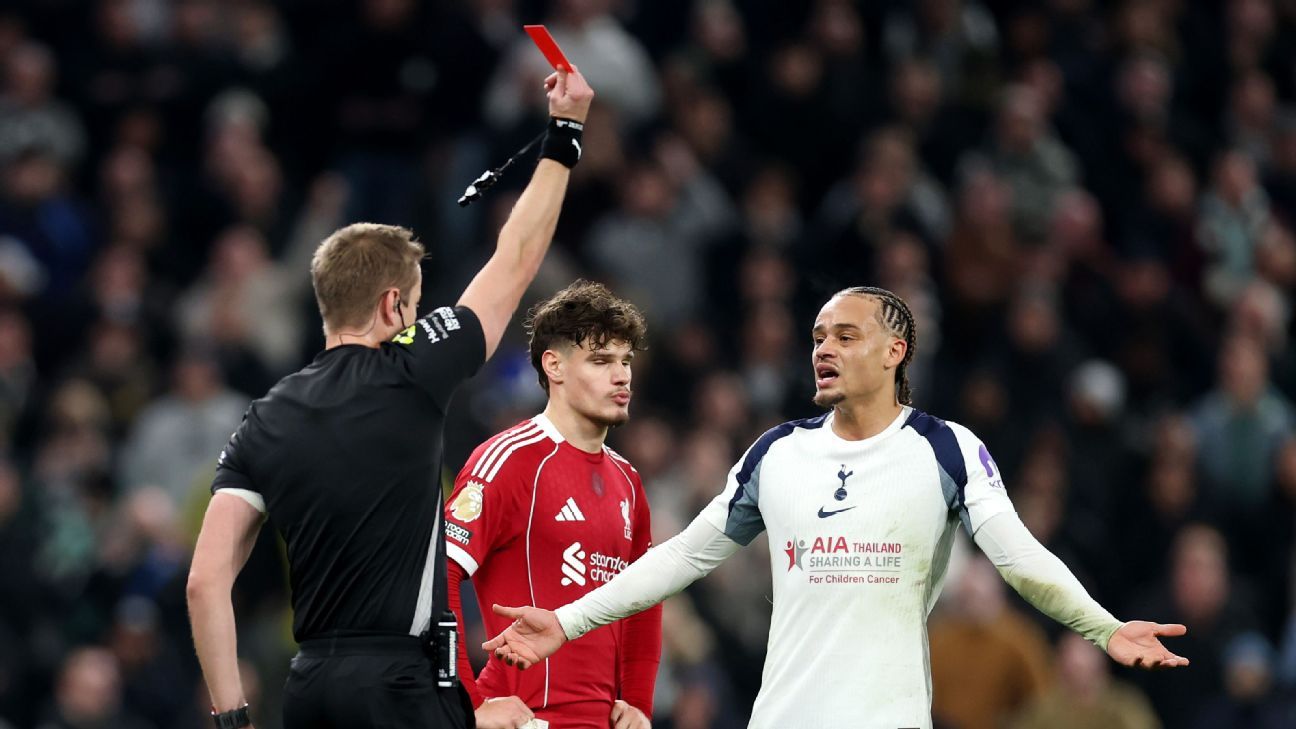
What transpired: Xavi Simons of Tottenham was late in his challenge against Virgil van Dijk. Referee John Brooks initially issued a yellow card for what he deemed a reckless challenge.
VAR decision: Following a VAR review, the referee revisited his original yellow card decision and issued a red card for serious foul play.
VAR review: VAR Stuart Attwell found it a clear-cut case to recommend an on-field review after examining the replays. The characteristics of a reckless challenge, noted by the on-field referee, were not present based on the footage reviewed. Attwell perceived that the force and speed of Simons’ contact with Van Dijk’s calf jeopardized the defender’s safety, thus meeting the criteria for a potential red card.
After analyzing the challenge from multiple angles and speeds, as well as pausing at the moment of contact, Attwell was confident that an on-field review was warranted.
Verdict: This was a correct and commendable VAR intervention, and Brooks rightly reversed his initial yellow card decision upon review. While some may argue that Simons was unfortunate due to a lack of intent, the nature of the contact—forceful and with speed—renders it a dangerous challenge, regardless.
Such challenges can be difficult to recognize as red card offenses in real-time. Assessing the point of contact, force, and speed during simultaneous player movements is challenging for referees, making Brooks’ initial yellow card decision understandable.
Newcastle United 2-2 Chelsea
Referee: Andrew Madley
VAR: Peter Bankes
Incident: Penalty appeal from Newcastle United
Time: 55th minute
What happened: As the ball entered the Chelsea penalty area, Chelsea defender Trevoh Chalobah challenged Anthony Gordon, seemingly missing the ball and hitting Gordon’s left leg instead. Referee Andrew Madley ruled it a fair challenge in real-time.
VAR decision: VAR confirmed Madley’s decision of no penalty for Newcastle, determining that Chalobah’s contact with Gordon was side-to-side in a shielding motion with the ball still in playing distance.
VAR review: As with all subjective calls, the starting point for VAR is the on-field decision and live communication. Madley interpreted Chalobah’s contact as normal, believing the ball was running out of play. In his view, Gordon positioned himself to draw the contact, suggesting he aimed to win a penalty rather than it being a foul by the Chelsea defender.
Bankes, after reviewing the footage, supported the on-field decision of no penalty and confirmed it as correct.
Verdict: This was indeed a foul by Chalobah, and the correct outcome should have been an on-field review leading to a penalty kick. I empathize with Madley since he may have doubted whether the level of contact, combined with the ball’s trajectory, constituted a foul from his vantage point.
However, the VAR review should have clearly indicated that, regardless of the ball’s location, Chalobah’s challenge on Gordon was clearly careless, with no contact on the ball. It’s perplexing why Bankes did not recommend an on-field review in this situation.
Referees often hesitate to penalize defenders in such scenarios—especially when it’s believed the defender is directing the ball out of play. Nevertheless, this instance was different, as all evidence showed it was a careless foul by Chalobah. An obvious mistake was made on the pitch, and an on-field review should have resulted.