



-

Tom Hamilton
Multiple Authors
Curaçao has made history, becoming the smallest nation by population and size to qualify for the World Cup. The team features the oldest head coach in the tournament’s history and began their campaign with the longest odds to win.
With a population of just over 158,000, a significant portion could fit into Houston Stadium, where they faced Germany. The small Dutch Caribbean island is part of the Netherlands, with 25 of their 26-man roster hailing from there.
Upon their arrival in the U.S. for the World Cup, few believed Curaçao could even find the net, let alone secure a draw. They were grouped with Germany, the Ivory Coast, and Ecuador, which posed a daunting challenge. However, under the leadership of 78-year-old head coach Dick Advocaat, Curaçao had a strategy to disrupt expectations.
In the lead-up to their first two group matches against Germany and Ecuador, forward Gervane Kastaneer shared insights into their experience as they prepared for their World Cup journey.
This is his journey narrated in his own words.
Part I: World Cup Debut Against Germany
The Curaçao squad arrived at their training base in Florida following a 4-1 loss to Scotland at Hampden Park, then clinched a 4-0 victory over Aruba in their farewell match. The players received a hero’s send-off aboard their famous blue bus, which was once a school bus. Videos of them dancing while traveling to the stadium went viral ahead of their opener against Germany on June 14.
“That bus means everything to us. It has no windows, allowing fans back home to high-five us and cheer, saying ‘good luck’ or ‘we love you,’ which creates a vital connection. The bus music is also fantastic. Even our driver, Marlon, is a local celebrity! It’s an attachment we cherish dearly.
“Although we won’t have that bus here, the new one has a big Curaçao flag on it, and we’ve carried over the music. When the coach wants to speak, he gestures for Leandro Bacuna to lower the volume; then it goes right back up afterward.
“The entire day before the Germany match felt surreal. I shared a room with Kenji Gorré, and when we opened our window that morning to see rain, we interpreted it as a sign of God’s joy. We exchanged amazed glances. The atmosphere on the way to the stadium was dreamlike, with countless fans waiting for us.
“As we walked onto the pitch, we spotted our families. Some teammates, who never cried even when we qualified, were overwhelmed with emotion. Defender Roshon van Eijma saw his parents in the crowd, and when his mother embraced him, he couldn’t hold back his tears. I, too, felt the same seeing my family—my mother Ivionella, father Gerrit, sister Zjaiviënne, as well as my girlfriend Darleen and son Saint Lopes. My brother Jernel couldn’t attend.
“My parents moved to Rotterdam seeking better opportunities. My brother, Jernel, was born in Curaçao, while I was born in Rotterdam. My upbringing was steeped in Curaçaoan language and culture, yet it sometimes felt like I belonged to a different place. Our home was filled with a mix of Dutch and Papiamentu, the native Creole language.
“Many classmates found it hard to relate to me. Like many on the team, I felt out of place, often being the only black student in the room. I played for the Dutch youth teams, but over time, Curaçao’s football ambitions grew. With stars like Leandro Bacuna and defender Cuco Martina in the Premier League, they reached out to me. My father left the decision to me, and I chose to represent Curaçao—it’s my identity.
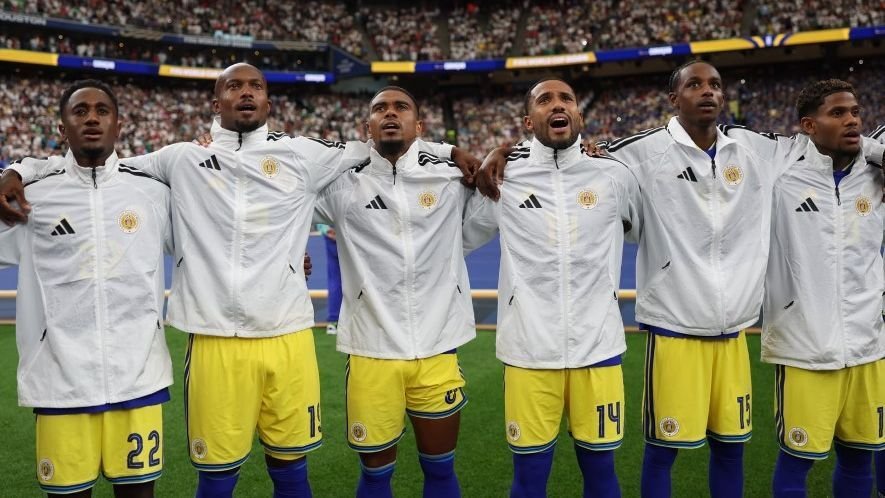
“As I stepped onto the pitch for the Germany match, I was already teary-eyed before the anthem. Hearing our anthem filled me with overwhelming pride—it signified our arrival on the world stage.
“I exchanged glances with some German players who smiled back, likely aware of the weight of the occasion for us.
“Dick’s last words before kickoff were to remember our training and make the most of this chance. We might be small, but we are professional footballers and serious about our game. We understood that playing at our best could lead to surprises, yet the match proved quite challenging.”
Germany drew first blood with a goal from midfielder Felix Nmecha, leaving Curaçao in a tight spot. But, in the 21st minute, Curaçao’s right back Livano Comenencia fired home an equalizer, marking the nation’s first World Cup goal.
“It may sound unbelievable, but I always believed we could score against any opponent. The pure joy we felt when we scored was immense; it validated our efforts. It wasn’t a consolation goal in a losing match; it made the score 1-1, affirming our place in the game.
However, Germany responded decisively, leading 3-1 at halftime, and by the time Advocaat brought me in, the score had ballooned to 6-1.
“Dick told me to work hard, urging me not to overthink—just focus on playing football. The realization of having played in a World Cup only hit me later in the changing room when I felt chills run through me.
“Despite that, disappointment lingered. A 7-1 defeat felt too harsh—a couple of goals were disproportionate. Nonetheless, it didn’t overshadow the day’s magnitude; the competitor in us simply wanted to win and certainly not concede seven goals.
“That evening, we viewed the match replay individually. There was no celebration bus that night, just silence.”
Part II: The Time Between Matches
The Curaçao squad returned to their training base in Boca Raton, Florida after the Germany match, with their next challenge against Ecuador on June 20 in Kansas.
Daily Schedule:
8:30 AM – Breakfast
10:00 AM – Training
12:30 PM – Team Meeting
1:00 PM – Lunch
7:30 PM – Dinner
11:30 PM – Return to Rooms
“I typically don’t struggle with sleep before or after matches, though some teammates do, battling adrenaline and anxiety the day leading up to a game. After our loss to Germany, some practiced while those who played the full match engaged in lighter sessions.
“Dick shared his disappointment regarding our performance against Germany, stating that 4-1 would have been satisfactory but seven goals were excessive. He emphasized the need for tighter defense against Ecuador, insisting we stick to our game plan.
“We anticipated Ecuador would apply significant pressure, and Dick’s demeanor during our training reflected his seriousness. If I or Jearl Margaritha missed opportunities in drills, he would raise his voice, pushing us to maintain our sharpness.
“Dick communicates predominantly in Dutch—about 60%—with the remaining 40% in our native language, affirming our ties to Curaçao.
“Faith plays a substantial role in our lives. While training in Holland, a local minister visited to pray with us. Observing our world, we perceive myriad prospects. As a resilient people, we’re not deterred by failure, striving to excel with a positive mindset and a strong work ethic.”
Prior to the tournament, Kastaneer received an emotional letter from his father. FIFA documented the moment as Gerrit expressed his pride in his son’s journey, which had included a remarkable recovery from a serious eye injury in early 2017.
“I had a promising performance in a friendly against FC Mainz 05, which led to them wanting to sign me with an enticing five-year offer from my previous club, ADO Den Haag. It seemed like a life-altering opportunity as I prepared to enter the German Bundesliga. However, ADO required me to miss any further matches. Unfortunately, they lost one match forcing me back to play another, which I did to close a chapter neatly.
“In that match, I initially scored from a corner. Yet, moments later, an accidental kick caused me to sustain a severe eye injury. I had to be taken to the hospital, and doctors revealed a loose retina with virtually no vision. Mainz arranged my treatment in Germany, but it took multiple surgeries and months of recovery before I could play again.
“Mainz supported me immensely, covering all costs, and my father guided the situation thoughtfully. He conveyed that they would not proceed with the signing until my eye healed, ensuring I made the best choice for my future.
“In the end, the move to Mainz didn’t materialize, leading to my signing with Kaiserslautern in Germany’s second division instead.
“My tattoos symbolize my life’s journey, such as the elephant which represents family protection—similar to how elephants surround their young in times of danger.”
Part III: Match Against Ecuador
Curaçao headed to Kansas, Missouri a day prior to their second match against Ecuador on June 19. On match day, team captain Leandro Bacuna addressed the squad.
“Leandro shared an inspiring video showcasing our youth teams, from under-9s to the U20s, expressing how proud they are of us: win or lose, they dream of following our path. Eight years ago, when I started, our fight to elevate football’s status was relentless. Previously, baseball dominated, but now young players in Curaçao aspire to be footballers, and it’s heartwarming.
“As we prepare to travel to the stadium now, I feel calm. The nerves typically hit once in the stadium—then my stomach knots. But we feel confident in our potential to secure a good result against Ecuador; any respectable outcome would validate our venture.
Curaçao achieved a remarkable feat, with Kastaneer coming on in the 83rd minute to help secure a 0-0 draw against the highly regarded Ecuador. Goalkeeper Eloy Room was awarded Player of the Match for his extraordinary performance making 15 saves. At full-time, Room showcased a tribute T-shirt honoring the late Jairzinho Pieter, their former teammate who passed away in September 2019.
After the match, the team received a visit in the changing room from King Willem-Alexander, Queen Maxima of the Netherlands, and their daughter Princess Ariane, who joined in their celebratory dance.
“Eloy was our hero today. His first save was phenomenal. He’s been a consistent part of our journey over the past ten years. While some might have doubted him after the Germany match, his skill has anchored us in many games.
“I was immensely proud of the team’s unity and perseverance. In my short time on the pitch, I could feel the determination to not only defend but to strive for a win. We believed we could have done it.
“Once the match concluded, we celebrated our achievement. The Dutch royal family came to our changing room to join the festivities—something we never imagined would happen. We caught the joy of their presence.
“We had a modest party bus on the trip back, buzzing with happiness; the guys joked about my yellow card from the game—a bit of fight I showed that seemed to energize them.
“During those moments, thoughts drift to family. Their support is invaluable. They have shared a challenging journey alongside me, deserving recognition for their sacrifices. I acknowledge my father’s unwavering presence, sacrificing time for my passion while my siblings might have missed out on their own experiences.
“Continuing this journey means the world to me, and the bonus is my girlfriend, who is from Cape Verde, cheered us on during their match against Uruguay. She’s ecstatic!
“One more match awaits; we realize the skeptics doubted our place here, expecting us to score no points. Yet, we have scored and earned a point. A formidable team like Turkey has exited the tournament, but we remain. We are ready to battle against the Ivory Coast.
“Our journey isn’t over.”