




The countdown to the World Cup has officially begun, with the tournament set to kick off on Thursday, June 11, 2026, in Mexico City. El Tri will open the event against South Africa. With only six months remaining, teams are now focusing on their final preparations following last Friday’s draw for the tournament.
In addition to tactical strategies and on-field plans, teams must also manage the logistics of extensive travel across the three North American host countries: the United States, Canada, and Mexico. Given the vast distances teams will need to cover, planning travel arrangements will be crucial.
In a sport dedicated to exploiting even the smallest advantages that can determine success, teams will need to carefully consider their travel strategies as some of the world’s best players compete in North America next summer.
Fortuitously, teams can draw on past experiences from clubs that have navigated similar travel challenges across the continent.
At the recent 2022 World Cup in Qatar, national teams efficiently moved through a country smaller than Connecticut. However, when they land in North America next summer, they will face considerably more extensive travel.
2026 World Cup Group Stage Travel Overview
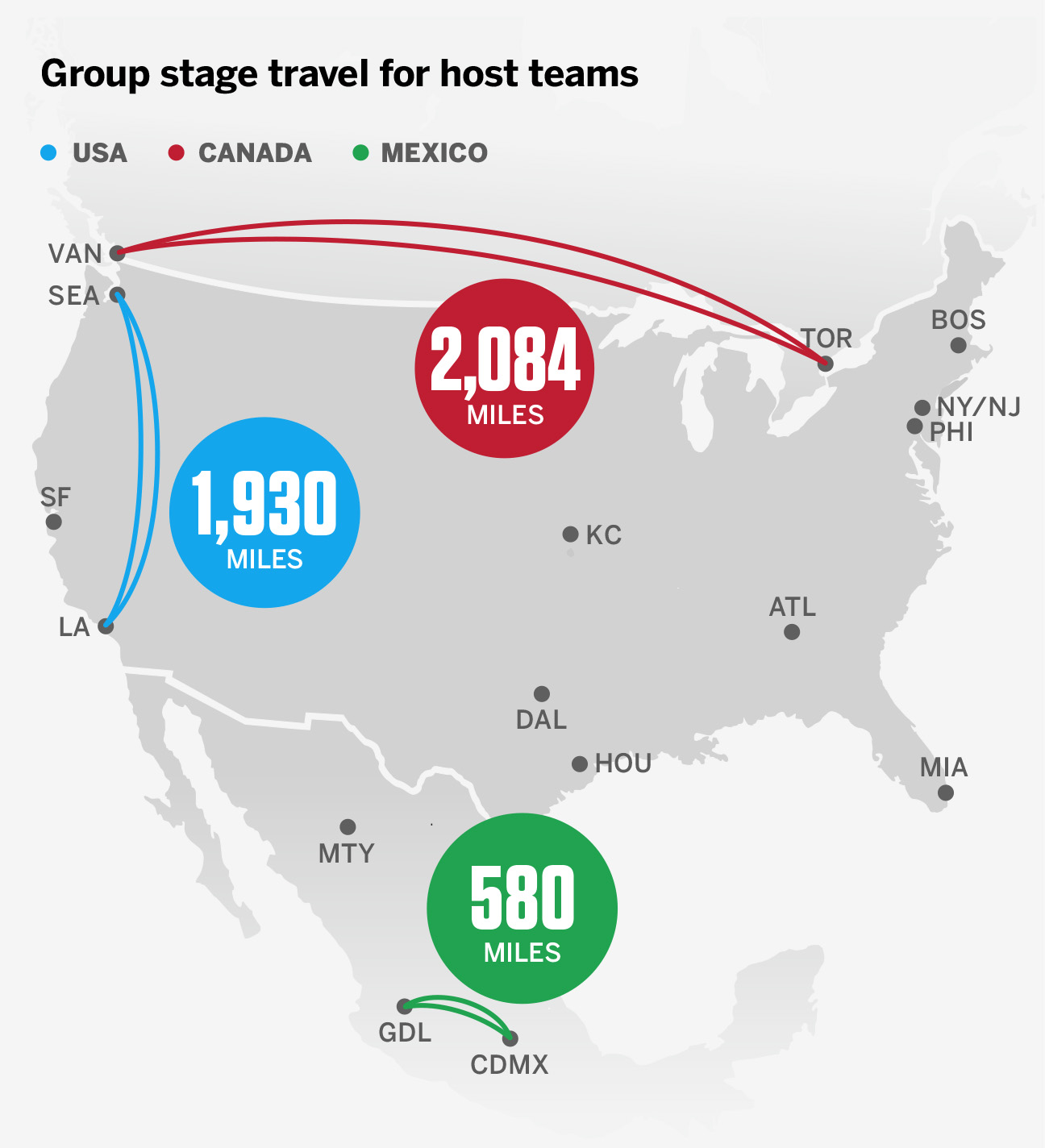
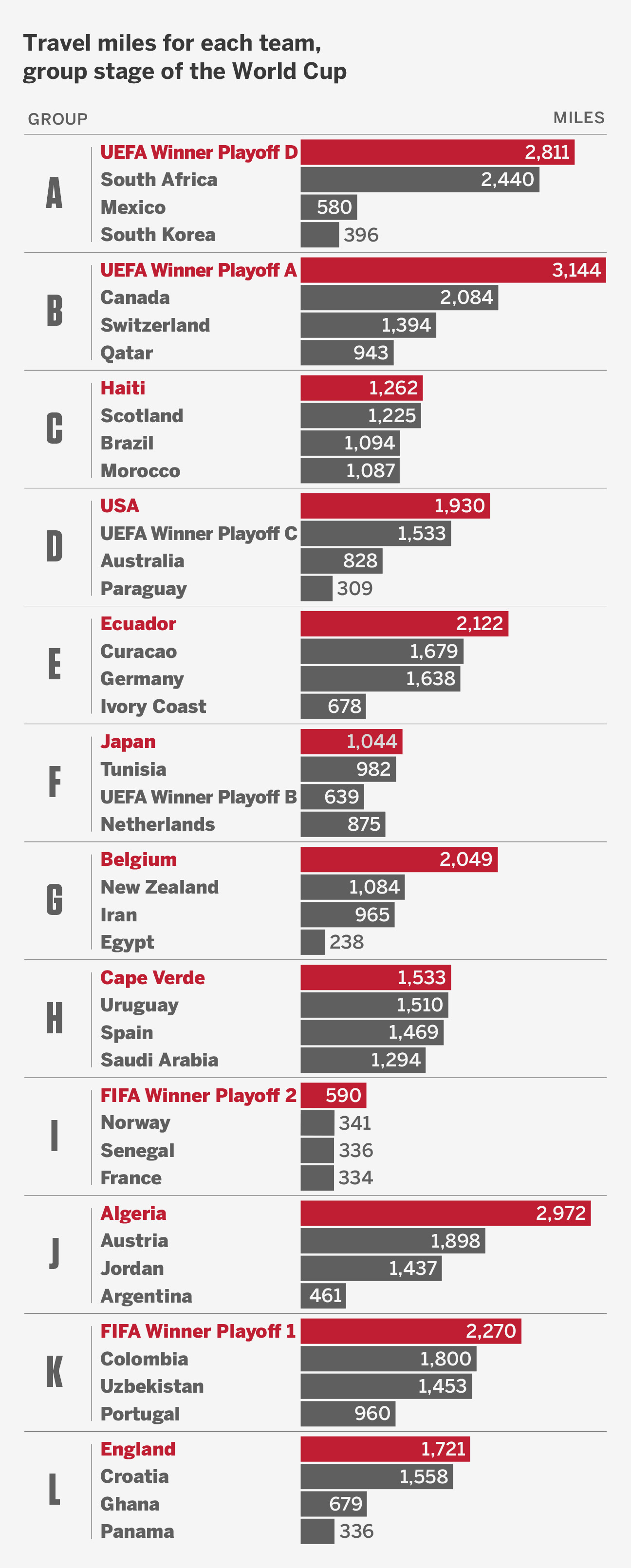
• Among the three host countries for next summer’s World Cup, Mexico offers the least demanding travel for its group stage matches against South Korea, South Africa, and a UEFA playoff qualifier (either Denmark, North Macedonia, Czechia, or the Republic of Ireland). In contrast, Canada will have the longest journeys to face Qatar, Switzerland, and another UEFA playoff qualifier (either Italy, Northern Ireland, Wales, or Bosnia-Herzegovina). The U.S. will travel between Seattle and Los Angeles for matches against Paraguay, Australia, and a playoff qualifier from UEFA (either Türkiye, Romania, Slovakia, or Kosovo).
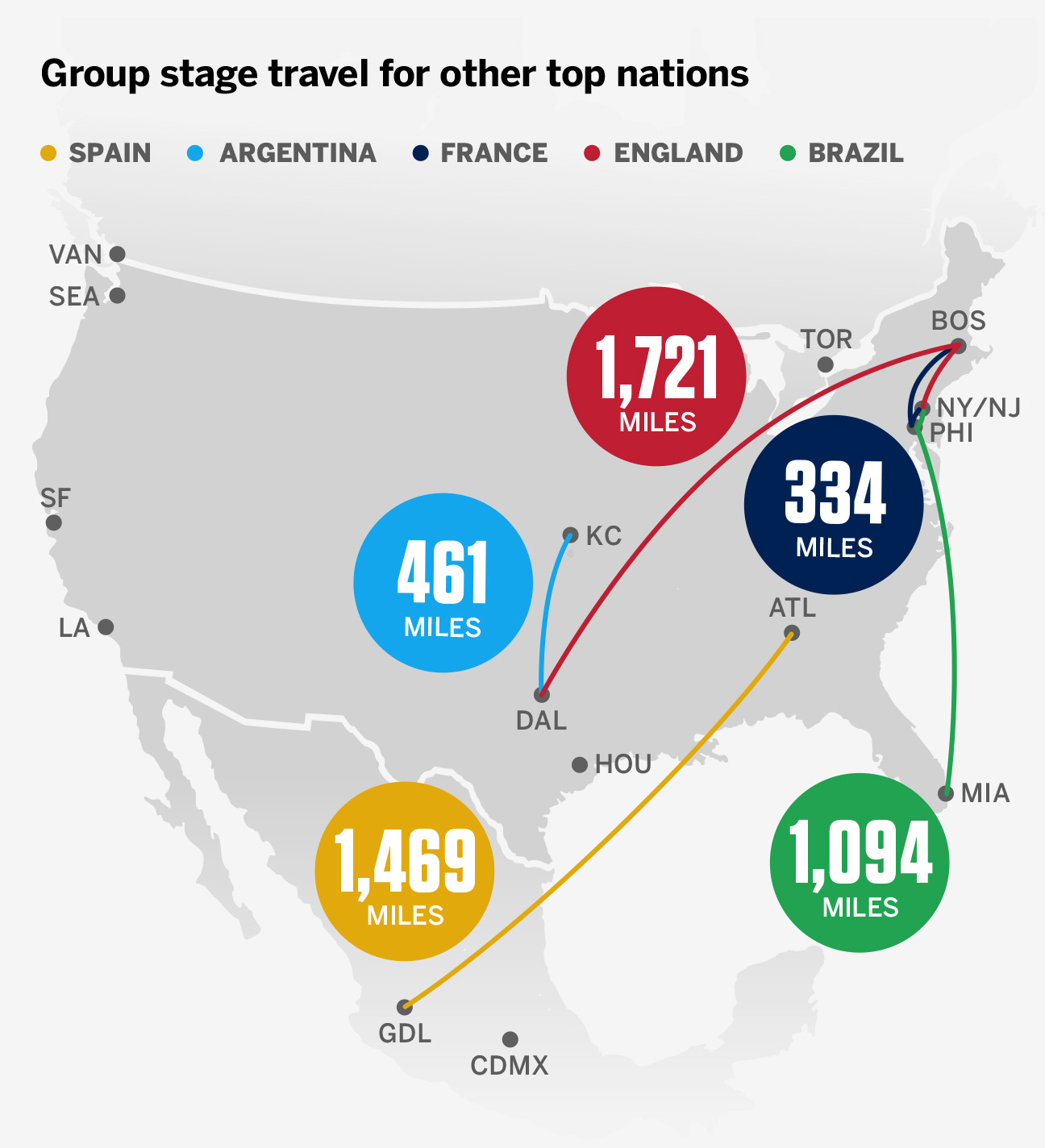
• Some teams vying for the championship will face vastly different travel experiences. Reigning champions Argentina will have minimal logistical challenges with matches in Dallas and Kansas City, while the 2022 runners-up, France, will remain in the northeastern region for all their Group I fixtures. The team with the toughest travel schedule is England, who will play in Massachusetts and Texas against Croatia, Ghana, and Panama.
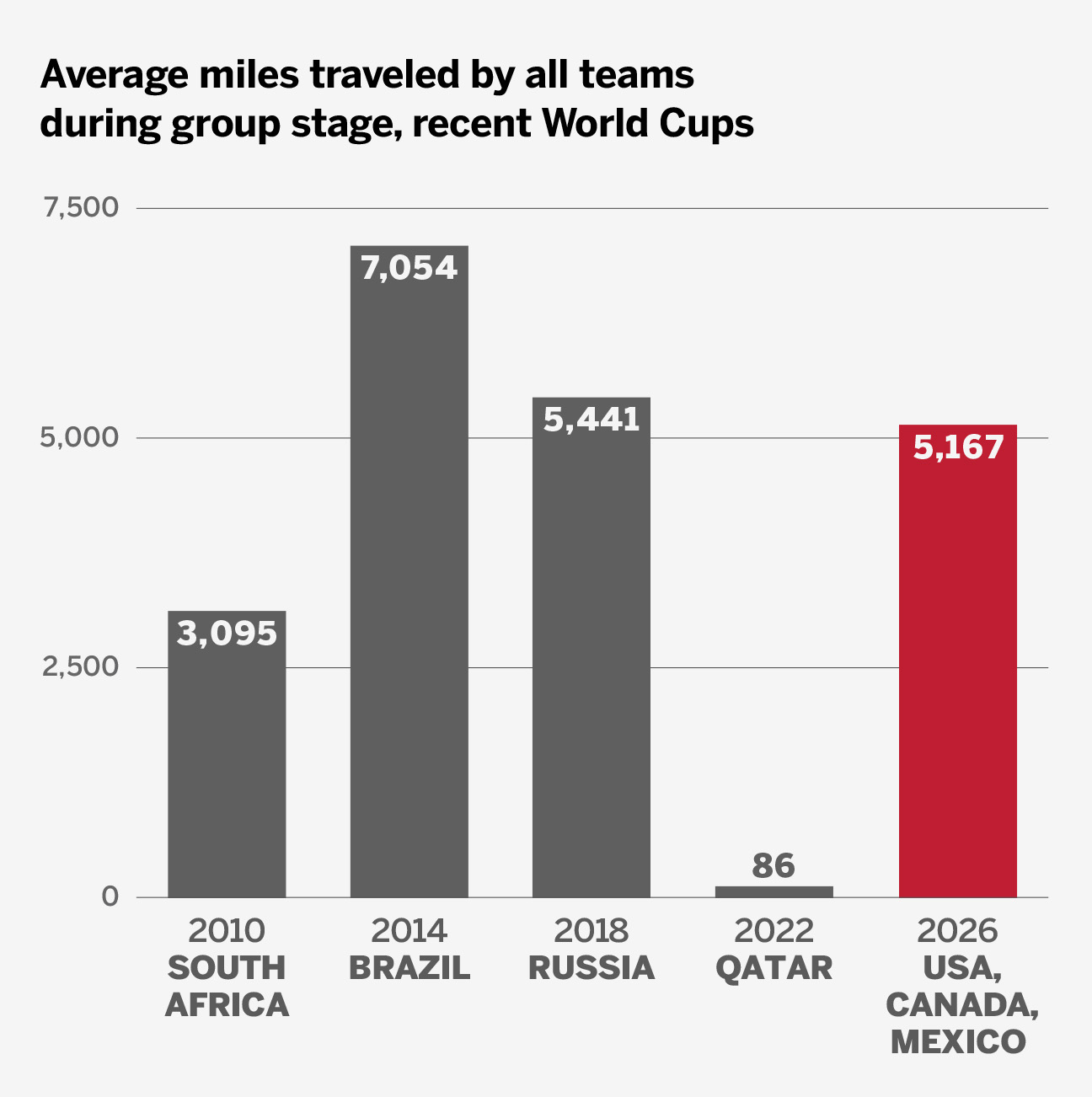
• The 2026 World Cup, spanning three countries, presents a more intricate travel scenario than the compact setting of Qatar 2022. However, the travel burden might still be lighter than at the 2014 World Cup in Brazil, where teams averaged more than 2,000 miles in the group stage.
The Impact of Extensive Travel
While some pursue advanced degrees in medicine or science, others, like Luke Jenkinson, the head of human performance at San Diego FC, have chosen to investigate the effects of travel in North American soccer for his PhD.
Jenkinson, who is working on a paper titled “Crossing Time Zones and Touch Lines” for the Journal of Sports Sciences, emphasizes the consequences of extended travel. Such journeys can disrupt players’ usual 90-minute rhythms, leading to travel fatigue and affecting their circadian rhythms. Sleep disturbances are a well-known issue for frequent travelers, but this can also have repercussions on players’ ability to metabolize food effectively.
“Digestive distress can increase, which is significant because it is uncomfortable,” said Jenkinson, who helped San Diego FC achieve the best away record in MLS this season. “If we encounter gastrointestinal distress, nutrient absorption—particularly carbohydrates—can be substantially hindered, affecting hydration as well.”
When players are fatigued, lacking essential nutrients, and potentially suffering from “digestive distress,” it’s understandable why teams that fail to manage these challenges struggle.
“There’s a clear pattern: numerous muscle injuries occur during these extensive trips due to inadequate recovery,” stated Jon Poli, head of physical training for the 2025 MLS Cup finalists, Vancouver Whitecaps.
Moreover, these long flights aren’t merely for sitting idle; the time spent in the air can also serve as valuable recovery time.
“We ensure players move around, rather than remaining seated the entire flight,” shared Pacific FC coach James Merriman, who faces a daunting 5,574-mile round trip to play HFX Wanderers in Halifax, Nova Scotia. “Players need to stretch and activate their muscles. It’s challenging, but necessary to overcome it.”
Another potential complication for national teams next summer—especially with travel spanning multiple time zones during the sweltering heat—is an unexpected issue.
“I think the biggest error … is that teams often arrive too early,” Poli noted. “Some will travel two days before a match, trying to acclimate players, but by game day, the players’ circadian rhythms can be completely off.”
Given all this, what can be done? For host nations like the United States, Canada, and Mexico, their travel demands will be less than those of their competitors. The U.S. and Mexico, in particular, will remain in the same region.
The Extra 1% to 2%: Comfort, Nutrition, and Adaptation
Consider a typical flight scenario where a few too many beverages lead to the unwelcome reality of an uncomfortable hotel bed. For Mathias Jørgensen, a Denmark international player for the LA Galaxy who participated in the 2018 World Cup, this was manageable a few years ago.
“A multitude of factors contributes to achieving that extra 1% or 2%. Denmark partnered with a company called Tempur to ensure that our special mattresses traveled with us to every hotel,” said the 35-year-old defender. “If players wanted them, the mattresses were transferred wherever we stayed.”
During the 2018 World Cup in Russia, Denmark faced similar travel concerns, covering 3,852 miles throughout the group stage, including stays at the Sheraton Moscow Sheremetyevo hotel. Jørgensen emphasized that attention to detail significantly contributed to their advancement to the knockout round.
“With regard to nutrition, sleep, and every little detail,” he said. “Perfecting those small aspects is crucial.”
As part of San Diego FC’s “fuel and load” program, the team prepares four meals from the night before an away match until kickoff, carefully managing the ingredients to prevent any stomach issues. Although there are spicy options, meals remain mild to ensure player comfort. Catering to their diverse roster, they provide varied meal options for different tastes, but a pre-match secret weapon has emerged: American-style pancakes.
“In England, we often had pancakes as our pre-match meal, as they’re an easy source of carbohydrates,” said Jenkinson. “They’re also very palatable.”
Along with pancakes, morning team walks prior to away games are used to enhance alertness before matches, and flight settings are adjusted based on their needs, whether requiring dimmed lighting for rest or bright lighting to keep players awake.
With an increase in MLS utilizing chartered flights—something national teams will experience next summer—a degree of flexibility emerges, allowing for transformative in-flight experiences that can serve as mobile locker rooms.
“We are fortunate to not fly commercial,” Poli explained, illustrating a cabin equipped with Normatec compression boots, electrical stimulators, and space for players to stretch. This experience starkly contrasts this with the past, when players were confined to commercial flights.
“Sitting in a middle seat on a Southwest flight is a different experience compared to charter flights,” joked Feilhaber.
The Importance of Mentality
From a logistical perspective, preparing for a World Cup or club soccer also involves a substantial support system of coaches, administrators, and communications personnel aiding the players.
In an effort to alleviate some logistical burdens, FIFA has segmented the tournament into east, central, and west regions, ensuring that teams will have three days of rest during 103 of the competition’s 104 matches.
FIFA also guarantees that no national team will have to travel coast to coast during the group stage. Base camp locations are set to be announced by January.
Nonetheless, when it comes to travel, the unpredictable weather of next summer could introduce numerous challenges, from intense heat to thunderstorms. Flight delays and cancellations—Feilhaber recounted a time when he endured an extra six hours in an airport—are common in North America.
Another vital aspect for overcoming these challenges, beyond better mattresses or chartered flights, is maintaining the right mindset. Whether through experiences in the more modest CPL or at the World Cup, the importance of a positive mental approach cannot be overstated.
“The key is having the right mentality. Don’t let it become a big deal,” said Pacific FC’s Merriman. “If players carry themselves negatively or comment excessively on their discomfort, they’re bound to feel the weight of travel and time differences.”
Jørgensen echoed this sentiment, reminding those participating next summer to embrace the opportunity.
“Experiencing different countries is a privilege,” he noted. “Recovery is as much a mental exercise as it is physical.”
“Approach the journey with a positive attitude, stay hydrated, do your part, and enjoy being part of the world’s largest sporting event,” he added.
We’ll see who maintains their positivity as they travel thousands of miles next year.