



-

Tom Hamilton
Multiple Authors
Brazilian social media is buzzing with memes about teenage striker Endrick and coach Carlo Ancelotti, humorously depicting their relationship as “whatever the player wants, Ancelotti does the opposite.” However, Endrick’s admiration for his coach runs deep.
“He [Ancelotti] acts on instinct, and things happen,” Endrick shared before Brazil’s round-of-16 clash against Norway. “It seems like there’s a divine influence guiding him…everyone follows his vision. When he instructs me, I don’t hesitate; I’ll follow his lead without question.”
The bond between Endrick and Ancelotti hasn’t always been so strong. Since Brazil’s quarterfinal exit to Croatia in the Qatar 2022 World Cup, the team has experienced significant upheaval. Ancelotti marks the fourth manager since the beloved Tite stepped down. Following Tite’s departure, Ramon Menezes took charge on an interim basis for three matches, followed by Fernando Diniz for six, and then Dorival Junior, who had a win rate of just 43.75% in his 16 games. Throughout this time, the Brazilian Football Association pursued Ancelotti, manager of Real Madrid.
In May 2025, they secured their target. At his initial press briefing, he addressed the weight of expectations surrounding Brazil’s pursuit of a sixth World Cup title and the necessity of crafting a fresh identity for the team. Since then, Ancelotti has initiated a transformation within the Selecao, moving away from the traditional Jogo Bonito style to what he terms “Ancelotti-ball.”
A Quiet Evolution
Each generation since Brazil’s last World Cup victory in 2002 has faced intense pressure. “Brazil has a duty to win the World Cup,” forward Matheus Cunha stated recently.
Throughout the tournament, Brazilian legends have been watching from the stands, resembling supportive Roman emperors. Icons like Ronaldo, Ronaldinho, Kaka, and Roberto Carlos are present, and each World Cup that passes without replicating the success of the legendary teams of 1958, 1962, 1970, 1994, and 2002 adds to the mounting pressure.
Brazil’s journey in this World Cup has not been seamless. Before the tournament began, they suffered injuries to key players like Estêvão, Éder Militão, and Rodrygo. They began their campaign with a disappointing 1-1 draw against Morocco. They showcased more of their potential in a 3-0 victory over Haiti, but also faced injury setbacks with Raphinha before another solid 3-0 win against Scotland.
The Round of 32 match against Japan was another test. After a weak first half, they trailed 1-0 at halftime. Casemiro, 34, faced criticism for his part in Japan’s goal, yet Ancelotti remained loyal to him, leading to an equalizer from Casemiro in the 56th minute. Arsenal winger Gabriel Martinelli secured the win in injury time.
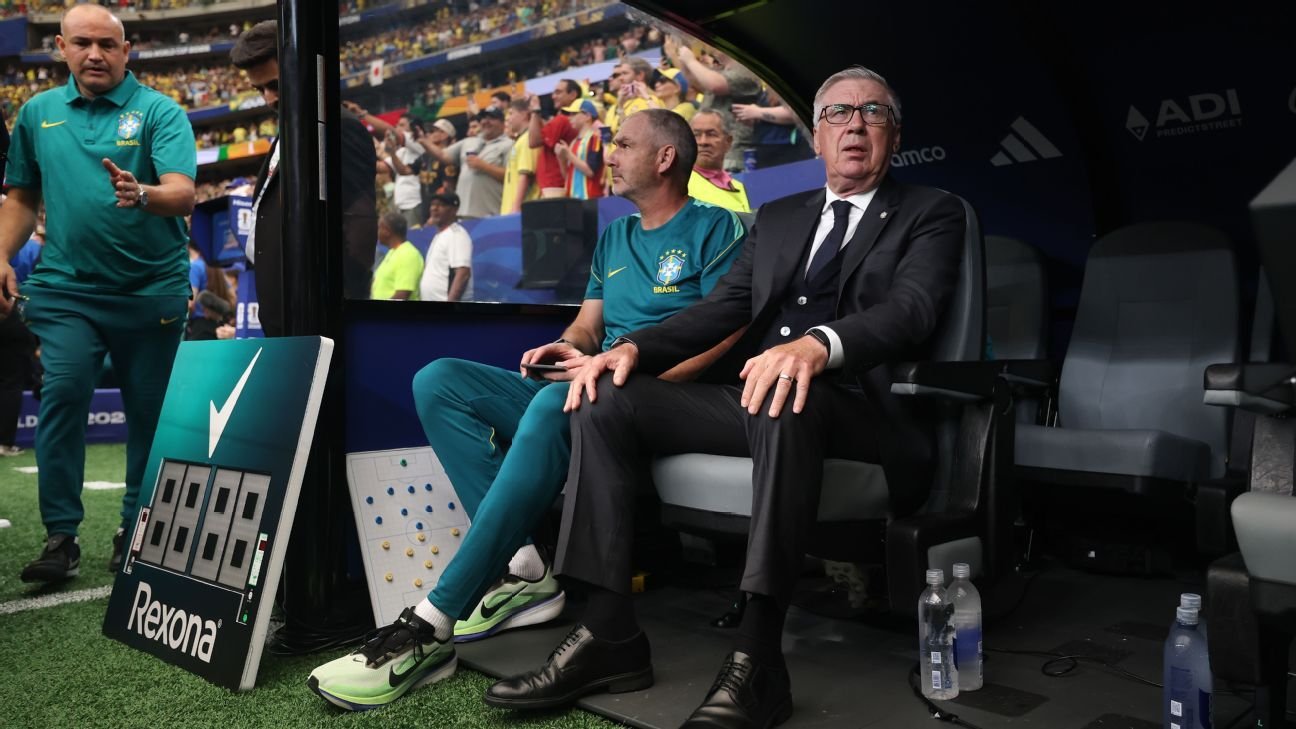
All throughout this process, players have praised Ancelotti’s composed demeanor. Brazilian fans have come to admire his subtle reactions on the bench, especially during high-pressure moments, such as when Martinelli scored against Japan.
“His tranquility instills confidence in us and eases the pressure,” says ESPN Brazil analyst André Kfouri, a sentiment echoed by players.
“We respect his legacy and are aware of his winning mentality,” Douglas Santos remarked. “His calming influence empowers us, providing the strength and confidence to regroup for the second half, relying on our skills.”
Despite early skepticism, Ancelotti has gradually gained acceptance in Brazilian football. Although he boasts five Champions League titles and six domestic league titles with esteemed clubs like AC Milan, Chelsea, PSG, Real Madrid, and Bayern Munich, his appointment as Brazil’s coach faced scrutiny when confirmed in May 2025.
Critics argued for a Brazilian coach, while Ancelotti became the first foreign manager since 1925 to lead Brazil in a competitive match. Emerson Leão, a revered goalkeeper from the 1970 World Cup, expressed concern after Ancelotti’s initial two matches ended with a draw against Ecuador followed by a narrow win over Paraguay.
“I believe he’s going to face substantial challenges,” he commented, adding that everyone involved needed to collaborate in moving forward.
Brazil encountered setbacks with losses to Bolivia, Japan, and France prior to the World Cup. Still, observers noted Ancelotti’s quiet yet positive evolution amid recent instability.
“He doesn’t need to justify himself; his club success speaks volumes, and he’s made solid strides with the national team,” said former Brazilian international Ze Elias. “Initially, he needed to grasp the unique passion for football in Brazil, which cannot be fully appreciated from an outside perspective.”
1:08
Nicol not convinced Brazil will beat Norway
A Versatile Approach
Ancelotti has forged his own path, including calling up 34-year-old defender Danilo when many believed his prime was past. He has also retained Casemiro despite public backlash, showcasing a self-assured management style that has marked him as one of the greatest coaches in history.
The Brazilian media has noted Ancelotti’s willingness to adapt; he undertook a rapid Portuguese course upon taking the role and now fluently switches between Portuguese, Spanish, Italian, and English during press conferences.
During the match against Scotland, Ancelotti delighted fans by singing the national anthem. Yet, his tenure has yet to be defined. Silas, a former participant in the 1986 and 1990 World Cups, remarked, “I think he’s making progress in winning over skeptics, but there’s still a challenging journey ahead.”
Doubts persist; Brazil’s performance has not been exceptional. However, should they claim victory in this World Cup, Ancelotti’s tactical expertise will be pivotal. “His ability to transform skepticism into triumphs, particularly in the abbreviated timeframe imposed by the World Cup, is crucial,” Silas notes.
Brazil initially struggled against Morocco in the opener, and Ancelotti’s bold 4-2-4 formation was ineffective. In the match against Haiti, he shifted focus towards regaining possession and pressuring opponents to exploit counterattacks. However, he also adapted tactics, using Vinícius Júnior in a more central role. Against Japan, after a challenging first half, Ancelotti advised his team to increase crossing attempts from deep positions. The strategy eventually paid off, leading to a breakthrough. Brazil’s evolving tactical style mirrors the multifaceted design of a Swiss Army knife.
Indeed, the variance in their approach has been pronounced during this World Cup. As Ancelotti mentioned previously, “Brazil has many identities. I don’t seek a rigid identity for the team in order for it to remain versatile. I want a squad that adapts to various scenarios: defending in a low block, attacking, maximizing player talents, and maintaining defensive solidity.”
Reflecting on this after the Brazil vs. Scotland match, he noted that those yearning for the classic beautiful football might be left wanting. “We know that performing well simplifies winning, but our objective is to secure victories. Coaches are evaluated based solely on outcomes, not on style.”
1:27
Laurens left disappointed by Japan’s game plan in Brazil defeat
Leading the Stars
In addition to his calm demeanor, exceptional tactical awareness, and strategic judgment, Ancelotti’s effective management of star players is crucial. Brazilian football has long been captivated by Neymar, the national team’s all-time leading scorer. The crowd began chanting for Neymar as he warmed up ahead of the match against Scotland. However, Ancelotti has diligently managed Neymar’s minutes considering his injury history; he was kept on the bench for the match against Japan after a lackluster performance against Scotland.
“Ancelotti’s respected history has greatly influenced discipline, respect, and the understanding of the significance of the Brazilian national jersey,” commented Ze Elias. “It’s crucial for a coach to maintain a strong presence when managing a team filled with high-profile players.”
Including Neymar sparked debate over his role in the final squad. Ancelotti has stated that he evaluates players based on current form rather than reputation, which led to the omission of players like Richarlison, João Pedro, and Savinho. Although Neymar hadn’t played for Brazil since October 2023 and was returning from a Grade Two muscle injury, the decision to select him remains divisive.
Many believe keeping Neymar was a strategic move to perennially please the public, yet he still possesses the ability to dramatically influence gameplay.
“Neymar’s situation comes down to his treatment as a key contributor: essential, but no longer the sole star player,” Silas offers.
Ze Elias commended Ancelotti for his direct communication with Neymar, ensuring he understood his expectations regarding the team’s cohesion over individual recognition.
This same philosophy of management extends to each player on the team.
According to ESPN Brazil analyst Gustavo Zupak, “Ancelotti has effectively reduced the focus on star players while nurturing a collaborative team environment.”
The emergence of Vinicius Junior is notable; prior to Ancelotti, he scored six goals in 39 appearances for Brazil; since Ancelotti has taken the helm, he has scored an impressive seven goals in just 13 games. Sources indicate that Vinicius is thriving within the current Brazil set-up.
Thus far, Ancelotti’s tenure has been promising. The Brazilian federation has responded positively, extending his contract through to 2030 in May. He recognizes, however, that expectations can shift rapidly. With Norway and Erling Haaland next on the calendar, only tangible success will suffice.
After the match against Scotland, a journalist asked Ancelotti what his message would be to fans, given the increasing anticipation surrounding a potential sixth World Cup triumph.
“Stay calm,” Ancelotti replied, raising an eyebrow and smiling slightly, fully aware that the true benchmark lies in winning. If Brazil remains in contention on July 19, perhaps the legends in the stands will allow themselves a rare smile.
“If he manages to blend an aesthetically pleasing style of play with achieving results, that’s wonderful,” says Ze Elias. “If he resorts to a more pragmatic approach while still securing victories — particularly in the Italian tradition of solid defense and counterattacking — that would be just as commendable.”
Additional contributions from Jean Santos and Vinicius Garcia Ferreira