



Manchester United has made significant progress this season. They qualified for the group stage of the UEFA Women’s Champions League (UWCL) for the first time and advanced to the knockout rounds after securing victories in four of their six matches, setting up a playoff against Atletico Madrid in February for a spot in the quarterfinals.
Since their promotion to the Women’s Super League (WSL) in the 2019-20 season, the club has enhanced its squad depth by bringing in high-profile players. The recent signings of Manchester City and England midfielder Jess Park and forward Fridolina Rolfö—the latter joining from three-time European champions Barcelona—demonstrate this commitment, and Marc Skinner’s side has continued to pursue talent this January.
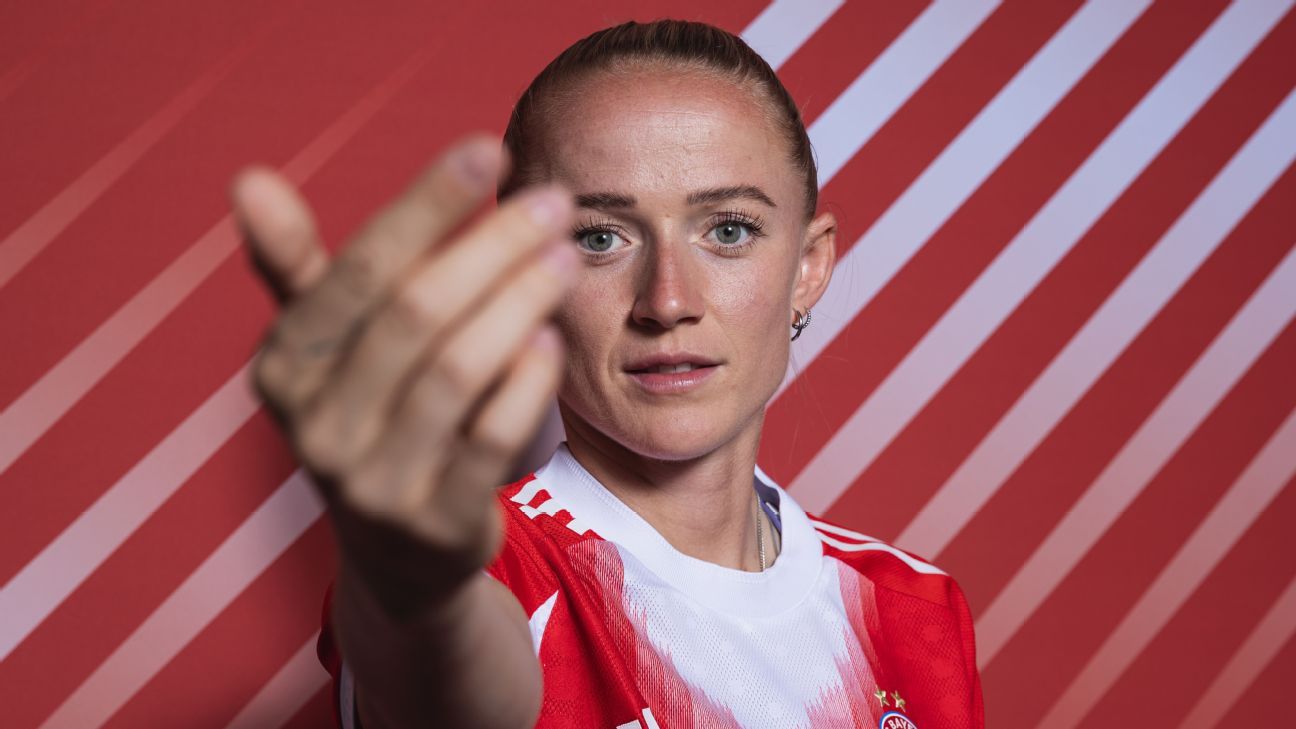
Following the acquisition of former San Diego Wave defender Hanna Lundkvist, United fortified their attack by signing 28-year-old forward Lea Schüller from Bayern Munich on a 3½-year contract for an undisclosed fee.
The Germany international enjoyed a remarkable 5½-year stint at Bayern, helping the team secure four league titles after arriving from SGS Essen in the 2020-21 season. She clinched the Golden Boot in the 2021-22 season with 16 goals and was named German Footballer of the Year in 2022 for her outstanding performances.
Schüller boasts an impressive scoring record, netting 10 or more goals in each of the past seven seasons in the Frauen Bundesliga. She has tallied 103 goals in 180 appearances for Bayern across all competitions, in addition to her 54 goals in 82 games for Germany.
But how will her signing bolster United’s ambitions?
Position
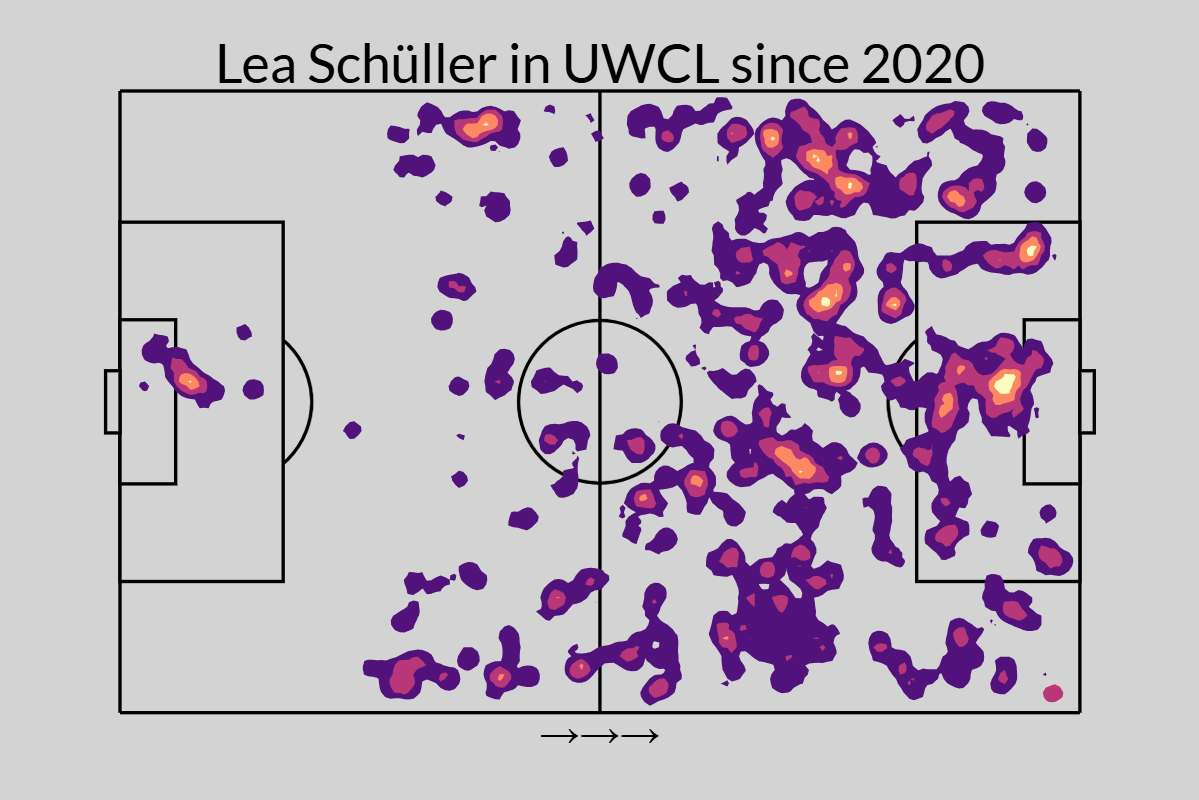
Schüller is a central striker who excels at exploiting space behind defenses and within the box. Her exceptional movement and great acceleration allow her to create one-on-one opportunities with goalkeepers, where she has a knack for scoring.
She also adeptly finds gaps between center-backs to capitalize on incoming crosses, earning her a reputation as a “fox-in-the-box” style striker.
Strengths
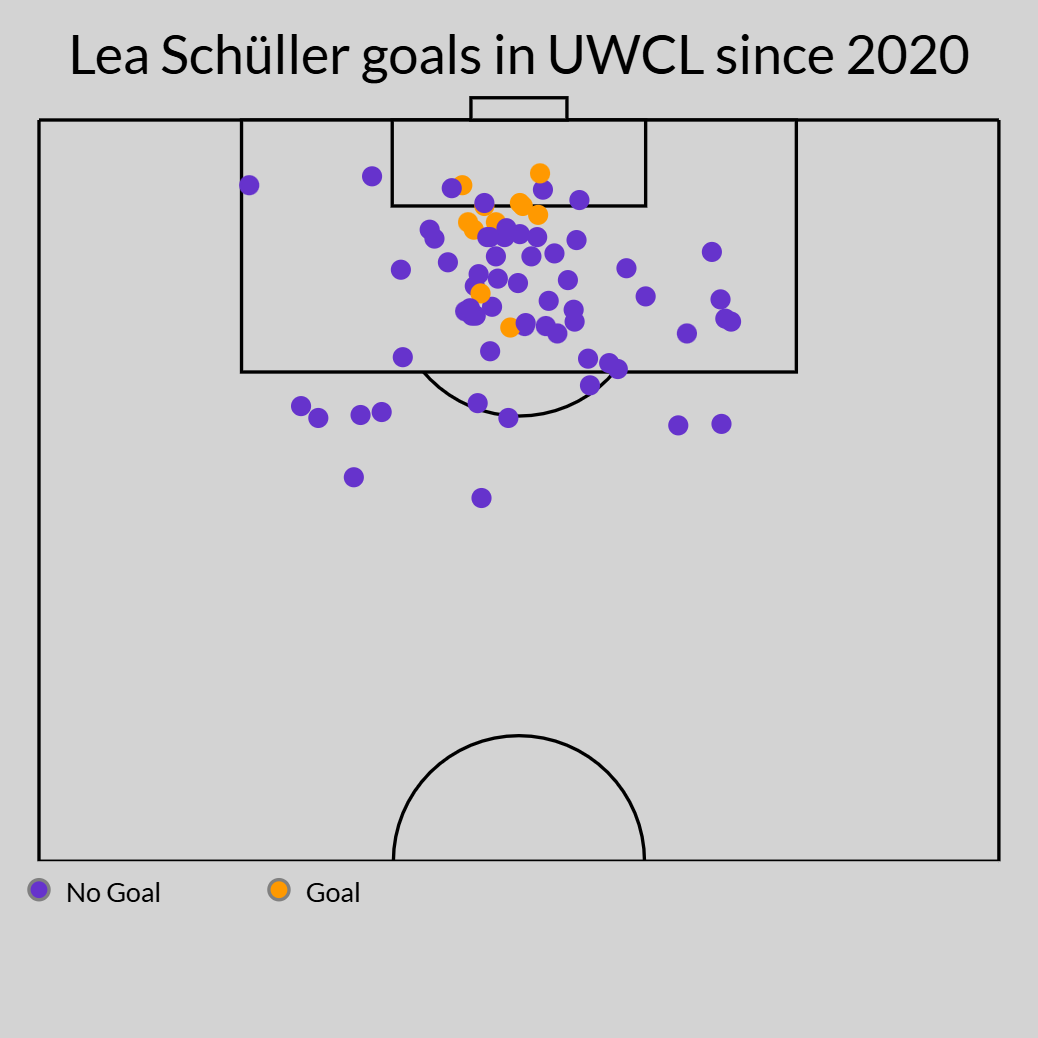
Schüller stands out as a prolific goal-scorer across various playing setups, possessing a diverse range of finishing techniques. Her impressive goal record for both club and country speaks volumes, as she has consistently performed since breaking through in the Frauen Bundesliga at just 16 years old.
Her ability to generate high expected goals (xG) values stems from her capacity to take shots from close range. This season, she ranks among the top five European forwards for non-penalty xG per 90 minutes, trailing only stars like Manchester City‘s Khadija “Bunny” Shaw and Barcelona‘s Ewa Pajor.
Her strong spatial awareness and impeccable timing of runs into the penalty area enable her to be in optimal positions, significantly contributing to her consistent overperformance in xG across seasons.
Schüller mainly depends on her teammates for service, not heavily engaging in the buildup phase.
Standing at 5-foot-8, she possesses remarkable leaping ability, allowing her to dominate aerial duels. Even from a stationary position, she generates considerable power on headers and accurately directs her efforts. Since the 2023-24 season, only VfL Wolfsburg‘s Alexandra Popp has had more headed attempts (67 vs. 39), and only Bayern’s Pernille Harder has scored more headed goals (11 vs. 8) in the Frauen Bundesliga than Schüller. In fact, nearly 35% of her shots and 30% of her goals in this timeframe have come from headers.
Areas for Improvement
While Schüller may not be a high-volume shooter, she prioritizes shot quality by positioning herself advantageously before releasing shots. Over the past four seasons, her average shot distance has remained around the penalty spot (12 yards), indicating where she is most active; indeed, 21% of her total touches during this period have occurred within the opponents’ penalty box.
This suggests there is room for her to become more involved in other areas, and it will be intriguing to see how she collaborates with a similarly skilled player at United, Elisabeth Terland.
How Will She Fit In at Manchester United?
With Schüller’s entry, United faces some overlap in player profiles. Under Skinner’s tactics, the central striker typically receives service from wingers and does not feature prominently in buildup play.
This situation could mean that while Schüller is an excellent fit, her skill set mirrors that of United’s current option: Terland. Both are goal-focused strikers who excel within the box due to their movement; however, each operates independently, creating limited room for both in the starting lineup.
Terland has been leading the attack for Skinner’s squad since the 2024-25 season, finishing as the team’s top scorer last season. Over the last two seasons, 80 of her 90 shots in the WSL have come from inside the penalty area—22 of which were headers.
Despite their stylistic similarities, Schüller holds advantages in aerial capabilities, speed, and experience. Terland’s rate of success in aerial duels is around 40%, while Schüller hasn’t dropped below 50% in the past four seasons. Adapting from the Frauen Bundesliga to the WSL will challenge Schüller with more structured defenses, but her quality should shine as she adds a reliable option to United’s system.
With Celin Bizet unavailable due to pregnancy, Skinner has utilized Melvine Malard and Park as nominal wingers this season. However, both prefer to cut inside, create opportunities behind defenders, and offer themselves as options in the penalty area; Schüller will better complement their fluid playing style, echoing the qualities she displayed alongside Jovana Damjanovic or Harder during her time at Bayern.
Schüller’s ability to make sharp runs behind defenses without getting caught offside often will add another layer to United’s attack. As the team’s aspirations continue to rise, she could provide the crucial depth and momentum needed to achieve their goals.