



-

Ryan O’Hanlon
Multiple Authors
Can you envision the scene?
After his Paris Saint-Germain squad secures a second consecutive UEFA Champions League title, manager Luis Enrique steps up to the microphone. His team has just triumphed over Arsenal, winning 3-1 in the final in Budapest. They have claimed victory in eight consecutive matches against Premier League teams. Of their last 12 encounters against English clubs, their only two defeats came in two-legged ties that they ultimately overcame.
Dressed in his trademark cycling attire, the slender Enrique takes a moment to relish his team’s accomplishment against the so-called pinnacle of football.
“You Brits are playing the style we Europeans evolved from so many years ago,” he declares. “Relying heavily on physical strength, but lacking in method and technique.”
You might be agreeing, as this sentiment echoes conversations surrounding the UEFA Champions League semifinals this year—a dazzling nine-goal contest between Bayern Munich and PSG, and a 1-1 deadlock between Arsenal and Atlético Madrid, where both goals were from penalty kicks. This sounds fictional, yet it feels prescient, doesn’t it?
But here’s the twist: it’s not a fabricated statement. A manager actually voiced those very words back in 1960.
Helenio Herrera’s Barcelona had just outclassed the defending English champions, Wolverhampton Wanderers, by a score of 5-2 in England, sealing a 9-2 aggregate win in the European Cup quarterfinals. On his return journey, Herrera unexpectedly held a press conference at the Birmingham airport to ridicule those who claimed to have originated the sport, stating, “In modern football, the British missed the evolution.”
The belief that English football’s physicality hampers its teams against their more sophisticated European peers has lingered since the mid-1950s, when these clubs first began competing.
This notion resurfaces every decade or so, and it’s back again today: the Premier League is deemed too physical for clubs to peak effectively, its teams purportedly incapable of playing like Bayern Munich and Paris Saint-Germain, whose style supposedly represents the ideal approach to the game.
If this were accurate, how do we explain that English clubs have amassed 15 European trophies—the second most by any nation? Or, more recently, that eight of the last 16 Champions League finalists hail from the Premier League? The reality is, a few knockout matches in a single season offer little insight into the overall landscape of European football.
– USMNT depth chart: Rankings for top 15 players in each position
– What if Liverpool hadn’t signed Salah? Alternative history
– Ranking: Top 20 women’s soccer club managers globally
How Premier League Teams Can Attack Despite Extra Matches
The first leg of Bayern-PSG was thrilling—something Arsenal manager Mikel Arteta can attest to.
Arteta remarked, “Bayern-PSG is possibly the finest match I’ve witnessed regarding both team quality and individual performances. It was unprecedented. But looking at the time on the pitch and the freshness of those players, it doesn’t surprise me.”
“To achieve those quality moments, players must be well-rested, and the difference between the leagues and their competitiveness is stark, highlighted by numerous recent statistics.”
He’s correct about the statistics. Consider the top 10 players in minutes played across all competitions among the four teams in the Champions League semifinals:
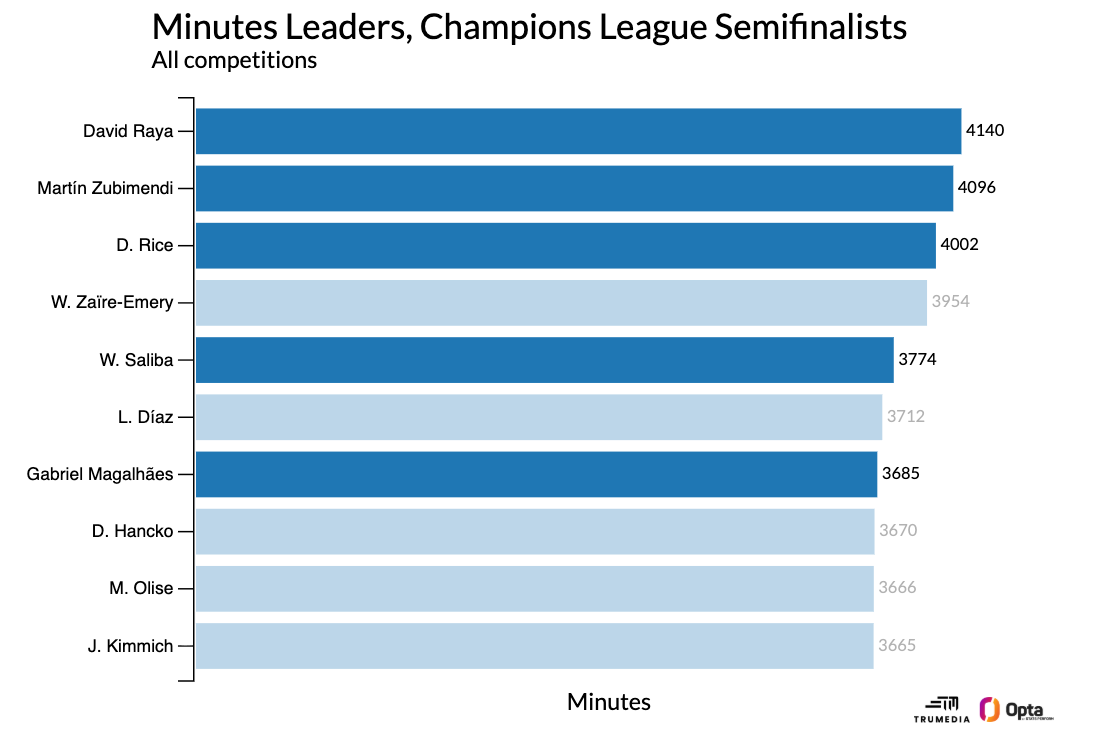
Arsenal players make up half of this top 10, while Bayern has three, and Atlético and PSG each have one.
To illustrate the physical demands of the Premier League versus Ligue 1, Gradient Sports analyzed the physical output of Arsenal and PSG’s box-to-box midfielders: Declan Rice and João Neves. Their findings were illuminating:
● The Minutes Gap: Neves would need to complete nearly 22 consecutive 90-minute games to match Rice’s playing time.
● The Distance Gap: To match Rice’s total of 350.34 km, Neves would have to run nearly five full marathons.
● The Acceleration Gap: Rice has accelerated around 900 more times than Neves throughout the season.
This represents a significant disparity, but it’s not an entirely new phenomenon.
Examining data from four years ago and comparing Bayern and PSG with the two English clubs that reached the Champions League semifinals that year presents similar—if not more pronounced—findings. The comparison chart concludes in early May because neither Bayern nor PSG advanced that far that season:
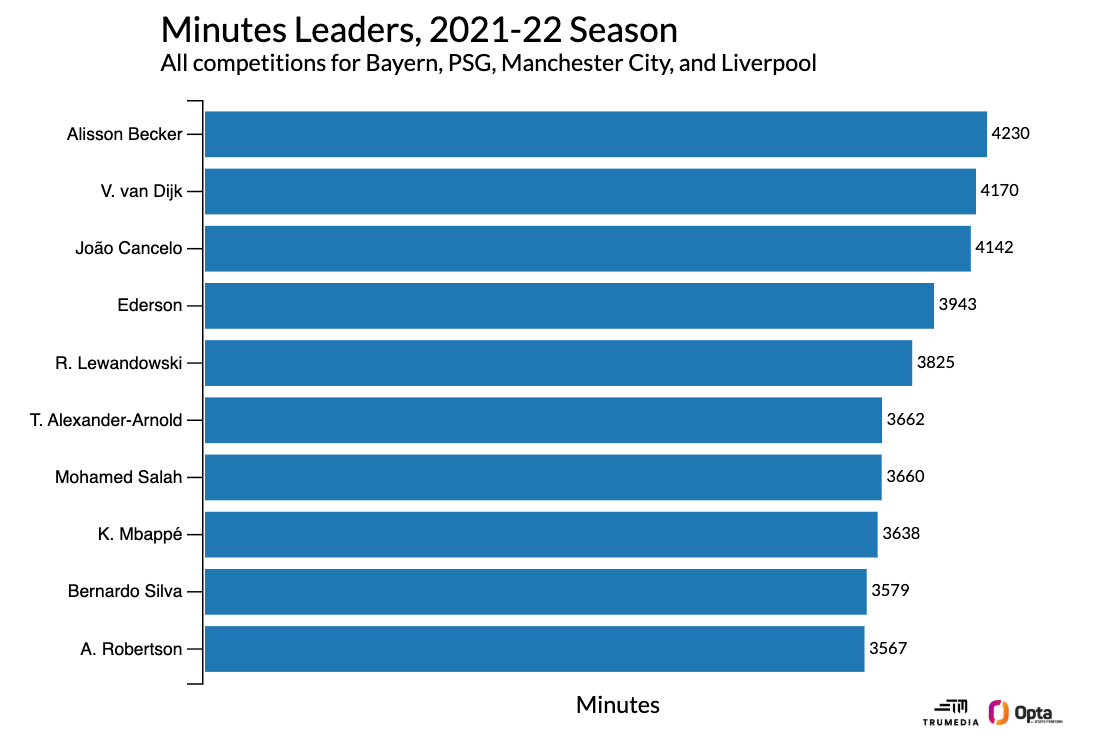
This data includes five players from Liverpool and three from Manchester City.
Gradient provides domestic league physical data for the 2021-22 season, and among these four clubs, the top 10 players in total distance covered featured three Manchester City players (Rodri, Bernardo Silva, and João Cancelo) and four from Liverpool (Sadio Mané, Jordan Henderson, Trent Alexander-Arnold, and Virgil van Dijk). City had Cancelo and Aymeric Laporte among its top players by acceleration; Liverpool contributed Van Dijk, Alexander-Arnold, Mané, Andrew Robertson, Mohamed Salah, and Joel Matip.
These players endured similarly strenuous physical demands as Arteta’s Arsenal while employing daring, high-pressing styles akin to those showcased by PSG and Bayern last week. That season, both Manchester City and Liverpool initiated possession higher up the pitch than any other clubs in Europe’s top five leagues, while they were the only two clubs to take over 700 shots throughout the season.
Both captured over 90 points in the Premier League; despite improbable losses to Real Madrid in the Champions League, they were the top two teams in Europe from start to finish.
In contrast, PSG and Bayern sauntered to domestic championships, yet PSG exited in the round of 16 after faltering against Real Madrid in the second leg, while Bayern failed to advance beyond Unai Emery’s Villarreal in the quarterfinals. Until recently, the narrative surrounding both clubs suggested that their domestic supremacy was hurting them on the European stage.
Each year, they entered the Champions League knockouts without having faced competitively tough matches. Unlike Spain or England’s top teams, neither PSG nor Bayern encountered opponents capable of matching their talent or consistently punishing their overly aggressive style; their game plan was straightforward: attack, then keep attacking.
The perception has reversed: now, it is believed that these easy domestic seasons enable both clubs to peak at the opportune moment, be aggressive, and maintain ball dominance.
However, the truth is neither assertion is entirely accurate.
What Can We Conclude About European Soccer?
Just a couple of months ago, the Premier League was a powerhouse in the Champions League, with five English clubs securing eight automatic spots in the round of 16. This was later joined by Newcastle United, totaling six out of the 16 teams in the knockout phase—double the next closest nation.
While only one remains now, the Premier League’s advantage over its rivals doesn’t lie in the very top tier; it is evident in how two teams from the bottom half of the table this season still advanced into the Champions League’s knockout rounds. Financially and competitively, clubs like Arsenal, Manchester City, and Liverpool are on relatively equal ground with giants like PSG, Bayern Munich, Barcelona, and Real Madrid. Estimates regarding overall talent and wage expenditures support this assessment.
Thus, the outcomes when these teams meet in the Champions League hinge mostly on the unpredictability of a single match’s circumstances rather than a uniform league identity.
Bayern has constructed a win-now squad, featuring an average age (based on minutes played) of 28.2—identical to Everton—boasting arguably the best striker in the world, the best player in the world, and a third key attacker of equal caliber. Manager Vincent Kompany has effectively capitalized on this attacking prowess, with key players like Harry Kane, Michael Olise, and Luis Díaz.
Kane excels in converting his share of goals while facilitating opportunities for his teammates; Olise can generate chances for himself and others, while Díaz complements this duo with relentless pressing and off-ball runs, as well as the ability to beat defenders when necessary.
The story from PSG centers less on their domestic ease and more on their commitment to a coherent tactical approach: high pressing. This strategy excludes aging superstars, thus they’ve assembled a team of athletically prime players who can execute Luis Enrique’s vision.
PSG is currently enjoying a likely unsustainable run of form; in five knockout matches, they have netted 17 goals while conceding six, despite producing just 7.38 expected goals (xG) and allowing 8.03 xG, giving them a negative xG balance in contests against Chelsea, Liverpool, and Bayern.
A commitment to pressing and possession has proven less crucial than PSG’s ability to convert a limited number of quality chances.
Conversely, Premier League teams are currently grappling with various issues. Both Newcastle and Tottenham are struggling through a challenging domestic season; Chelsea has already cycled through three managers this season; Liverpool is navigating the complexities of reevaluating their title-winning roster. Manchester City seemed to find their optimal form only recently, while many of Arsenal’s key players are sidelined due to injury.
This isn’t to dismiss that the increased number of fixtures—and the heightened competitiveness of those matches—takes a toll on Premier League clubs. This Premier League season is indeed tougher than ever. However, this manifests more in terms of squad health than in the quality of play.
In the first leg against Atlético Madrid, Arsenal’s starting lineup was missing Bukayo Saka, Kai Havertz, Riccardo Calafiori, and Jurriën Timber, with Martin Ødegaard only able to play less than an hour. During the second leg against PSG, both Hugo Ekitike and Alexander Isak started for Liverpool but were unable to contribute beyond the first half.
The Premier League finds itself in a peculiar tactical impasse, characterized by set pieces dominating scoring and a trend toward slower, more controlled ball possession among the richest teams. Yet such patterns were evident earlier this season when Chelsea triumphed over Barcelona, and Liverpool and City defeated Real Madrid, while Arsenal outclassed Bayern Munich.
Just last year, Arsenal dominated their quarterfinal matchup against Madrid, and Liverpool fell to PSG in a penalty shootout. A couple of seasons back, Jürgen Klopp’s Liverpool executed an aggressive style while achieving an 82-point season—an identical pace to that of both Manchester City and Arsenal at present.
The idea that Arsenal does not play like Bayern or PSG is not because they endure too many matches but rather because their squad is not adequately constructed to emulate their styles. It’s impractical to continuously convert centre-backs into full-backs if your strategy aims to thrive in a high-scoring affair.
Due to their domestic enjoyability, Bayern Munich and PSG can construct deep squads and rotate them effectively. In contrast, Premier League teams contend with more matches against rigorously competitive opponents week in and week out.
This has always been the case—regardless of which clubs prevail in the Champions League.