



-

Bill Barnwell
Multiple Authors
The same viral tweet emerges every time the U.S. is eliminated from the Men’s World Cup: “If America’s best athletes played soccer, the U.S. would dominate.”
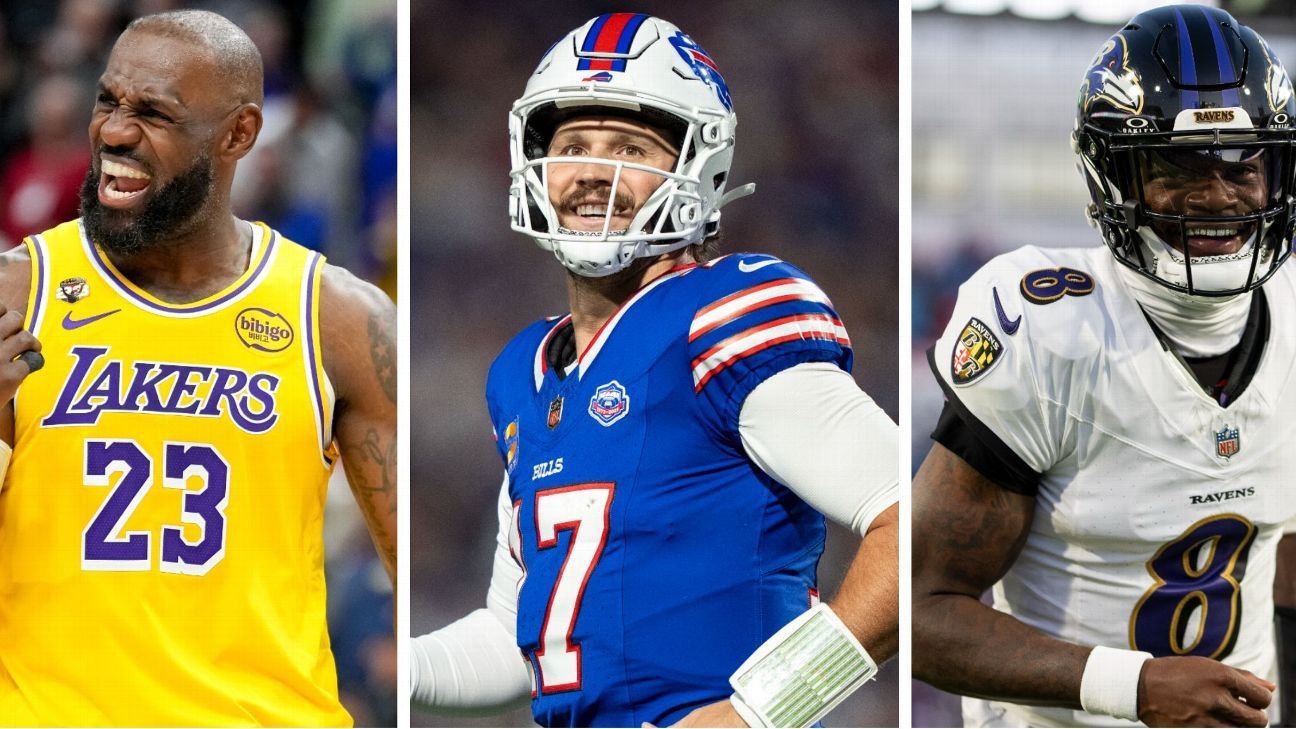
On the surface, the idea sounds fantastic. Imagine Lamar Jackson delivering crosses for LeBron James or Josh Allen charging through midfield. That would be entertaining, no doubt.
But would it truly propel the United States to unrivaled success in global football? I have my doubts, largely stemming from the iconic player of this era, Lionel Messi.
The reason the U.S. can’t just tap into a pool of super-athletes to win a World Cup comes down to a player standing at 5-foot-7 and weighing 148 pounds.
– Connelly: Evaluating FIFA’s major changes for the 2026 World Cup
– Lindop: The real question: Does Klopp need Germany?
– Kassouf: Why the USWNT may or may not win the 2027 Women’s World Cup
Messi is an extraordinary athlete, yet he differs significantly from the American superstars that might populate a hypothetical national team featuring elite talent.
In sports like basketball or football, Messi’s stature might be a limiting factor, but in soccer, his low center of gravity and quick agility allow him to maneuver around larger opponents effectively. Whether his exceptional vision, creativity, and precise passing skills stemmed from adapting to outplay bigger players at La Masia is uncertain, but it is a relevant consideration.
Messi may be one of the shortest players on the field, but he isn’t an outlier among legends. Diego Maradona stood at 5-foot-5 and weighed 160 pounds. Ronaldinho was 5-foot-10 and 172 pounds. Even
Kylian Mbappé is 5-foot-10 and 163 pounds.
While incorporating more elite athletes would certainly enhance the U.S. Men’s National Team (USMNT), the notion that they would emerge as world leaders in soccer is overly simplistic. While height and speed matter, they’re advantages in certain roles and limited in others.
To illustrate this, let’s examine the best players.
ESPN FC compiles an annual Top 100 list based on various positions. The latest edition featured 10 goalkeepers, 10 fullbacks, 10 central defenders, 15 central/defensive midfielders, 15 attacking midfielders, 20 wingers, and 20 central forwards. I computed the average height and weight of each group. Although this isn’t an exhaustive sample, these categories shouldn’t reflect outliers compared to the broader player pools.
A notable distinction exists: goalkeepers, center backs, and center forwards average around 6-foot-2 and weigh over 183 pounds, while fullbacks, midfielders, and wingers average about 5-foot-11 and weigh just over 160 pounds.
If you watch soccer regularly, these trends are intuitive. Goalkeepers need to be tall to cover the net effectively. Center backs and forwards are expected to excel in aerial duels, both for scoring and defending headers. Typically, taller players are steered toward those positions during development.
However, at those positions, excessive height can impede ball control and protection from opponents. Last year, only four outfield players across Europe’s top five leagues (England, France, Germany, Italy, and Spain) played over 600 minutes and stood 6-foot-6 or taller. Compare that to just two in the 2019-20 season and five back in 2014-15.
Many countries likely don’t have as many tall elite athletes as the United States does, yet these leagues scout talent globally. In a competitive landscape that excels at funneling elite players into the top five leagues, a handful of 6-foot-6 players showcasing top-level skill can be counted on one hand. Furthermore, these players typically occupy striker or center-back roles. Although exceptional athletes like LeBron James and Kevin Durant possess incredible ability, translating their talents from one sport to another is far from guaranteed. Thus, a significant portion of the athlete pool is already filtered out.
While taller players tend to be goal scorers and defenders, creative playmakers are usually shorter. Over the last three seasons in the Big Five leagues, 33 players have recorded at least 10 assists.
The average height of these players stands at 5-foot-10, with only Cristiano Ronaldo (listed at precisely 6-foot-2) being that tall. Expanding the analysis to include players creating 50 or more chances reveals that just 15 out of 267 meet the 6-foot-2 minimum requirement, while nearly twice as many (27) players stood 5-foot-7 or shorter.
Players 6-foot-2 or taller accounted for about 22% of minutes played across these seasons but contributed to only about 12% of assists, chances created, and successful dribbles. This doesn’t undermine the effectiveness of taller players, like Harry Kane (6-foot-4) and Paul Pogba (6-foot-3), but teams rarely rely on tall players in creative midfield or winger roles.
Another key point is that footballers generally weigh less than their American counterparts. This is unsurprising given the running demands of soccer compared to sports like baseball and football, which feature brief bursts of action interspersed with pauses. Athletes have physically evolved to optimize their performance in each respective sport.
0:51
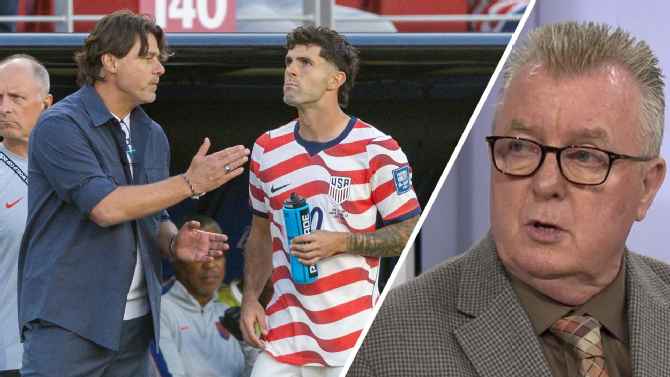
Nicol: Pochettino changed the identity of the USMNT
For instance, Minnesota Vikings star wide receiver Justin Jefferson stands at 6-foot-1 and weighs 195 pounds—strictly average by NFL measurements. While Jefferson’s explosiveness would suit him well as a winger on an all-star USMNT, very few fullbacks, midfielders, or wingers in the top 100 exceed 190 pounds apart from Scott McTominay, a 6-foot-4 player at 192 pounds.
If Jefferson trained specifically for soccer, he would likely drop to around 165 or 170 pounds. While he would retain his athletic prowess, it raises the question: Would he retain the same level of explosiveness and dynamism without that muscle mass? Adapting to soccer could be even more challenging for someone like Ja’Marr Chase, who weighs in at 205 pounds.
Conversely, switching sports might create openings for athletes of shorter stature. A player like 5-foot-7 slot receiver Greg Dortch could potentially excel as a world-class winger in soccer with proper training. Basketball legend Allen Iverson, who stood 6 feet and weighed 165 pounds, might have made an outstanding defensive midfielder. These hypotheticals seem more plausible than envisioning top athletes from other sports successfully transitioning to soccer while maintaining their size.
We recently witnessed an example of how challenging it can be for elite footballers to compete in an alternative version of a different, albeit recognized sport.
This past March, the U.S. men’s flag football team faced teams featuring current and former NFL players like Saquon Barkley, Jalen Hurts, Devonta Smith, Patrick Peterson, Luke Kuechly, and even Tom Brady. Remarkably, the flag football team, none of whom had ever played in the NFL, won all three matchups by a combined score of 106-44.
Interestingly, most of the players on the winning flag football team were on the shorter side, with ten out of twelve measuring 5-foot-11 or below, and only one player exceeding 6 feet. For a game where agility is crucial for avoiding flag pulls, being smaller may actually be an advantage.
I have no doubt that NFL players could improve their performance if they dedicated time to mastering flag football, or had specialized in that format from the start; however, it underscores the idea that height and size may not always be beneficial when the sport changes. And while flag football shares some similarities with tackle football, soccer presents a completely different challenge where a lower center of gravity could be even more advantageous.
The largest team by average weight in this year’s World Cup came from Norway, featuring players averaging 6-foot-1 and 182 pounds. While the heaviest teams—such as Panama, the Ivory Coast, and Switzerland—followed, many of the tallest teams were eliminated quickly in the tournament, including Bosnia, the Netherlands, and Germany.
3:07
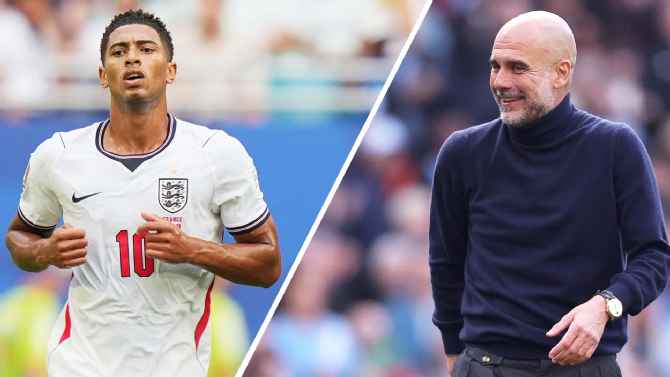
What would England’s team look like if Pep Guardiola was manager?
Who had the shortest team in the World Cup? Argentina. Spain ranked just below average in terms of height, finishing 30th, and 26th by weight. France landed in the middle, 17th in height and 5th heaviest, while England ranked 11th in height and 25th in weight. The U.S. finished close to average as well, being 22nd in height and 20th in weight.
Norway’s standout player, Erling Haaland, appears to be built like a professional basketball or football player at 6-foot-5 and 205 pounds, demonstrating how a couple of touches can turn a match in his favor. His aerial prowess and explosive presence inside the box exhibit qualities often associated with top-tier American athletes.
While placing a team of top-tier athletes from other sports isn’t a guaranteed path to World Cup victories, it stands to reason that a reality where American men devote their lives to soccer could yield more elite players. The U.S. is more likely to produce athletes like Haaland or Cristiano Ronaldo, strikers who apply extraordinary athleticism to score regularly.
In such a scenario, the U.S. would find itself stronger in players like strikers, center backs, and goalkeepers. Historically, Goalkeeping has been the U.S.’s strength, with legends like Kasey Keller, Brad Friedel, and Tim Howard enjoying lengthy careers in the English Premier League. However, creating a consistent pipeline of central defenders or forwards has been challenging, indicated by Folarin Balogun, arguably America’s best striker, having spent the majority of his life in England after being born in the U.S.
Even if one accepts that the U.S. could develop premium goalkeepers, center backs, and strikers in this ideal scenario, there remains a void in creative talent on the wings and central areas of the pitch. Historically, the most prominent midfielders or wingers from the United States—such as Claudio Reyna, Clint Dempsey, Michael Bradley, and Weston McKennie—don’t compare favorably with their global peers at prestigious European clubs.
3:07
What would England’s team look like if Pep Guardiola was manager?
Despite McKennie’s contributions to a Champions League team and Dempsey’s ability to score spectacular goals, no American has consistently been the primary playmaker for a successful European club. In contrast, countries like Argentina, England, France, and Spain often have multiple such players at any given time.
Solving this puzzle around developing American players with skills for these roles is a pressing concern for the U.S. Soccer Federation. My colleague Dan Wetzel explored the challenges surrounding pay-to-play soccer and youth travel systems. Arsene Wenger, the iconic Arsenal manager and FIFA’s global development lead, has voiced similar concerns. Transitioning to futsal or street soccer could be beneficial, emphasizing skills in tight spaces from an early age; however, that is another issue entirely.
Ultimately, I contend that simply inserting elite athletes from other sports into the U.S. soccer lineup wouldn’t pave an easy path to excellence. Even in such a tactical overhaul, it begs the question: wouldn’t other countries reap similar benefits? If soccer became the sole focus for athletes while lessening the priority on other sports, how would France capitalize on someone like Victor Wembanyama playing as a 7-foot-4 center-forward? Would Shohei Ohtani reign supreme as the planet’s best striker? Could Australia gather its rugby or cricket athletes to form a formidable squad?
Countries that are already ahead of the U.S. in soccer, like England and Germany, also have access to talent from various sports. The U.S. is not the only nation nurturing elite athletes.
It’s a captivating thought nonetheless.