



In the wake of the Heysel tragedy in 1985, where 39 fans tragically lost their lives, a stigma emerged, branding English football supporters as hooligans. This unwarranted stereotype should have faded by the beginning of the new millennium. Instead, four decades later, it continues to persist across generations.
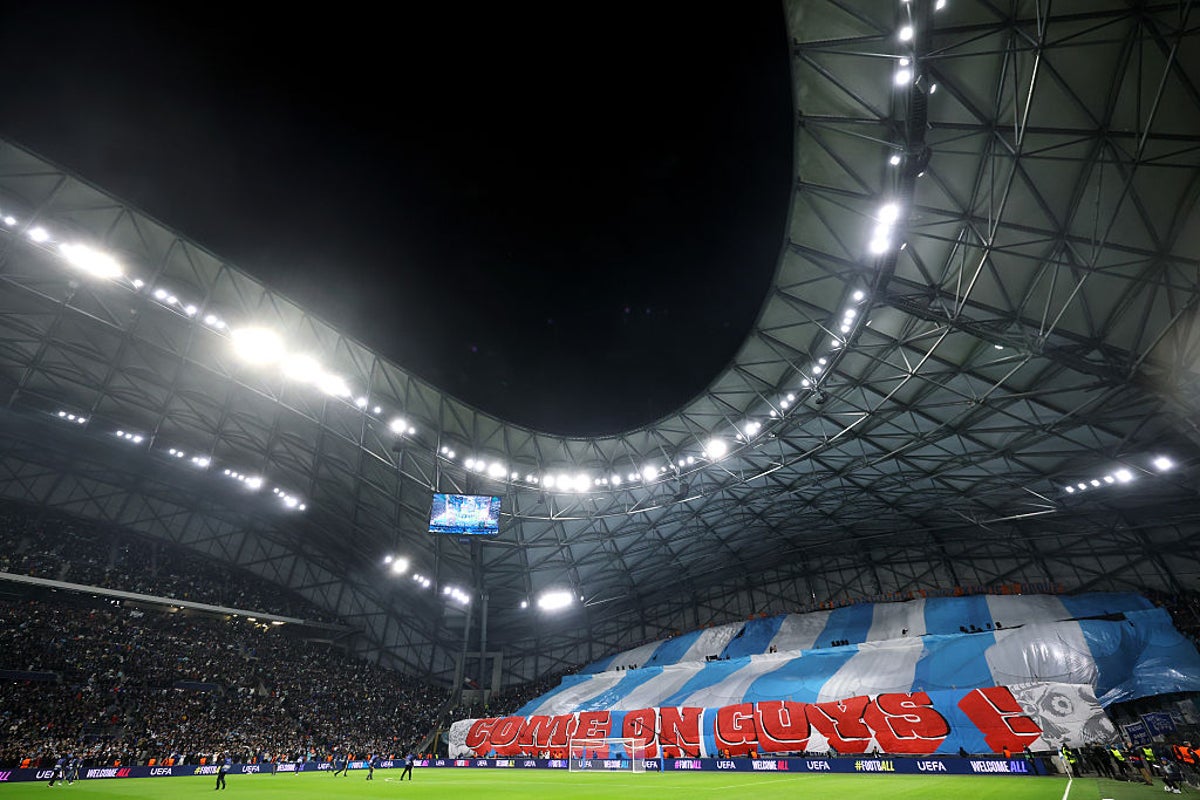
Recently, Newcastle United fans faced distressing circumstances during their trip. The club plans to formally lodge a complaint with Uefa regarding the treatment received by its supporters after the team’s loss in a Champions League match against Marseille, wherein fans alleged they were subjected to baton attacks and pepper spray by French police while attempting to return to their hotels.
Advertisement
The supporters, organized in groups of 500, were reportedly waiting patiently and without incident inside the Stade Velodrome, held for about an hour for safety protocols post-match. However, after the first group was permitted to leave, police began to “indiscriminately assault” the fans remaining, causing a dangerous situation with visible distress leading to potential crowd crushing in the upper concourse of the away section – a scenario that, as historical evidence shows, can result in fatalities.
Newcastle players applaud their fans at full-time (Reuters)
“We will be urging Uefa, Olympique de Marseille, and local authorities to conduct a thorough investigation into this incident to ensure that lessons are learned and such behavior does not occur again,” stated a Newcastle spokesperson. This appeal has been made in the past, yet the long-standing issue remains unresolved.
The perception of “disorderly” English fans being managed with an iron fist emerged strongly after the Heysel disaster. On the day of the 1985 European Cup final between Liverpool and Juventus, 39 people died and hundreds were injured in a crush caused by a collapsing wall. Despite evident failures in crowd control and stadium safety contributing to the calamity, Liverpool fans were largely scapegoated, seen as responsible for the chaos when they breached a barricade separating them from a neutral area occupied predominantly by Juventus fans.
Advertisement
Subsequently, 14 individuals were convicted of manslaughter and imprisoned, which led to a five-year ban on English clubs from European competitions and reinforced the belief that English hooliganism was an ongoing issue in Europe.
The Heysel disaster fueled the perception that English fans were bringing hooliganism to European matches (AFP via Getty)
This enduring reputation has become a reflexive justification for European authorities, particularly the French police, to impose excessive force on fans, overlooking the systemic failures of authorities that contribute to fan dangers and impede progress.
On the 40th anniversary of Heysel earlier this year, The Independent interviewed Professor Clifford Stott of Keele University, an expert in crowd behavior and policing, and co-author of an independent report about the chaotic events at the 2022 Champions League final in Paris. On discussing the recurring narrative blaming hooliganism for such incidents, he stated: “This narrative is not helpful in understanding the actual issues at hand. The real focus should be on crowd management, dynamics, and psychology.”
Advertisement
Liverpool fans also faced challenges during the 2022 Champions League final when local authorities funneled supporters into an inadequate bottleneck near the Stade de France. This caused crowd congestion, leading to the deployment of tear gas. Initially blamed for the situation, the Liverpool fans were later vindicated by an independent report which also placed responsibility on the police for the chaos.
Liverpool fans were famously embroiled in pre-match troubles with Paris police ahead of the 2022 Champions League final (Getty)
Liverpool fans cover their faces after police deployed teargas outside the Stade de France (Getty)
Manchester United supporters also faced similar circumstances in Lyon last season after their Europa League quarter-final, with local authorities justifying the heavy-handed approach by claiming it was necessary to restore order.
Advertisement
These instances of excessive policing violate the Saint-Denis Convention—legislation ratified by the Council of Europe in 2016, designed to establish a framework for managing major sporting events. While it aimed to foster a safe environment for fans and prevent future disasters, its essence, which promotes international police cooperation for events across borders, has proven idealistic and challenging to realize.
“The ideal framework outlined in the 2016 agreements remains unrealized,” Stott continues, emphasizing that the repeated incidents involving French authorities are not coincidental. “A clear pattern emerges where the Saint-Denis Convention is not being followed by certain countries, including France.”
The Saint-Denis Convention set the framework for how major sporting events should be managed – but it is incredibly difficult to implement at scale (Getty)
As long as English fans face dangers when traveling across the Channel, the football community must work to implement the lessons learned from past experiences—lessons that are well documented in laws and regulations. Stott suggests that significant advancements could be made if Uefa took a more active role in overseeing matchday policing across its events. “Uefa’s failure to ensure effective delivery of safety and security measures at these events is central to the issue,” he states. “Our key recommendation is for Uefa to assume greater responsibility because the current practices expose fans to potentially life-threatening situations.”
Advertisement
As evidenced in Marseille, progress remains stagnant, with recurring issues threatening the safety of traveling supporters. Without proper action, disaster continues to lurk around the corner at every match.