



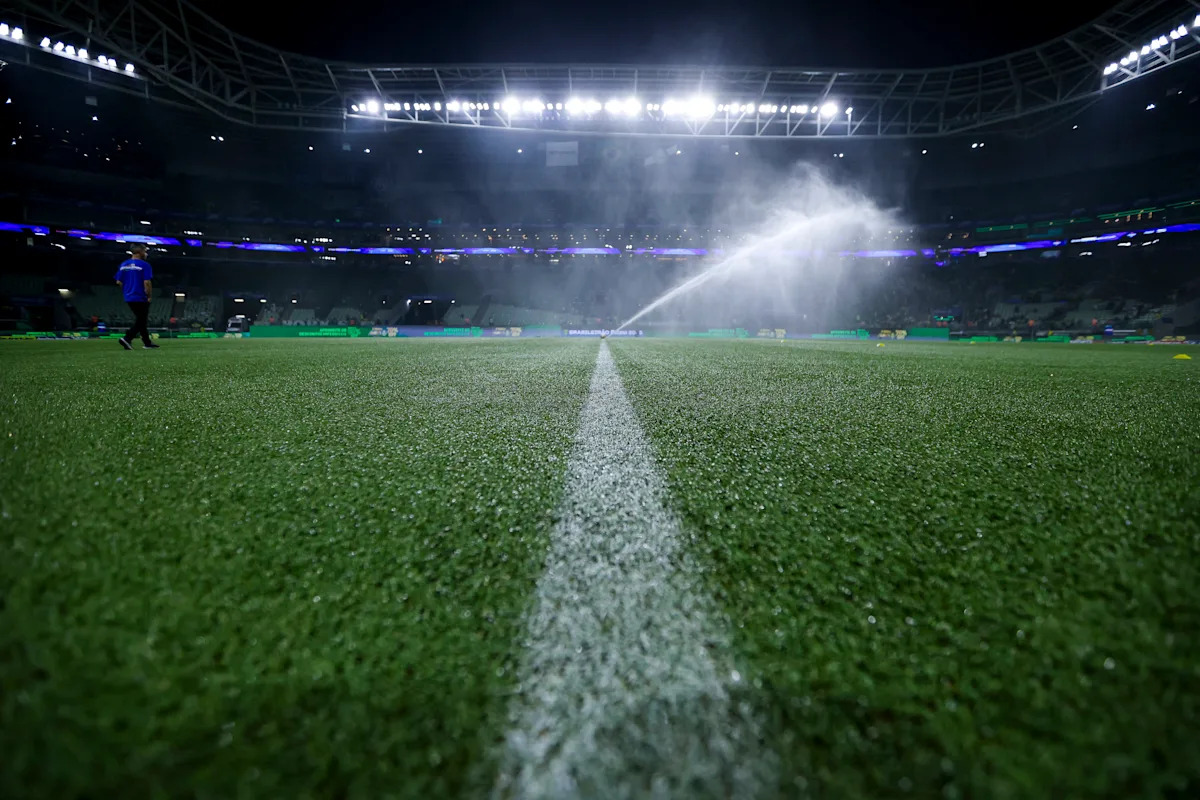
On the evening of this Monday (8), Flamengo announced on its official website that it has submitted a “technical contribution” to the Brazilian Football Confederation (CBF) aimed at forming a working group dedicated to enhancing and standardizing football pitches across the country.
The Carioca club’s statement emphasizes that this initiative is part of their commitment to promoting “WORLD-CLASS FOOTBALL.”
Advertisement
Through the “Program for the Evaluation and Monitoring of the Quality of Brazilian Football Pitches,” Flamengo proposes various suggestions designed to “enhance pitch quality, improve gameplay, and elevate Brazilian football to the highest levels of global competition.”
Additionally, these suggestions form part of Flamengo’s formal response to the CBF’s request for input to adjust the General Competition Regulations (RGC) and the Specific Competition Regulations (REC) for the upcoming 2026 Brasileirão.
As stated, Flamengo is now waiting for the formal establishment of the working group to explore these initiatives further, facilitating discussions and decisions before the next season kicks off.
Below are Flamengo’s proposals:
-
Flamengo contends that artificial pitches do not provide the necessary conditions for high-performance football. Such surfaces are banned in the major European leagues and are not used in the principal South American leagues (Argentina, Uruguay, and Colombia). No country that has ever achieved World Cup glory permits artificial pitches—Brazil is the exception. A survey conducted by the club found that no matches in these leagues during the 2025 season were played on synthetic turf.
-
This concern about artificial pitches is not limited to Flamengo. Players, the sport’s key figures, have publicly voiced their opposition to these surfaces in high-level competitions, with some even refusing to play on them. This situation poses a risk that elite athletes, both Brazilian and international, may choose not to engage with Brazilian football due to poor pitch conditions.
-
Moreover, several studies referenced in Flamengo’s submission indicate that artificial surfaces pose health risks, leading to an increased incidence of injuries and other issues related to contact with plastic.
-
Recognizing that proponents of synthetic pitches cite cost savings and the ability to host events as justifications, and to mitigate immediate impacts on clubs currently using these surfaces, Flamengo suggests a transition period. They propose that artificial pitches in Série A be phased out by the end of 2027 and in Série B by the end of 2028, allowing adequate adjustment time without sacrificing sporting quality.
-
Even during this transition, improvements to the quality of synthetic pitches are essential. Flamengo advocates for implementing a minimum quality standard for these surfaces that includes criteria such as fiber type and material, grass height, stitch density, cushioning layer, infill type, and color.
-
Flamengo argues that it is insufficient to merely ban artificial pitches; there must also be a minimum quality standard for natural pitches, adhering to rigorous standards set by FIFA and UEFA, tailored to the unique context of Brazilian football.
-
The club presented a detailed document to the working group that outlines minimum technical standards for assessing pitch quality, irrespective of type. This includes testing for ball roll, impact absorption, and surface rigidity. Currently, there’s no evaluation protocol for stadiums with either natural or artificial pitches for CBF-organized matches, making regulation crucial to ensure that Brazilian football meets international standards.
-
Flamengo also proposes establishing minimum infrastructure standards applicable to both natural and synthetic pitches, covering irrigation and drainage systems, proper maintenance equipment, specifications for the structural base, types of grass or fiber, pest and disease management, and leveling. The aim is to guarantee that from 2026 onwards, every playing field will offer a consistent experience in ball-surface and player-surface interactions.
This article has been translated into English by Artificial Intelligence. You can read the original version in 🇧🇷 here.
📸 Ricardo Moreira – 2025 Getty Images