



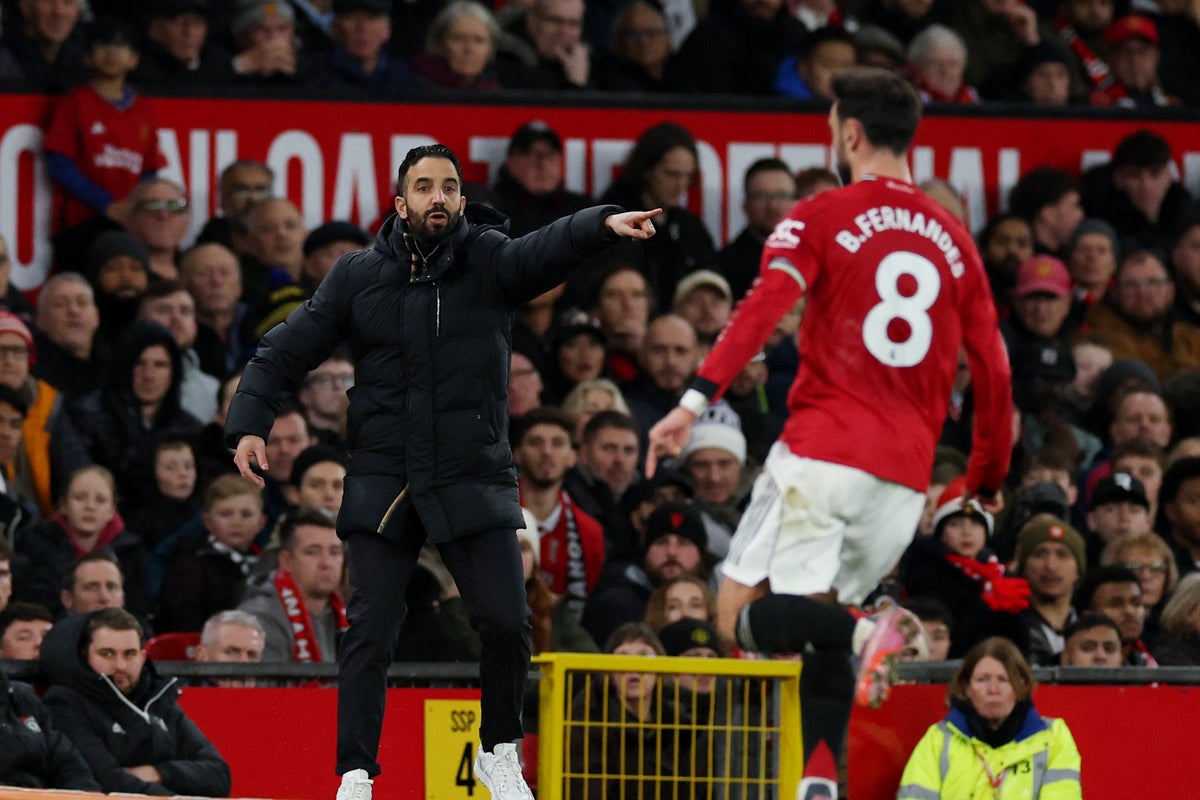
Ruben Amorim made a notable shift from his familiar 3-4-3 formation for the first time as Manchester United manager, trying out a revamped system during the Premier League match against Bournemouth.
While the chaotic 4-4 draw against Andoni Iraola’s team may not seem to reflect a significant improvement, Amorim’s squad displayed enhanced sharpness in attack and consistently threatened their opponents throughout the match.
Prior to the game, Amorim emphasized the need for United to “adapt” as Bryan Mbeumo, Amad Diallo, and Noussair Mazraoui prepare for the Africa Cup of Nations, highlighting that his team must “learn from past mistakes.” Critics had previously pointed out that Amorim seemed overly reliant on his 3-4-3 system since taking over from Erik ten Hag last November—an approach that had previously yielded success at Sporting Lisbon but had not proven effective at Old Trafford.
In September, Amorim humorously remarked that not even the Pope could convince him to change his formation, stating, “This is my job. This is my responsibility. This is my life. Therefore, I will not change that.”
What was different against Bournemouth?
Initially, it appeared that not much had changed. The starting lineup suggested a back three comprising Leny Yoro, Ayden Heaven, and Luke Shaw, with Amad Diallo and Diogo Dalot continuing in their roles as wing-backs.
However, once the match began, United’s play looked more dynamic. Yoro took on a more traditional right-back role, while Shaw moved into the center alongside Heaven, and Dalot positioned himself on the left.
Amad was pushed higher up the field to join Mason Mount, Matheus Cunha, and Bruno Fernandes in support of Bryan Mbeumo, while Casemiro assumed the role of sitting midfielder, allowing Fernandes to advance.
This formation resembled a 4-1-3-2 setup, with Mbeumo and Cunha as the forwards, Amad on the right, Mount on the left, and Fernandes playing as the No 10. It shifted to a more traditional 4-4-2 when Bournemouth had possession.
- Manchester United XI: Lammens; Yoro, Heaven, Shaw, Dalot; Casemiro, Fernandes; Amad, Mount; Mbeumo, Cunha

Manchester United’s Amad Diallo celebrates the opening goal against Bournemouth (Martin Rickett/PA Wire)
How did it look?
The first half was impressive, while the second half fell short of that standard.
Manchester United recorded an impressive 17 shots in the first half—the highest for any team in the Premier League this season—amassing an xG of 2.62.
United went into halftime leading 2-1, but the second half escalated into a chaotic affair, culminating in a 4-4 draw.
Nevertheless, there was a marked increase in the danger and threat posed by United’s attacking play. Despite Bournemouth enjoying periods of control, Amorim’s side appeared more balanced overall.
The hosts maintained sustained attacking pressure and displayed a dynamic attack, with Amad, Mbeumo, Cunha, Fernandes, and Mount showcasing excellent interplay.

Ruben Amorim seemingly finally switched away from his beloved 3-4-3 formation (Getty Images)
“I think it’s the best I’ve seen Manchester United, certainly in the first half, under Amorim,” stated former Liverpool defender Jamie Carragher on Sky Sports, potentially drawing comparisons to their opening match of the season against Arsenal.
“United were fantastic in those first 25 to 30 minutes. It felt reminiscent of the Sir Alex Ferguson era—fast, attacking football, with energetic players making forward runs, staying positive, and regaining possession quickly.”
Amad opened the scoring after finding space at the end of Dalot’s cross following a missed connection by Cunha. The second goal came from a set-piece with Casemiro heading in, and United certainly earned their lead.
The second half saw disarray as Bournemouth capitalized on United’s defensive frailties. Amorim’s squad has only kept one clean sheet this season and was missing key center-backs Matthijs de Ligt and Harry Maguire.
What did Amorim say after full-time?
“A lot of good things, but also many aspects to improve. We often miss opportunities to win games due to minor details, whether we are playing with a back four, three, or five,” Amorim explained.
“It’s crucial to focus on the details and understand the game’s momentum. We need to be more clinical because today, against a strong opponent, we created numerous chances to secure the victory.”
“Today’s performance was noticeably different from our last two home games, and we must acknowledge that. While the result remains the same, the performance improved.”
“At this point, it’s frustrating, but we must find solutions with the players available to us. After last season, I believe we are ready to handle whatever comes our way. Let’s move forward. We expected injuries; all teams in England experience them. We will seek to score goals through new methods.”