



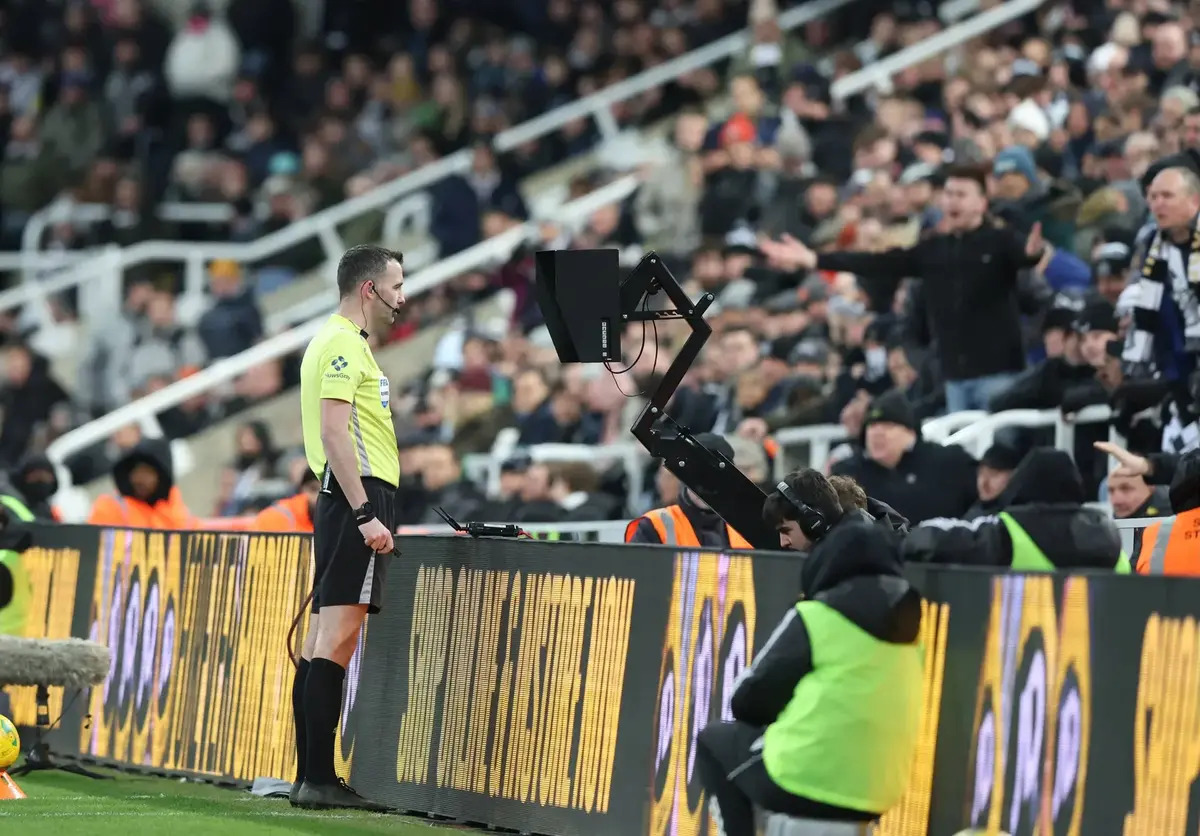
The VAR review that led to Antoine Semenyo’s disallowed goal has faced significant scrutiny following Tuesday night’s match.
The lengthy pause at St James’ Park quickly became a major talking point during City’s Carabao Cup semi-final first-leg win, leaving players, staff, and fans awaiting clarification.
Advertisement
This match, already charged with intensity, was disrupted by the stoppage, heightening frustrations regarding lengthy VAR checks in critical moments. From City’s standpoint, the incident felt particularly impactful, as they were dominating the match.
A second goal from Semenyo at that juncture would have given City a commanding advantage, putting them one step closer to the final. Instead, the prolonged delay introduced uncertainty, temporarily offering Newcastle a psychological boost.
Pep Guardiola has emphasized the need for clarity, speed, and consistency in officiating, and the drawn-out process in Tyneside amplified broader concerns regarding the use of technology in officiating.
According to the Press Association news agency, the delay that led to the disallowance of City’s second Semenyo goal occurred because semi-automated offside technology was not applied in this instance.
It is reported that the VAR check would have been much quicker had semi-automated offside technology been available. However, due to the crowded penalty area during the incident, its use was not permitted.
Consequently, VAR officials resorted to drawing crosshairs amidst the many players in the box, as the Premier League’s website classifies such situations, where SAOT cannot be implemented, as “edge cases.”
The goal originated from a corner, with Semenyo deftly flicking the ball into the net after Tijjani Reijnders’ delivery. However, celebrations were quickly muted when referee Chris Kavanagh was sent to review the situation at the pitchside monitor, ultimately ruling the goal offside due to Erling Haaland’s involvement in the build-up.
The interval from the ball crossing the line to the final ruling exceeded five minutes, leaving Manchester City’s players visibly confused and the fans unsure about the ongoing checks, further emphasizing that even with sophisticated technology, some scenarios still depend heavily on human judgment.
Advertisement
Ultimately, the decision did not seem to hinder City’s dominance in the semi-final, especially after Semenyo had already opened the scoring, continuing his impressive start since his £65 million transfer from Bournemouth, complemented by Rayan Cherki’s late goal that provided a crucial second strike.
Looking forward, Manchester City will hope that the controversy does not overshadow what was otherwise an impressive away performance, as they set their sights on the Carabao Cup final, even with an entire 90 minutes still to be played in early February.