



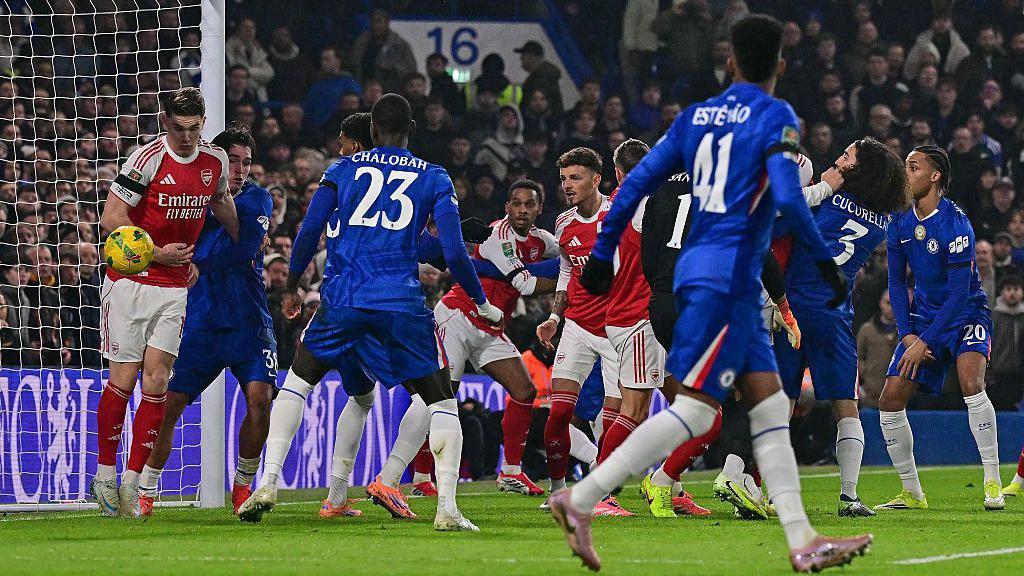
It’s almost unbelievable. Just 24 hours after Manchester City had a goal controversially disallowed by VAR, Arsenal’s goal was allowed to stand.
Two EFL Cup semi-finals featured nearly identical offside scenarios, yet produced distinctly different results.
Advertisement
Fans are understandably demanding consistency, which has sparked many questions.
How can the VAR system disallow a goal in one instance while permitting it in another?
During Manchester City’s 2-0 victory against Newcastle United, Antoine Semenyo believed he had scored a second goal. Initially, it seemed no one had noted any issues.
However, VAR official Stuart Attwell informed referee Chris Kavanagh that an offside Erling Haaland was affecting Malick Thiaw’s ability to defend as the ball passed by on its way to the net.
Fast forward to the next day, when Ben White’s header helped Arsenal secure a 3-2 victory against Chelsea. In this instance, the ball eluded an offside Viktor Gyokeres, who was tussling with Chelsea’s Marc Guiu. Yet, VAR did not intervene.
Advertisement
While ruling out Haaland’s offside was technically correct according to the laws, it feels like an overreach by VAR. This is not the level of interference we typically observe in Premier League matches, and it was expected that Carabao Cup officiating would align with that standard.
The situations surrounding both goals were similar, yet had key differences. Haaland was directly influencing the play and could be deemed to be obstructing Thiaw’s access to the ball.
In contrast, Guiu was facing away from the action when White scored and appeared not to be in a position to interfere with the goal.

PGMOL believes the VAR was overly meticulous in disallowing Antoine Semenyo’s goal due to Haaland’s offside position [Getty Images]
Consistency Should Not Be Defined by Erroneous Decisions
A few years ago, VAR failed to award a penalty against Manchester United’s goalkeeper Andre Onana after a collision with Wolves striker Sasa Kalajdzic.
Later in the same season, when Onana fouled in a similar circumstance, VAR did not remain passive and a penalty was awarded for consistency’s sake, even though it was compared against a previous error.
The standard for consistency should not be predicated on a poor decision or a faulty VAR judgement. Referees were informed of the expectations, leading to adjusted decision-making practices.
This principle applies to the recent offside calls in the Carabao Cup. However, when such stark discrepancies arise just a day apart, it understandably raises doubts.
VAR frustrates fans predominantly with unexpected decisions and lengthy delays.
Advertisement
The ruling on Haaland’s offside frustrated fans for both reasons. The Professional Game Match Officials Limited (PGMOL) took notice.
Since Howard Webb became the head of referees three years ago, he has continually stressed that officials should avoid excessive scrutiny. A VAR must possess confidence in their evaluations to function effectively.
Delays can sow frustration and uncertainty among supporters. Prompt and efficient reviews are generally perceived with greater trust.
Average VAR review times have dropped significantly to around 50 seconds, but incidents like at St James’ Park, which left fans in the lurch, will garner warranted scrutiny.
Envision if VAR had concluded within 90 seconds that Semenyo’s goal was disallowed. There would still be controversy, but perhaps less uproar.
At Stamford Bridge, VAR Jarred Gillett performed a much quicker check, likely aware of the preceding night’s events.
The Haaland ruling stands out, especially given that the Premier League experiences the lowest VAR intervention rates in European football. VARs tend to remain uninvolved in more subjective calls.
The Premier League’s Key Match Incidents Panel reports only two incorrect interventions out of 47 this season, the fewest at this stage yet.
Advertisement
Incidents like the Haaland scenario further undermine VAR’s credibility.