



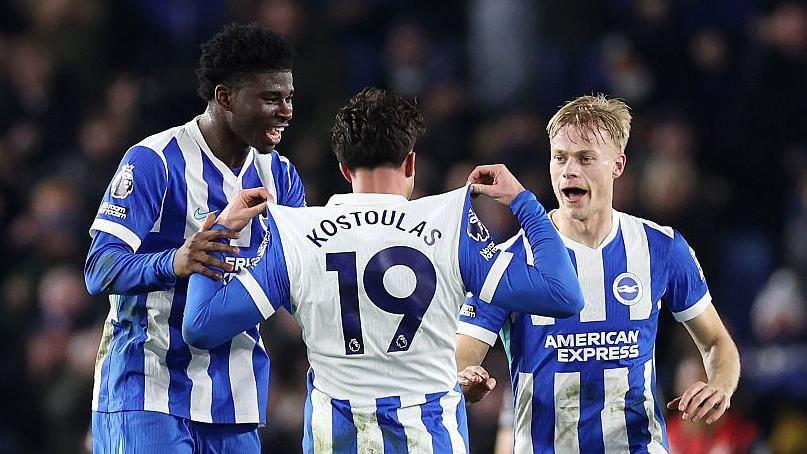
Charalampos Kostoulas will always remember this pivotal moment.
The 18-year-old Greek forward for Brighton executed an acrobatic overhead kick to equalize in stoppage time—a spectacular way to mark his first goal at the Amex Stadium.
Advertisement
The substitute, who joined from Olympiakos for £29.78m during the summer transfer window, scored just when it seemed the Seagulls were destined for defeat, having fallen behind to a controversial penalty awarded to Bournemouth in the first half.
Brighton manager Fabian Hurzeler expressed his admiration for his young star but remained frustrated about the penalty that allowed Marcus Tavernier to equalize, with goalkeeper Bart Verbruggen deemed to have fouled Amine Adli after a VAR review.
Hurzeler stated, “It was a beautiful goal. We all know his potential. But we all prefer a victory.”
When asked about the penalty decision, he replied: “No, I don’t think it was a penalty. Talking to referees is challenging. They have their views, and conversing with them is tough. We must accept their decisions, even if we disagree.”
“A slight touch and contact shouldn’t be enough for a foul, as the referees told us at the beginning of the season. Yet, in some instances, they don’t apply this consistently, which is simply the reality.”
“Contact does not equal a foul, and in this case, there was some contact, but it wasn’t a foul. It doesn’t make sense.”
Kostoulas, who debuted professionally in 2024 after progressing through Olympiakos’ academy, had a solid season last year, scoring seven goals in 22 league appearances.
If his transfer fee includes an additional £1.7m, it would set a record for a Greek player’s transfer.
Advertisement
Since arriving at Brighton, he has made 17 appearances and netted two goals, with team captain Lewis Dunk referring to him as a “special talent.”
Dunk commented, “I’ve seen him score better in training, but that was incredible. You’ve witnessed glimpses of his talent, and there’s much more to come. He’s adjusting to a new country and league, and he’s displayed what he can achieve. This goal exemplifies just that.”

Controversy arose as Amine Adli was ruled to have been fouled by Bart Verbruggen [Getty Images]
Why was the penalty given?
The incident occurred about half an hour into the game when Bournemouth’s Adli was initially cautioned for diving by referee Paul Tierney after he fell under Verbruggen’s challenge.
Advertisement
However, after a recommendation from VAR official Jarred Gillett, Tierney reviewed the incident on the pitchside monitor, reversed his call, and awarded a penalty, stating that contact had indeed occurred.
Tavernier confidently converted the penalty, giving the visitors an early advantage, which seemed to secure them the win until Kostoulas’s late equalizer.
Replays indicated that only a mere flick of contact occurred from Verbruggen’s elevated foot, yet the ball was rolling away harmlessly, leading to outrage among Brighton’s players, staff, and supporters.
Following a weekend filled with controversial refereeing decisions—Arsenal’s dissatisfaction over a missed penalty and Manchester City’s vexation regarding Diogo Dalot’s non-red card—it was yet another contentious point of discussion on Monday night.
Advertisement
Bournemouth manager Andoni Iraola, however, backed the penalty decision.
He commented, “After reviewing the replay, I noticed Verbruggen raised his leg significantly and made contact with Amine. So, I anticipated the decision.”
Former Arsenal striker Thierry Henry concurred on Sky Sports: “It’s a penalty. If you’re lifting your leg while hitting the player, the ball is still active. Regardless of whether he can reach it or not, it’s still in play.
“In modern football, we analyze situations in slow motion. It was given. Rather than debating whether it was a penalty or not, we should acknowledge that it was preventable based on the visible contact.”
Advertisement
Ex-Liverpool defender Jamie Carragher added, “Penalties like this wouldn’t have been rewarded a decade ago. The ball was still in play, and there is visible contact, but Adli wouldn’t have reached the ball.”
Instances of errors by video assistant referees had risen during the first half of the Premier League season.
Research compiled by BBC Sport from the Premier League’s Key Match Incidents (KMI) Panel indicates a 30% rise in errors, from 10 to 13, compared to the previous season.
While this was an improvement compared to earlier years—20 errors at the same point in the 2023-24 season and 23 during the 2022-23 season—it still highlights ongoing concerns regarding officiating.
Advertisement
‘Clear and obvious?’ – analysis
This raises the question of “clear and obvious” that Brighton will likely ponder after the VAR penalty awarded to Bournemouth.
If referee Tierney had identified the contact by Verbruggen on Adli and simply declared ‘no penalty,’ it’s doubtful a pitchside review would have occurred, as his interpretation would have been reasonable.
The VAR’s intervention stemmed from the belief that Tierney misjudged the situation. Initially, he penalized Adli for diving, which was inaccurate, hence allowing for a review.
Nevertheless, the VAR still needed to determine whether the contact met the threshold for a penalty. One could argue that the contact was minimal and insufficient to warrant a fall from Adli.
Advertisement
An important consideration was the irregular manner of Verbruggen’s challenge, with his high boot hitting Adli after he maneuvered past him.
It’s irrelevant that Adli may not have been able to retain possession, as the foul occurred while the ball was still in play.
‘Football is becoming a sport for divers’ – what fans are saying
Sam, Brighton: “That was a terrible decision to overturn—barely touched him, and he was already going down. It’s embarrassing from the referee and VAR.”
Simeon, Woking: “Another week, another VAR blunder—it’s time to eliminate it!”
Russ, Upton: “Football isn’t even worth watching anymore. Why did the referee change his mind on that penalty? The striker a) isn’t taking a shot, b) isn’t reaching the ball after pushing it away, and c) wasn’t sufficiently fouled to go down! It seems that having more referees only exacerbates the issues.”
Advertisement
Phil, Toronto: “The term ‘clear and obvious’ is problematic. It appears any slight infringement is now considered ‘clear and obvious.’ Technology can aid in decisions like determining whether the ball crosses the line, but for tackles and handballs, the referee is in the best position to make that call. Waiting around for players isn’t ‘clear and obvious.’”
Tom, Innsbruck: “Stop with this ‘there was contact’ excuse. Is the player falling because he’s genuinely fouled, or does he throw himself down the moment he’s touched? Football is becoming a sport for divers.”