



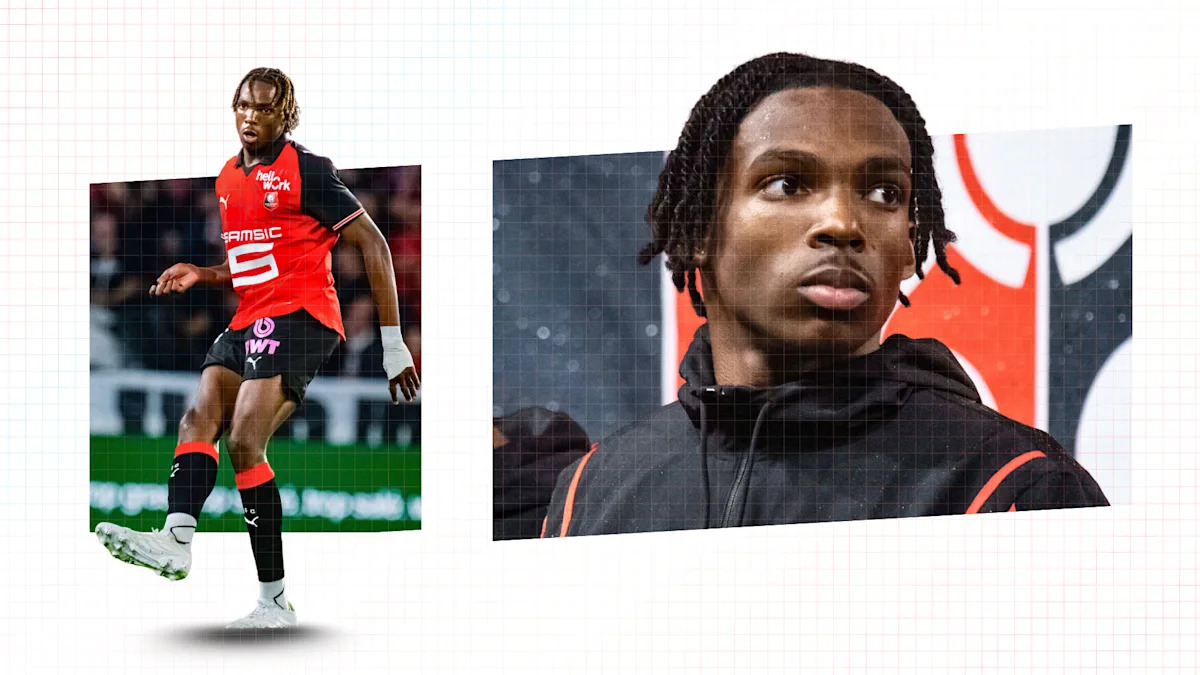
Liverpool have made an outstanding acquisition in Jeremy Jacquet, a player with immense potential.
In the world of football, a single year can feel like a lifetime. Just one year ago, Jeremy Jacquet had recently returned from a loan spell at Clermont in Ligue 2 that ended prematurely.
His impressive performances during that loan and Rennes’ urgent need for reinforcements led to the 19-year-old being recalled for the latter half of the season.
Upon his return, he joined a struggling team that had lost eight out of their last eleven matches, managing just three clean sheets and conceding 18 goals during that span.
In his first start back, Jacquet not only helped secure a clean sheet but also guided the team to a victory against Saint Etienne. He won seven out of ten defensive duels and excelled in three aerial challenges during the match.
Rennes went on to win six out of the next thirteen matches, with Jacquet starting ten of those games, ultimately evading relegation.
Advertisement
From the outset, it was clear that Jacquet was a unique talent. He stands out as more than just your average teenage centre-back.
Despite grappling with a few injuries early in his career, Jacquet exhibited remarkable mental resilience, consistently bouncing back and pushing through to break into the senior team.
His character, consistently praised throughout his youth career, was evident as he captained France at U16, U18, U19, and U20 levels.
While he has yet to wear the captain’s armband for Rennes, his maturity is evident in the way he commands and organizes the defense, often positioning himself as the central figure in a back three—a role typically requiring greater maturity than that expected from young defenders. Usually, younger centre-backs occupy right or left positions based on their dominant foot, while playing centrally demands additional poise, which Jacquet has demonstrated throughout the season.
Advertisement
This maturity is surely a key reason why Liverpool took notice. It speaks volumes of both his abilities and character.
Physically, Jacquet is distinctive. Standing as an ectomorph with long limbs, he benefits significantly from his height as a defender. His long legs facilitate key interceptions, timely tackles, and decisive blocks.
Of course, this body type comes with challenges. In one-on-one scenarios, he still requires development, as his leg speed sometimes lags, allowing quicker, smaller players to maneuver around him.
While he covers ground efficiently, largely due to Rennes’ disorganized defense, Jacquet consistently makes recoveries along both flanks.
Overall, he adeptly defends channels, and his physical attributes lay a strong foundation for becoming an elite centre-back.

© IMAGO – Jeremy Jacquet Liverpool
When evaluating any player, especially centre-backs, it’s crucial to consider not just physical attributes but cognitive abilities as well.
Advertisement
Jacquet’s game awareness is commendably high, which partially explains why he has earned a spot as the central defender in a back three.
This can be measured statistically through his interceptions. Renowned for his elite game reading, Virgil van Dijk consistently ranks among the Premier League’s best center-backs in this metric. Currently, Jacquet holds the second spot for possession-adjusted interceptions (7.57 per 90 minutes) among Ligue 1 centre-backs.
Observing him play is the best way to assess his cognitive capabilities.
Advertisement
Jacquet faces constant challenges at Rennes due to their chaotic defensive organization, resulting in frequent demands for defensive intervention.
In these difficult situations, he maintains his composure and consistently executes crucial tackles that thwart goal-scoring opportunities.

© IMAGO – Jeremy Jacquet Liverpool
Another testament to his cognitive prowess is his proficiency in aerial duels. Among centre-backs who have played at least 1200 minutes in Ligue 1 this season, Jacquet boasts the highest success rate in aerial duels at 69%.
He is especially formidable within his penalty area, consistently clearing crosses and overpowering attackers.
Advertisement
While his physical attributes contribute to his effectiveness, much of his success can be attributed to his cognitive skills. His keen positioning, timing, and judgment regarding the flight of the ball allow him to excel in these situations.
As a scout, you’re continually searching for centre-backs who excel in these scenarios and demonstrate a propensity to intercept balls instead of allowing them to bounce. Some players possess an innate ability to predict where the ball will land better than others.
This is evident in how a 6’2″ defender can outjump a 6’5″ attacker, or how Wataru Endo may outperform Ryan Gravenberch in aerial success despite their differing heights, with Endo measuring at 1.78 meters compared to Gravenberch’s 1.90 meters.
Jacquet possesses an intuitive awareness in these situations, enhancing his value as a defender.
Advertisement
At Liverpool, defending alone isn’t enough; players must also excel in ball progression and involvement in build-up play.
Fortunately, Jacquet is very comfortable on the ball. He handles pressure well, though he may struggle at times against attackers if forced to use his left foot, indicating a lack of comfort on the left side, especially when executing risky passes under duress.
Conversely, on his right foot, he displays impressive technical skills, adeptly carrying the ball and delivering passes into threatening areas.
Jacquet ranks fifth among Ligue 1 centre-backs for accuracy among those averaging at least seven progressive passes per 90 minutes (76%). This showcases not only his passing volume but also his ability to find teammates with incisive, line-breaking passes.
Advertisement
He tends to be a vertical player, occasionally opting for diagonal passes and attempting ambitious long switches. This boldness is a valuable asset, particularly against teams that employ low defensive blocks.
Although his ball-carrying skills aren’t yet at Joel Matip’s level, he does make forward runs and can comfortably carry the ball over longer distances, though he can sometimes find himself in precarious positions. This season, he won just 41.67% of his 0.61 dribbles per 90 minutes.
While Jacquet is still honing these aspects of his game, it is essential to recognize that he is often placed in demanding situations. At Rennes, he is regularly pushed beyond his limits, which can lead to moments where he must take risks, sometimes forcing him to carry the ball into hazardous areas due to a lack of options. As previously mentioned, his workload at Rennes is considerable. In a more structured setup, he might take fewer risks and showcase his talents even more effectively.
However, what stands out most about Jacquet is how he has consistently delivered impressive performances, even while operating within a disorganized team.