



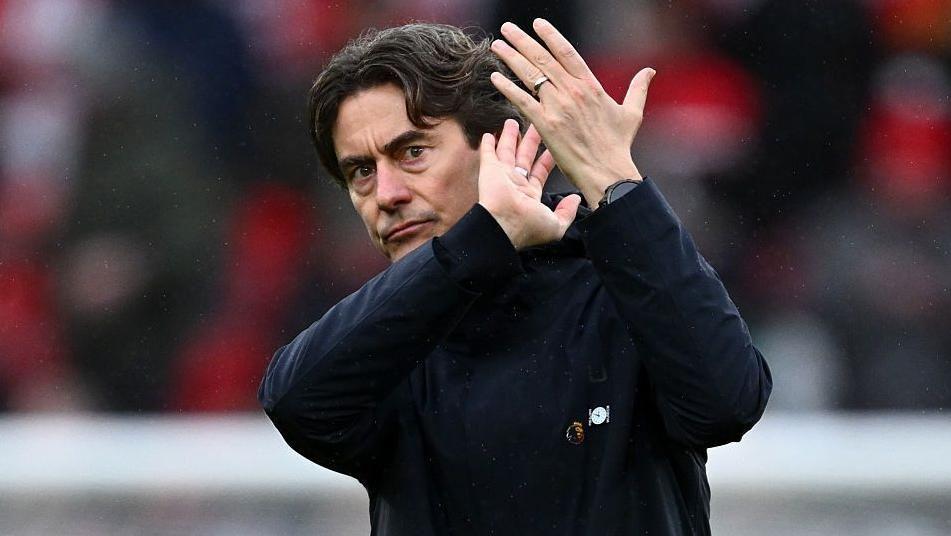
The decision to appoint Thomas Frank as Tottenham’s head coach proved to be a risk for both him and the club, resulting in a tumultuous and negative atmosphere.
In taking on the role, Frank abandoned the stability and structure that had characterized his standout achievements at Brentford, exchanging it for the turmoil at Spurs.
Advertisement
Frank transitioned from the solid foundations provided by Brentford’s owner Matthew Benham and director of football Phil Giles to a high-pressure scenario at Spurs, where even winning the Europa League—Tottenham’s first trophy in 17 years—was not enough to save his predecessor Ange Postecoglou from dismissal.
For Spurs, hiring a coach who had largely evaded the intense scrutiny and lofty expectations characteristic of big clubs was a bold move that ultimately backfired. Frank soon appeared overwhelmed by the demands of the role.
This period has been marked by a lack of joy and a pervasive atmosphere of hostility from the majority of Spurs fans, who swiftly decided that Frank was not the right fit for their club or the responsibilities required.
Frank’s exit will be a significant disappointment for the popular and personable Dane, who earned his chance with Spurs after leading Brentford to the Premier League and successfully maintaining their status there for four seasons.
Advertisement
So, where did everything go awry?
Lack of Identity at Spurs
Taking charge of a team that finished 17th in the Premier League last season, having suffered 22 losses, Frank inherited a squad that was far from formidable.
Despite a Europa League victory, the true indicator of a team’s caliber lies in their league standing, suggesting that Frank had a considerable challenge ahead. The idea that such an issue could be remedied or even meaningfully altered in just a few months is unrealistic.
Spurs were in need of both personnel changes and a cultural overhaul, a crucial element in understanding Frank’s downfall.
The club has long struggled to find a successor to Mauricio Pochettino, who was dismissed merely six months after Spurs’ defeat in the 2019 Champions League final.
Advertisement
Frank’s dismissal places him alongside notable managers such as Jose Mourinho and Antonio Conte, alongside Nuno Espirito Santo and Postecoglou, who earlier brought much-needed silverware to the club.
Ultimately, Frank struggled to meet the demand of a highly challenging task, which took a toll on him, leaving him a diminished and beleaguered figure.
Without a clear identity, Frank’s squad seemed mired in confusion, resulting in a cautious and defensive playing style. Noteworthy among the losses that defined Frank’s regime were defeats to Chelsea and Arsenal during the north London derby, which will likely be remembered for their lackluster performance.
Advertisement
Statistically, these matches featured the lowest attacking displays from any Premier League teams this season, with Spurs generating a mere 0.1 xG against Chelsea and just 0.07 xG in their 4-1 defeat at Arsenal.
It was Frank’s overly cautious strategy—demonstrated in a five-man defense meant to limit damage—that sparked significant backlash after the Arsenal game, allowing the Gunners to secure an easy victory.
The fact that Eberechi Eze—player Spurs wanted but lost to Arsenal added to the embarrassment.
While the defeat against Arsenal was particularly painful for fans, the loss to Chelsea, at home no less, raised even more concerns about the team’s direction.
Advertisement
Only a mixture of squandered chances from Chelsea and outstanding performances from goalkeeper Guglielmo Vicario spared Spurs from a more severe defeat.
What ensued was an arduous path towards the inevitable conclusion.
Previously known for his clarity in strategy and communication at Brentford, Frank lost these strengths as Spurs faltered following an initial victory streak comprising two Premier League wins.
Either Frank’s message lacked clarity or the players failed to embrace his tactics. Observers would struggle to identify a definitive style or strategy, as what appeared was a blended assortment with no clear hallmark.
Advertisement
Frank kicked off his tenure with wins against Burnley at home and Manchester City away. However, much like Postecoglou’s brief success, this promising start quickly faded.
While at Brentford, Frank’s game plan focused on playing quickly, long, and putting pressure on opponents both in open play and during set pieces, aided by forwards like Ivan Toney, Bryan Mbeumo, and Yoane Wissa.
At Spurs, Frank could not establish a discernible identity, leading to a swift backlash from fans who viewed his methods as either overly pragmatic or depressingly negative.
Fans, as well as some players, either struggled to comprehend or trust Frank’s approach, leaving him visibly shocked as the team’s performance deteriorated.
Advertisement
One of Frank’s early decisions was to appoint Cristian Romero as captain, replacing Son Heung-Min. This choice proved misguided, as Romero has often been a liability on the field and has made controversial off-field remarks. He received red cards against Liverpool and Manchester United and later made critical comments about the club’s leadership.
Ultimately, this decision undermined Frank’s position.
Injuries and Missed Signings Hampered Frank’s Plans
Alongside on-field struggles, Frank faced unfortunate circumstances related to player availability.
Advertisement
Injuries kept several key players sidelined, which severely impacted his plans. Additionally, the exit of the iconic Son proved detrimental.
One critical setback occurred when Spurs allowed the potential signing of Eze to drag, leading Arsenal to swoop in and complete a £60m deal.
Spurs also believed they had a €60m agreement for Nottingham Forest’s talented midfielder Morgan Gibbs-White, only to see the situation end with the player renewing his contract.
Had Eze and Gibbs-White been added to the squad, they might have proved invaluable to Frank’s efforts.

Dejan Kulusevski’s long-term knee injury deprived Frank of a key attacking option [Getty Images]
Dejan Kulusevski, a dynamic attacking player, missed every game under Frank due to knee surgery, while James Maddison, whose influence fluctuated under Postecoglou, suffered a torn ACL in a pre-season match against Newcastle.
Additionally, striker Dominic Solanke was out for extended periods due to an ankle operation, and key signings like Mohammed Kudus from West Ham and Richarlison also encountered lengthy injuries.
While Frank struggled to adapt, the absence of these players certainly hindered his options.
Frank Struggled to Connect with Fans
Former chairman Daniel Levy often bore the brunt of Spurs fans’ frustration. When he left in September, it was seen as a relief for many but left Frank more exposed, without the usual protective layer.
Advertisement
At Brentford, Frank was immensely popular, both for his on-field achievements and the strong rapport he built with supporters—often leading his players in a post-match walk to thank fans.
Ironically, one of the most toxic moments of his tenure arose during a dismal goalless draw on New Year’s Day, where he faced loud boos from visiting Spurs fans.
Establishing personal connections in a sprawling 61,000-seat stadium proved challenging, and these bonds typically rely on wins, which did not materialize, with only two victories in 11 home league matches.
Advertisement
Frank’s attempts to engage with fans were further complicated by his players’ reluctance to join him in post-match acknowledgments, notably after losses, illustrating a troubling disconnect.
Following a devastating defeat to Chelsea, the reaction of defenders Djed Spence and Micky van de Ven, who refused to participate in the customary post-match appreciation, created negative optics, leading to questions about Frank’s authority.
Even when Spence later expressed remorse, it highlighted an ongoing disconnect with his squad during a disappointing loss against Nottingham Forest, further emphasizing Frank’s struggles.
It has been a period marked by relentless disappointment, where most matches concluded in frustration—a disconnect aptly noted by the club.
Advertisement
While Frank had previously eschewed public criticism of fans at Brentford, which often backfires, he labeled the booing of goalkeeper Vicario as “unacceptable” after a defeat to Fulham, suggesting it did not reflect a true Spurs fan’s sentiment.
This approach, albeit directed at only some supporters, carried significant risk, and without the wins to patch that rift, it proved counterproductive.
Whereas Frank’s honesty and charm resonated at Brentford, the environment at Spurs was starkly different.
Crucially, patience—historically ample at Brentford—was in short supply at Spurs, especially with fans who did not quickly warm to Frank, doubting his suitability and methods.
Advertisement
Many supporters believed that Frank’s experience at a smaller club like Brentford did not adequately prepare him for the monumental challenge in north London.
To counteract this skepticism, Frank needed to make a strong start but ultimately fell short.