



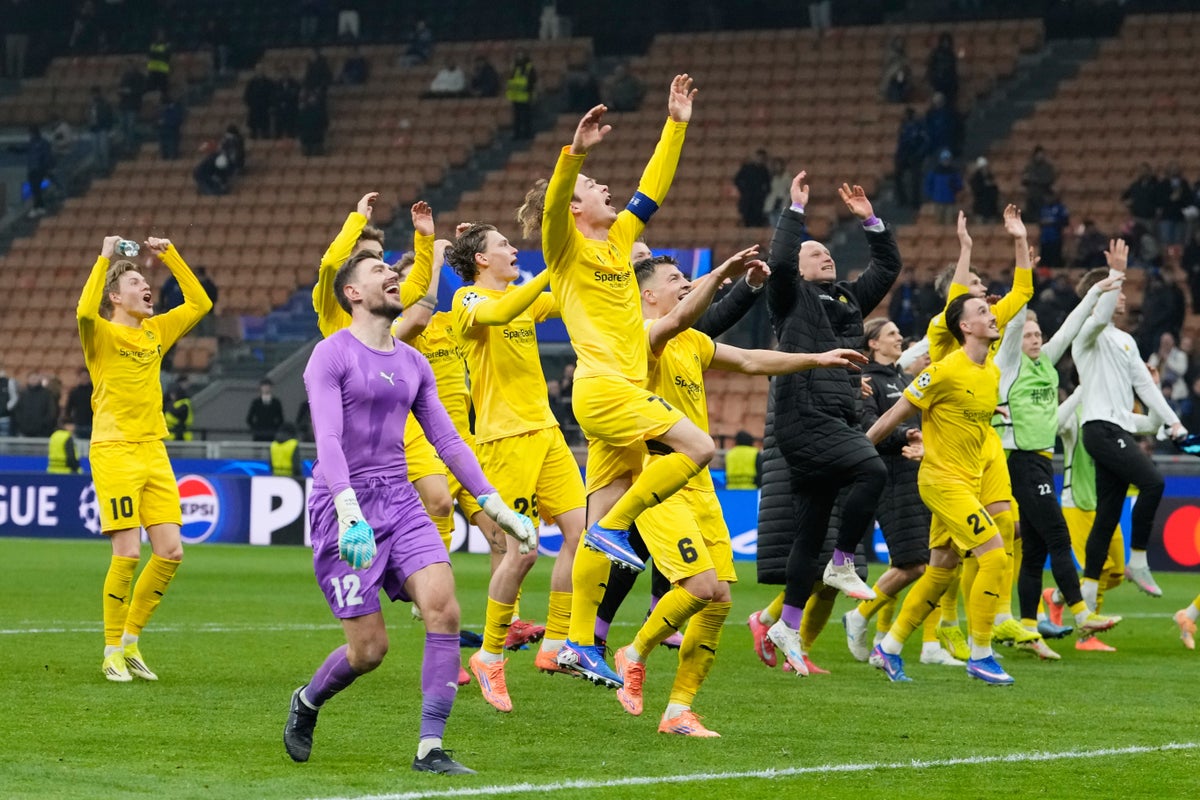
As the Champions League’s last 16 showcases renowned football giants such as Real Madrid, Liverpool, Barcelona, Bayern Munich, Paris Saint-Germain, and Manchester City, one name stands out for its unexpected presence: Bodø/Glimt.
Originating from a small fishing town in northern Norway with a population of just 55,000, this humble club is shattering expectations and demonstrating its place among Europe’s elite. Not only are they competing fiercely, but they have also secured an impressive four consecutive victories that have propelled them into the knockout stage of this prestigious tournament.
Among their notable wins is a remarkable 3-1 home victory against Manchester City, a crucial 2-1 away triumph over Atletico Madrid, and significant home and away victories against last season’s runner-up, Inter Milan, during the Norwegian league’s off-season. Their captivating run continues this Wednesday as they gear up to face Portuguese champions Sporting Lisbon in the first leg of the last 16.
Here’s what you need to know about the small club that is delivering a heartwarming narrative in this season’s Champions League campaign:
Bodø is situated above the Arctic Circle, more than 1,000 kilometers (620 miles) north of Oslo, Norway’s capital. Located along the western coastline near the Norwegian Sea, it is farther north than any previous venue in the history of soccer’s top club competition.
Map of Bodø:
The town, equipped with its own airport, experiences less than an hour of sunlight during its shortest days, leading players to take supplements in response to the lack of sun exposure.
While the winters can be harsh and icy, the locals have braved the current one. The forecast for kickoff against Sporting is a chilly 3 degrees Celsius (37 degrees Fahrenheit).

(Getty Images)
Away from football, Bodø garnered attention in 2024 after being named the European Capital of Culture.
An Artificial Pitch
Bodø/Glimt’s Aspmyra Stadium, which seats around 8,000 fans, is somewhat limited for hosting matches in a prestigious tournament like the Champions League.
A new stadium, the 10,000-seat Arctic Arena, is underway on the outskirts of town, but it offers only a slight increase in capacity.
A unique aspect of Aspmyra is its artificial turf, which has been met with skepticism from some in the football community due to differences in how the ball responds compared to natural grass.

Bodø/Glimt plays on an artificial pitch at their modest Aspmyra Stadium (Stian Lysberg Solum/PA) (PA Archive)
UEFA permits the use of approved artificial pitches until the semifinals of its tournaments.
Advertisement
The Former Fighter Pilot Leading Bodø/Glimt’s Success
Bodø/Glimt, established in 1916, experienced over a century of waiting before claiming its first Norwegian championship, largely facilitated by the recruitment of a former fighter pilot.
After the team was relegated to Norway’s second division, highlighting its “elevator club” status, Bjørn Mannsverk was invited in early 2017 to join the coaching staff as a mental coach.
Mannsverk applied techniques from his time training his squadron before missions in Libya, fostering a culture within Bodø/Glimt where players openly discuss feelings, modify attitudes toward preparation and nutrition, and eliminate stigma surrounding mental training.
Advertisement
The players and coach Kjetil Knutsen embraced Mannsverk’s approach, which included a rotating captaincy and group discussions after conceding goals to strengthen team unity. This collaborative environment has fostered substantial growth within the team.
Bodø/Glimt clinched its first league title in 2020 and captured three more within five years, finishing as runners-up last season. Their successes translated onto the continental stage as they reached the Europa League semifinals last season, falling to Tottenham across two legs, before making their debut in the Champions League.
Unlike many clubs funded by wealthy investors, Bodø/Glimt operates on a modest budget with a squad composed mainly of lesser-known players from Norway and Denmark.
Only two players from Bodø/Glimt were called up for Norway’s most recent national team selection.
Advertisement
The star striker, 25-year-old Kasper Høgh, has yet to represent his national team, while another key attacker, Jens Petter Hauge, returned to Bodø/Glimt in 2024 after struggling to make an impact at AC Milan four years prior.

Manchester City’s players refund fans who travelled to Bodø/Glimt for their Champions League defeat (Fredrik Varfjell/NTB via AP) (AP)
Under the guidance of Knutsen, who took charge in 2018, Bodø/Glimt is more than just a determined underdog; they play an exhilarating, high-pressing, attacking style, having previously outplayed Manchester City at Aspmyra Stadium.
In 2017, the club operated with around 40 employees and had a modest budget of 4.2 million euros ($5 million).
Advertisement
Last year, the club’s income soared to 80 million euros ($93 million), thanks to earnings exceeding 26 million euros ($30 million) from the Europa League and additional revenues from the Champions League. In contrast, Real Madrid reported more than 1 billion euros in revenue for 2025, as per Deloitte.
The club is budgeting for 50 million euros ($58 million) in 2026, with that amount likely to rise depending on their performance in the Champions League.
Potential Future Opponents for Bodø/Glimt
If Bodø/Glimt continues to make history and progresses past Sporting, they could face either Premier League leaders Arsenal or the German champions, Bayer Leverkusen, in the quarterfinals.