



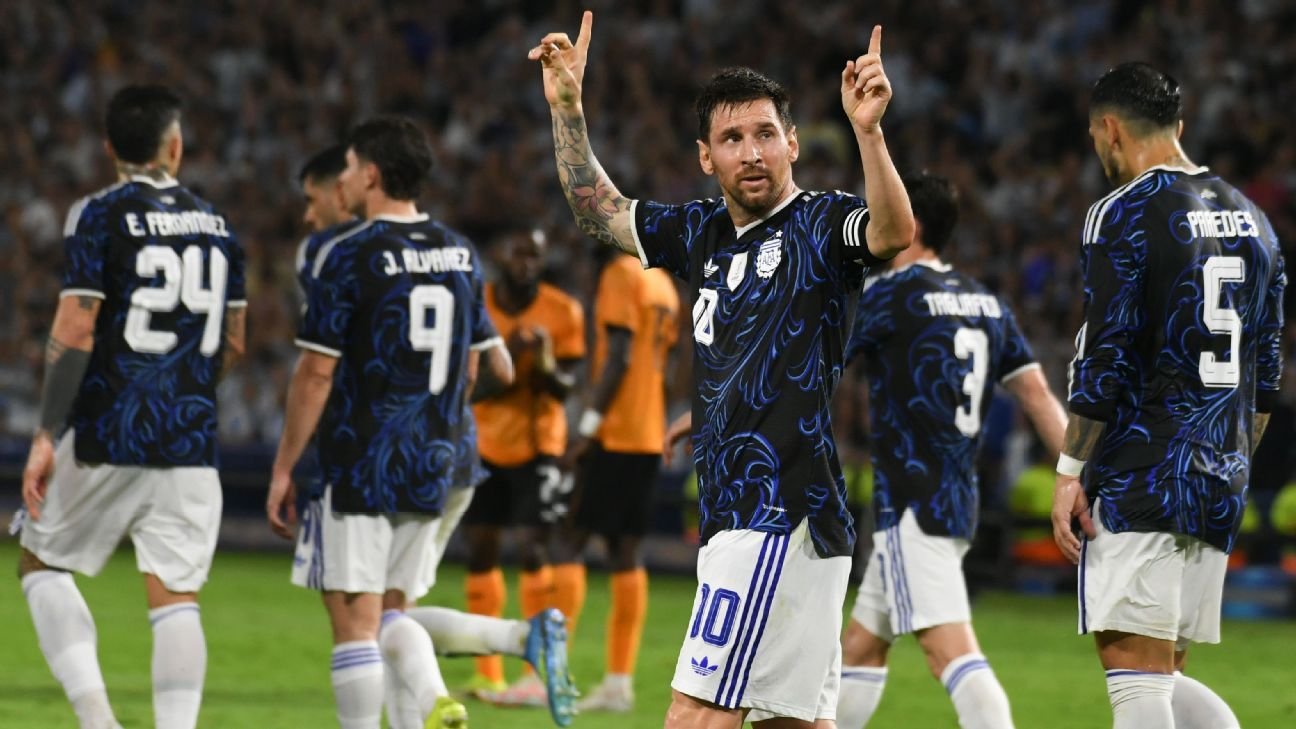
With the exception of the teams competing in the playoffs, European clubs finally had the chance to face opponents from other continents during the late March FIFA dates. This allowed all South American nations preparing for the World Cup to test their skills against European teams, albeit with one notable exception.
Argentina was set to compete against Spain in the Finalissima, featuring the champions of the Euros and the Copa América. However, due to ongoing conflicts in the Middle East, Qatar was deemed an unsuitable venue, and talks for an alternative fell through.
– Ranked: All 48 teams that can win the 2026 World Cup
– One key insight about each of the 48 World Cup teams
– Can Casemiro sustain Brazil’s two-man midfield?
This situation left Argentina in a bind for the final FIFA date before World Cup preparations ramped up. They decided to bring the squad back to Buenos Aires. This would allow players to spend time with their families, engage in training sessions, and participate in one or two matches to receive a warm send-off from fans. It would also serve as a tribute to Lionel Messi, likely in his final appearance with the national team on home soil.
The question then arose: Where would they play and who would be their opponent?
Argentina’s usual venue is River Plate‘s Monumental Stadium, which boasts the largest capacity in South America—ideal for such a special event. However, it was already reserved for AC/DC concerts, prompting Argentina to shift to the smaller Boca Juniors‘ La Bombonera.
Guatemala was initially set to be the opponent, but FIFA intervened, citing that Guatemala was already scheduled for another match in Italy, thus preventing them from playing on two different continents during the same FIFA date.
The last-minute fix was to host Mauritania for a match last Friday, followed by a match against Zambia for Tuesday’s send-off.
This unusual preparation timeline means Argentina’s list of opponents post-World Cup qualification includes Venezuela, Puerto Rico, Angola, along with two more African teams that didn’t qualify for the tournament in June and July.
Does it really matter? Argentina could argue that they have performed admirably since claiming the title in Qatar almost four years ago. They successfully defended the Copa América in 2024 and topped the South American World Cup qualification table with ease. Moreover, they have identified ways to play that lessen their reliance on Messi. A standout performance was their dominant 4-1 victory against Brazil in Messi’s absence.
Still, it’s important to consider the challenges they will face. While Italy defended their title in 1938 and Brazil did so in 1962, no team has successfully won back-to-back World Cups outside their home continent. Argentina aims to make history in June and July, suggesting that a more rigorous evaluation of their capabilities would have been beneficial.
There are three key issues to consider. First, there’s Messi. There is yet to be any official announcement regarding his participation in the World Cup. Scaloni has stated that Messi will make that decision when the time comes. Given that he approaches 39—his birthday is June 24—questions arise about his ability to influence the game at the highest level. While there are still glimpses of brilliance, how can Argentina assess his impact without having faced European competition since the 2022 World Cup final?
Argentina’s 2-1 victory over Mauritania last Friday was somewhat concerning. They performed decently in the first half with Julián Álvarez on the pitch, but struggled in the second half when Messi substituted in. The team’s focus seemed to wane, and there was an exaggerated attempt to set up Messi for farewell goals.
A clear conclusion emerged: Álvarez has emerged as Argentina’s most effective player, and Messi’s inclusion now seems more logical when paired with Álvarez’s energy, intelligence, and skill. This was reaffirmed in the Zambia match, where their partnership shone as they combined early to open the scoring and did so again just before halftime to extend their lead.
The second issue involves Messi’s former teammate, Ángel Di María. Known for his skill, versatility, and significant impact in crucial moments, Di María has been integral to Scaloni’s success. Currently playing for Rosario Central, he shows no signs of reversing his decision to retire from international play. How can Argentina fill the void left by such a key player?
Initially, there were expectations that Alejandro Garnacho could take on this role, but his development has been slow. Recent performances have hinted that Valentín Barco may step into such responsibilities. The left-footed winger, currently with Ligue 1 club Strasbourg, showed promise, creating opportunities on both flanks and capping off the 5-0 victory with the last kick of the match. While not expected to be a regular starter in the World Cup, Barco could be considered for a game-changing role akin to Di María’s past contributions.
The third and perhaps most critical issue is Argentina’s defensive setup. Throughout the Qatar campaign, the defensive unit struggled under pressure, a trend witnessed in matches against Australia, the Netherlands, and nearly against France in the final.
Given that the upcoming World Cup will have an additional knockout round, the potential for defensive errors remains high. Unfortunately, no new defensive talents have emerged, and Argentina is set to take a similar defensive lineup as they did to Qatar. There were alarming moments during recent friendlies, particularly the second half against Mauritania, where they appeared highly susceptible to counterattacks. If such vulnerabilities persist in these less intense matches, how will they fare in the critical moments of the World Cup?
At this juncture, uncertainty looms. In recent months, Argentina hasn’t faced opponents of the caliber they’ll encounter in North America. Scaloni will be relying heavily on a team that is familiar, yet nearly four years later, they are stepping into uncharted territory.