



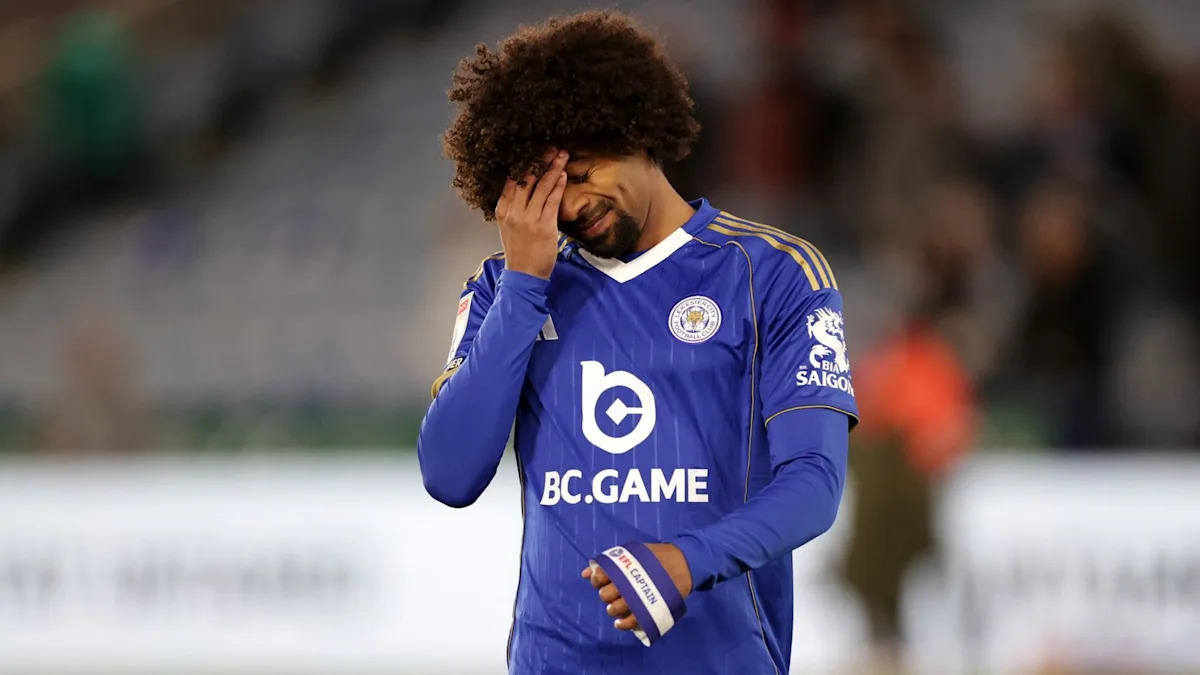
Just a decade ago, Leicester City stood on the brink of claiming the Premier League title. Next season, however, they will be competing in League One.
The Foxes have faced a dramatic downturn since securing the FA Cup in 2021, and their recent 2-2 draw with Hull City sealed their fate in the third tier.
Advertisement
From the euphoric heights of their historic 5,000-1 title victory that astonished the world to the tragic loss of owner Vichai Srivaddhanaprabha in a helicopter crash just two years later, the Foxes have endured a whirlwind of emotions in the last decade.
In the 2016-17 season, they faced Atletico Madrid in the Champions League quarter-finals. Now, a decade later, they find themselves playing alongside teams like Bromley, who have spent 132 of their 134 years in non-league football.
Rapid Decline
After finishing eighth in the Premier League in 2022 and reaching the semi-finals of the Conference League, former manager Brendan Rodgers cautioned that the club needed to adjust its expectations.
Advertisement
The impact of COVID-19 hit King Power, owned by Vichai, significantly as air travel came to a halt.
These effects lingered, and following a winless start to the 2022-23 season, Rodgers emphasized that Leicester should focus on reaching 40 points.
This was a stark contrast to his earlier ambitions as he aimed to disrupt the elite in the Premier League, following near misses for a Champions League place in 2020 and 2021.
Under Rodgers, Leicester also lifted the FA Cup, triumphing over Chelsea. However, the team quickly began to decline due to a lack of effective investment.
Advertisement
While Leicester attempted to remain stable, they unintentionally fell backward.
Though the squad still included international stars like Jamie Vardy, James Maddison, and Youri Tielemans, Rodgers was sacked in April 2023 with the team in the relegation zone. Dean Smith, the former boss of Aston Villa and Norwich, took over but couldn’t save them.
In the three years post-Rodgers, Leicester cycled through seven managers, leading to doubts about decision-making as the club oscillated between styles without a clear identity.
From Smith to Enzo Maresca, who at least led them to the Championship title in 2024, to Steve Cooper—after an unsuccessful pursuit of Graham Potter—to Ruud van Nistelrooy, who managed only five wins in 27 games.
Advertisement
Marti Cifuentes was hired in July but was dismissed in January, leading to internal dissatisfaction regarding the timing of his replacement, with former Foxes defender Gary Rowett eventually appointed three weeks later, having been sacked by relegation rivals Oxford in December.
Under Rowett, Leicester’s fortunes worsened, and they faced a six-point deduction for EFL financial rule violations, leaving them just above the relegation zone on goal difference.
Advertisement
Inside the club, a complacent culture seemed to prevail—one that ultimately contributed to their relegation from the Premier League in 2023.
Many were shocked by the team’s poor performance in the recent defeat against Portsmouth, which sparked an altercation between midfielder Harry Winks and fans as he boarded the team bus.
Winks was greeted with boos upon entering the pitch against Hull as a second-half substitute.
Aftermath of Owner’s Death
The repercussions of Vichai’s death—following a helicopter crash after a match against West Ham—has left lasting scars on the club.
Advertisement
Vichai purchased Leicester for £39 million in 2010, alleviated their debts, and saw them rise to the Premier League four years later, culminating in the remarkable title win in 2015-16.
“His influence was immense,” said former defender Robert Huth, a member of the title-winning squad. “He had a determination to get things done.”
Following Vichai’s passing, his son Aiyawatt, known as ‘Top’, assumed control of both the club and its associated business.
“Top is younger than me,” Huth noted. “He lost his father and now bears the responsibility of King Power. The pressure is immense. His father’s guidance was taken from him overnight.”
Advertisement
Leicester has made strides to reverse its decline, but issues such as a blame culture and a lack of accountability have surfaced within the squad and the club.
Additionally, some have suggested that the owner has become overly reliant on Jon Rudkin, the newly appointed chief football officer, who has spent 30 years at the club and was director of football when they won the Premier League.
“I found Jon to be fair and honest,” Huth remarked, having served as Leicester’s loans manager from 2022 to 2024.
Advertisement
“Both he and Top care deeply about Leicester and want the best for the club, but they need more support.”

Empty seats were conspicuous during Tuesday’s match against Hull.
Fans’ Perspective
“It’s heart-wrenching to witness this decline after such a remarkable period—daring to dream and achieving the impossible,” lamented Foxes Trust chair Lynn Wyeth in an interview with BBC Sport.
“Few truly anticipated that we would compete for the Premier League each season. While we weren’t naïve, there was genuine optimism that we could contend for European spots regularly.
“This hasn’t been a gradual decline; it has been a rapid nosedive—especially since Brendan Rodgers took charge.
Advertisement
“Everything has soured alarmingly fast. It’s wholly chaotic, and there seems to be no clear path to recovery.”
Financial Fallout of Relegation
Leicester’s relegation presents significant financial challenges.
Having faced a six-point penalty for exceeding the maximum allowable loss up to the 2023-24 season by £20.8 million, the club also reported an additional hefty loss of £71.1 million for 2024-25.
Notably, that second figure was recorded while they were still in the Premier League.
For two consecutive seasons leading to 2023-24, Leicester’s wages-to-turnover ratio surpassed 100%, indicating they spent more on salaries than they earned.
Advertisement
Although wages fell to 82% during the relegation season—mainly due to television revenue—they still had numerous high-earning players.
Although some of these players’ salaries would be reduced upon relegation, several remain among the highest-paid in the Championship.
Key players such as Patson Daka, Ricardo Pereira, and Winks are all set to be out of contract by summer.
Nevertheless, Oliver Skipp, who has earned 10 caps for England, is under contract until 2029, and Jannik Vestergaard also has an extended deal after signing a three-year contract just before turning 31 in 2024.
Advertisement
Finding new clubs for these players will be a challenge.
Moreover, the club’s loan from Australian investment bank Macquarie presents additional complications.
In September, Leicester sought to advance payments for players like Tom Cannon, Kasey McAteer, and James Justin. In January, they rolled over another loan, utilizing their final remaining parachute payment until June 2027.
‘Top’ has previously written off significant sums in loans.
Currently, it seems that Macquarie is fronting much of the funding, utilizing future revenues.
As television revenues will significantly drop in League One, Leicester may soon find itself without substantial assets against which to borrow.
Advertisement
Starting next season, League One clubs will be limited to spending 60% of any additional football revenue—such as prize money or transfer fees—on player-related expenses.
With several players still earning salaries that seem extravagant for League One, Leicester will struggle to comply with these regulations.