



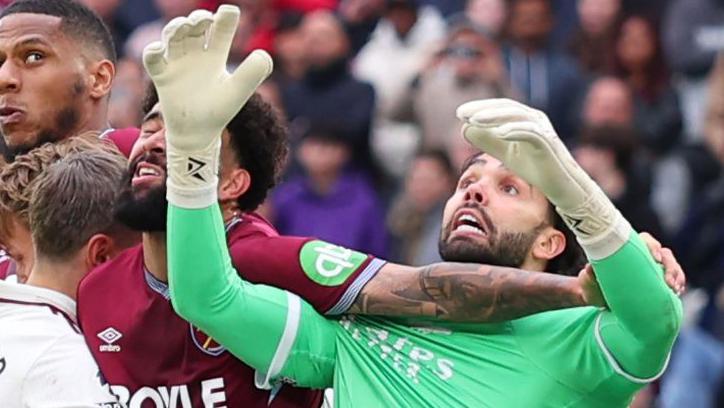
One of the most pivotal moments in the history of the Video Assistant Referee (VAR) system in the Premier League unfolded during a tense four minutes and 11 seconds of nail-biting uncertainty at the London Stadium.
This interval, which seemed to stretch on indefinitely, became a defining moment that could reshape the immediate futures of both Arsenal and West Ham United.
Advertisement
In the broader context, this incident and the VAR decision could be viewed as a season-defining moment for both teams involved.
Arsenal was ahead 1-0, courtesy of Leandro Trossard‘s goal in the 83rd minute, when West Ham substitute Callum Wilson connected in a crowded penalty area following a corner.
West Ham fans erupted in celebration, while Arsenal manager Mikel Arteta buried his head in his hands, fearing a critical win had slipped away at the last moment—only for protests to ensue.
Has there ever been a VAR decision that evoked such tension? Have the stakes ever been higher in a Premier League match?
Advertisement
The late-game intensity compounded the agony for those invested in the outcome.
Arsenal contended that goalkeeper David Raya had been fouled by Pablo, with West Ham’s Mads Hermansen barreling across his line.
Referee Darren England meticulously examined what would be deemed the most pivotal VAR decision in domestic football since its introduction in 2019 before sending referee Chris Kavanagh to the sidelines to review the footage.
Although VAR decisions aren’t unheard of, none have carried implications of such magnitude, potentially propelling Arsenal towards their first Premier League title in 22 years and simultaneously threatening West Ham’s top-flight status.
Advertisement
As Wilson’s shot crossed the goal line, West Ham supporters erupted in jubilation, only for the tension to culminate once more as Arsenal fans mirrored their delight when the referee ultimately stated: “After review, West Ham number 19 committed a foul on the goalkeeper.”
With those decisive words, Arsenal propelled themselves into a commanding position, now five points clear of Manchester City – having played one game more – while West Ham’s plight deepens, sitting just a point adrift of Tottenham Hotspur, who will play their game in hand against Leeds United on Monday.
West Ham and their fans were left in a state of outrage long after the final whistle, feeling cheated out of a crucial point in their battle for survival, while Arsenal reveled in a victory of monumental significance.
In deliberating whether to send Kavanagh to the monitor, England also considered potential fouls involving Trossard against Pablo and Declan Rice on Crysencio Summerville.
Advertisement
Ultimately, he determined the foul committed by Pablo on Raya was the critical one.
This incident had been anticipated due to the frequent jostling that occurs in penalty areas during set pieces.
Finding a solution to this issue seems nearly impossible, as it appears to be beyond the officials’ abilities to fully control.
Reactions following the decision varied dramatically. On the field. On the sidelines. In the stands. And in the aftermath.
Arsenal’s Arteta praised the “bravery” of the officials for making such a consequential call, while critics noted, “Of course he would say that.”
Advertisement
Arteta further acknowledged, “Today made me realize just how challenging and weighty a referee’s role is. To be in that position, making a decision that could alter the fate of both teams… What a significant obligation.”
Speaking to BBC Radio 5 Live, he remarked, “It was an enormous decision, but it was undeniably the right one. My initial instinct was to call a foul, yet as time ticks by and the referee awaits the VAR evaluation, it becomes clear that the contact impedes how David Raya raises his arms and catches the ball. It’s nearly onto his throat.”
“A monumental decision, particularly when both teams are battling for such high stakes.”
West Ham’s manager, Nuno Espirito Santo, expressed his devastation, emphasizing the confusion surrounding what constitutes a foul in penalty areas during set pieces.
Advertisement
He shared with BBC Radio 5 Live, “To be honest, I didn’t observe it well. I need to see a replay, but I have immense faith in my players’ perspectives. They are on the field and said it was not a foul. We’re heartbroken and disappointed.”
“I will review it now to gain a better understanding. I’m not here to criticize the referee or VAR’s role. It’s just the inconsistency we’ve witnessed over the last few seasons.”
He added, “With the tolerance for grappling, blocking, and holding, I believe we’ve lost clarity on what is deemed a foul. Previously, these situations seemed to be judged differently, and that’s what frustrates me.”
Nuno attempted to maintain a brave front, delivering resolute remarks as he faces a daunting task to ensure West Ham’s survival in the top flight.
Advertisement
In critical moments like this, legacies and destinies can shift dramatically.
‘Foul on Raya had direct impact on play’
Consider the position of England as the VAR official in Stockley Park.
The pressure on him must have been immense. He was unaware of the Sky Sports commentary and had no insight into public opinion.
This is the same referee who, in September 2023, was at the center of a significant VAR blunder that marked a low point for the Premier League.
England had previously misinterpreted an offside call, leading to a disallowed goal for Liverpool‘s Luis Diaz at Tottenham.
After that ordeal, England worked diligently to reclaim his standing in top-flight refereeing.
Advertisement
Presented with a decision that could determine the fates of two clubs this match day, it’s no surprise he took his time. He needed to ensure the accuracy of his judgement.
England dedicated two minutes and 41 seconds analyzing every viewpoint, scrutinizing the initial foul and considering all ramifications.
We’ve seen pushing and pulling during corners throughout the season; goalkeepers have experienced pressure consistently as well.
What made this case unique was its context.
Arsenal had excelled in manipulating such situations all season, utilizing crowded penalties to create scoring opportunities, and now they were beneficiaries of a pivotal moment.
Advertisement
Yet it is difficult to argue that the Spain international was not obstructed; had Pablo not made contact, Raya likely would have easily caught the ball.
Pablo was seen with an arm across Raya, effectively restraining his left arm.
England explored the other potential infractions as well, initiated by Trossard against Pablo and Rice against Summerville.
However, the crucial foul with direct implications for the play was Pablo on Raya. A penalty cannot be awarded for a foul that follows any prior infraction.
The significance of getting that decision right was paramount—and England accomplished just that.
Referee Kavanagh took a full minute and 15 seconds at the video monitor, acutely aware of the repercussions his final choice could carry.
Advertisement
In total, the four minutes and 11 seconds had the potential to shift both the title race and relegation considerations.
If it requires that much time, can it truly be “clear and obvious”? This misconception oversimplifies the matter. When faced with a monumental, season-altering call, ensuring correctness is far more critical than expediting the process.
Leading up to the final minutes of the match, England likely pondered the correctness of his call.
Inside the VAR room, there are no means of communication, no mobile devices, no feedback mechanism to verify the accuracy of your decision.
Consider the relief once he exited the room and learned he had made the right choice—that Pablo had interfered with Raya’s ability to contest the ball.
Advertisement
This Saturday, England will officiate the FA Cup final between Manchester City and Chelsea.
Just a couple of years ago, this seemed implausible. Now, he’s poised to manage one of the most significant games on the football calendar, having resolved his earlier VAR challenges.

There were four minutes and 11 seconds from the goal to the referee’s announcement [Getty Images]