



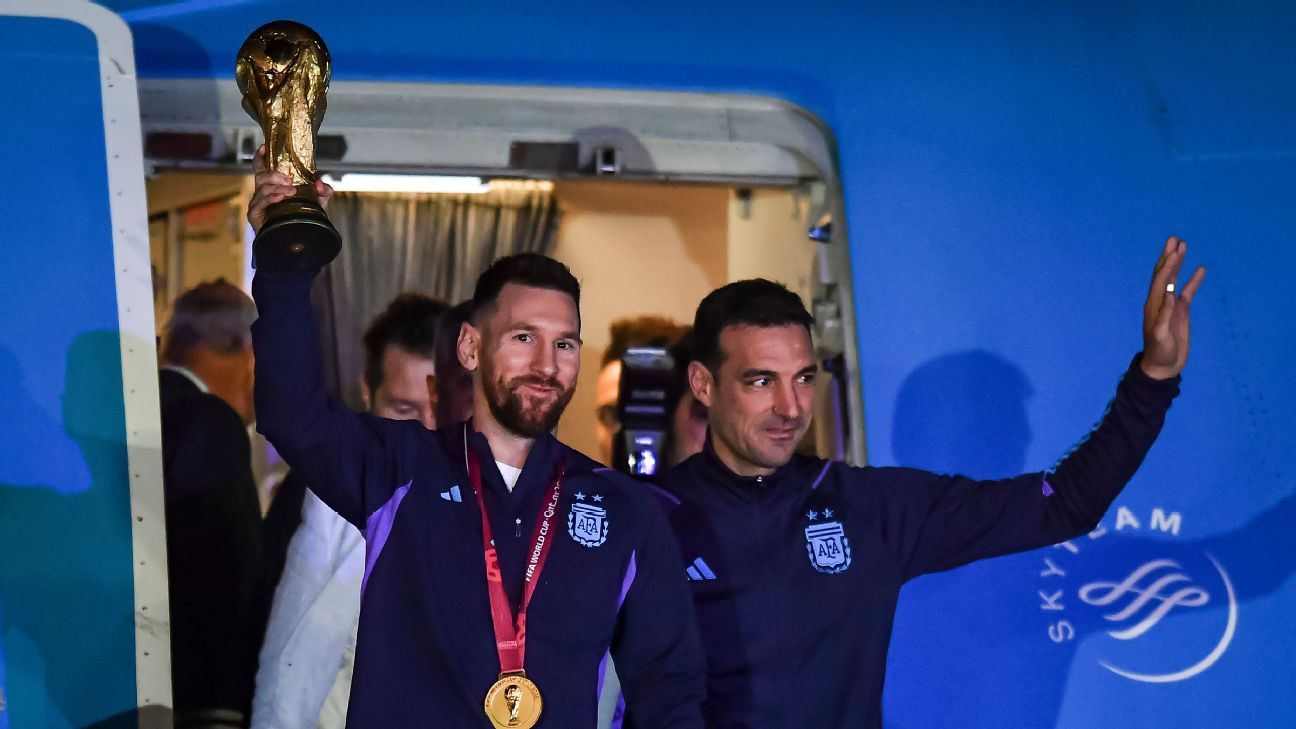
Introducing the updated Argentina World Cup lineup; it’s largely unchanged from the previous squad.
The reigning champions have retained most of their roster since the thrilling victory against France at Qatar 2022, with 17 members from manager Lionel Scaloni’s championship team heading to the tournament in the U.S., Mexico, and Canada. It could have been 20 if midfielder Giovani Lo Celso and versatile player Nico González had not missed the last World Cup due to injuries. This year, defender Juan Foyth finds himself sidelined with injury.
So, who has been excluded, who has been included, and what implications does this continuity carry? Is it a cause for celebration or concern?
Of the nine players from Qatar who are not part of the current squad, Foyth is the only one under 30. There has been a natural progression in the team, with some veterans just missing the cut—like left back Marcos Acuña—while others have fallen out of favor, including holding midfielder Guido Rodríguez, attacking midfielder Alejandro Gómez, and striker Pablo Dybala, who struggled to integrate into the squad.
One notable absence was not a decision by Scaloni: now 38, winger Ángel Di María would have been a core member of the team had he not chosen to retire from international football after winning the Copa America in 2024. His replacement poses a challenge for the coach, as Di María’s unique skill set—being a creative force without the ego of a superstar—remains unmatched.
In his absence, Scaloni would welcome a player who can match Di María’s incisiveness in one-on-one situations, injecting some flair into the team’s passing style. Initially, there were hopes for Chelsea winger Alejandro Garnacho to fill this role, but his development has not progressed as anticipated. Meanwhile, Napoli’s energetic forward Giovanni Simeone, previously in the Qatar mix, has gained prominence.
It will also be interesting to observe how much trust is placed in two promising newcomers: Strasbourg’s Valentín Barco (who is reportedly heading to Chelsea) exhibits some of Di María’s offensive diversity, able to operate across multiple positions in midfield and attack, while the promising Como talent Nico Paz is one to keep an eye on. His moment might truly come in the post-Messi era, as he’s a player who thrives with the ball at his feet, which complicates his integration into the team. However, his talent could be crucial in a World Cup scenario, especially when coming off the bench against fatigued defenses.
Argentina is likely to wear down many opponents, supported by a robust selection of midfielders entering their prime. Choosing the midfield was straightforward for Scaloni; he essentially hit “repeat” while adding Lo Celso, whose absence just before Qatar was viewed as a significant loss. Players like Alexis MacAllister and Enzo Fernández have matured under increased responsibilities, giving Scaloni ample options now.
Julián Álvarez, who emerged as a crucial player during Qatar 2022, is arguably even more critical to Argentina’s offense than Messi, who will turn 39 during this summer’s tournament. Álvarez is capable of covering for Messi’s work rate, leading from the front in a congested midfield, or stepping into Messi’s preferred No. 10 role to create space for Lautaro Martínez at center forward. The key question remains his stamina after a grueling season at Atletico Madrid, compounded by ongoing transfer speculation about his future.
The other center-forward option is newcomer Juan Manuel “Flaco” Lopez, whose skills have significantly evolved while playing for Palmeiras in Brazil.
Throughout much of the team, stability is seen as a positive; Scaloni’s Argentina possesses a clear identity while also allowing for strategic variations. Yet, the coach likely anticipated a few more adjustments within his defensive lineup.
Argentina nearly faltered under pressure in 2022 against Australia, and Netherlands, and again in the final against France, where only a last-minute spectacular save by Emiliano Martínez averted an undeserved loss. The lack of new defensive talent is a concern as they head into this tournament.
Scaloni has experimented with a few defenders, including Kevin Lomonaco, Mariano Troilo, and Tomás Palacios. However, none have proven convincing, resulting in Argentina returning with the same defensive line as in Qatar.
Nahuel Molina and Gonzalo Montiel will vie for the starting right-back position; Nicolás Tagliafico covers the left side (with Gonzalez and Barco also in contention); while Cristian Romero and the ageless Nicolás Otamendi (now 38) will centralize the defense. Backup options include Lisandro Martínez, Leo Balerdi, and Facundo Medina, who edged out Marcos Senesi
.
Remarkably, every player who started more than one match during World Cup qualification made the final squad, solidifying this group as Scaloni’s legacy—the team that claimed both the World Cup and Copa America and dominated South America’s qualification phase.
A new era is inevitable after the World Cup when Messi departs, but for now, this team stands as one of Argentina’s most formidable squads, poised for potential further success. History reveals this tournament poses a significant challenge, yet should they fall short in the 2026 World Cup, it won’t be due to a lack of experience.