



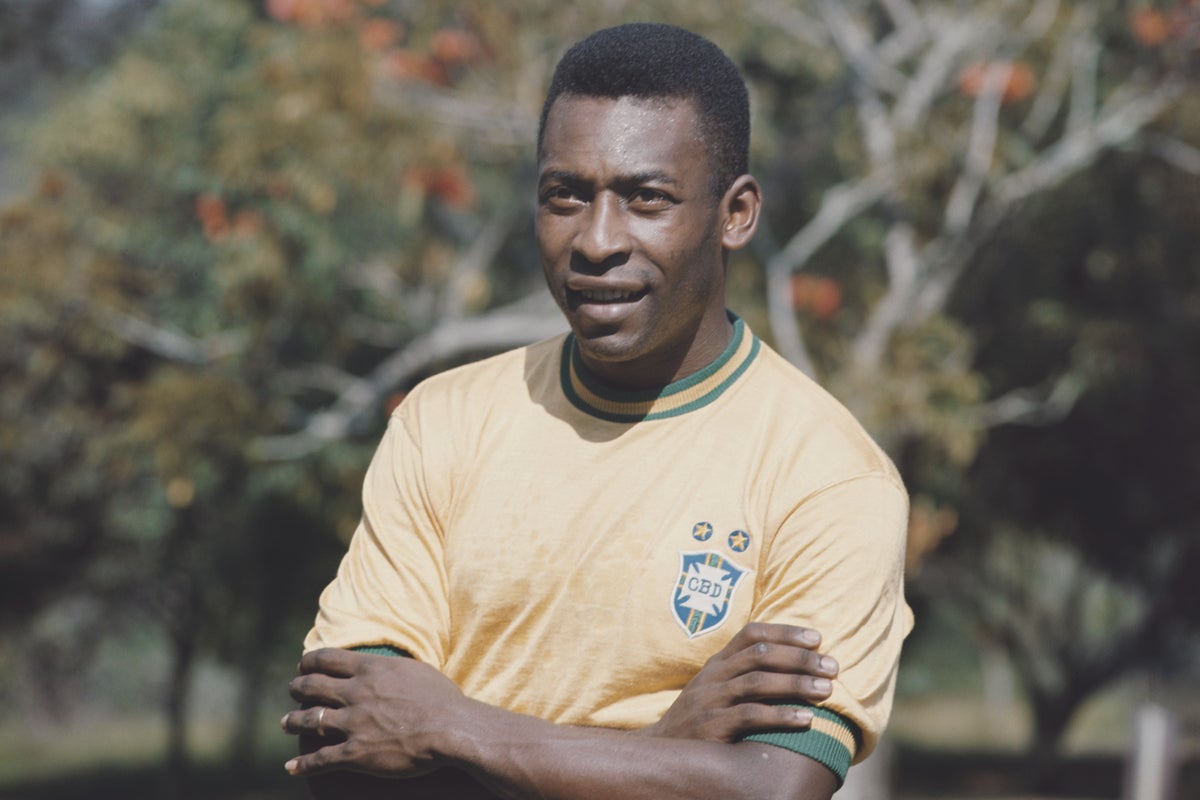
Pele was undoubtedly crafting his own legacy. On the afternoon of June 21, 1970, as he watched Carlos Alberto raise the trophy for Brazil’s third World Cup, he felt a level of emotional intensity he had never experienced before, yet primarily felt a sense of satisfaction.
“I participated in every match, emerged injury-free, and felt as if I had accomplished everything I set out to do,” he reflected. No other player in football history has come close to achieving what he did; Pele remains the only player to have won the World Cup three times, and he didn’t merely win those titles—he brightened and elevated each tournament uniquely.
Advertisement
Pele stands as the quintessential World Cup player, the obvious choice to lead a list like this.
However, his impact transcends mere football statistics or records. The circumstances around his journey add a richness to it. Ironically, many of these stories do not fit the legacy that Pele sought to construct. Others from the Brazil squad on that historic day at the Azteca Stadium recount different memories, portraying him as a man who experienced more than just satisfaction.

Pele (bottom-centre) was part of the famous 1970 Brazil World Cup-winning squad (Getty)
Upon entering the locker room, Pele was reportedly exclaiming, “I didn’t die! I didn’t die! I didn’t die!” This was seen as a release and relief as he had been compelled to leave his self-imposed exile and rejoin the Brazilian national team, which had been mandated by the military dictatorship. They were not just calling for his return; they demanded victory.
Advertisement
This situation has reignited debates in Brazil regarding Pele’s potential complicity with a tyrannical regime, intensifying the extraordinary pressure placed upon him—one of football’s legends, yet still just a man.
Amid these pressures, it’s remarkable that the 29-year-old managed to execute one of football’s most iconic moments with unparalleled calm. This culminated in perhaps the sport’s greatest goal, defined by Pele’s seemingly casual pass to Carlos Alberto during a brilliantly orchestrated play, which led to a 4-1 victory against Italy in Mexico.
While the appearance of that goal may seem casual, it stood as testament to Pele’s brilliance; it was executed with perfect precision, the product of years spent understanding the game alongside Carlos Alberto, building to that magnificent moment.
Advertisement
And in that moment, Pele became immortal—he ascended to a legendary status.
In keeping with the mythic nature of his story, Pele’s World Cup journey also seemed destined; almost prophetic.
Two decades earlier, a nine-year-old Pele played football in the streets of Bauru, frequently rushing into his modest family home to catch the radio updates of the 1950 World Cup final. His father, Dondinho, had gathered friends in hopes of witnessing Brazil’s long-anticipated first victory.
However, the outcome was devastating, as Uruguay famously defeated Brazil 2-1 in what became known as the “Maracanazo,” a loss that felt akin to “Brazil’s Hiroshima.” The sight of his father in tears profoundly affected young Pele, marking the first time he witnessed his father cry.
Advertisement
In a moment of solace, the young boy promised his father he would one day win him the World Cup.
By 1958, despite a promising start for the Brazilian team, they needed a spark. After opening the tournament with a 3-0 win over Austria, the team stumbled with a 0-0 draw against England, leaving them in a precarious position ahead of a critical final group game against the USSR. Given their historical status, Brazil was burdened by the weight of past failures and had yet to lift the World Cup trophy.
So for this pivotal match, manager Vicente Feola reinstated 17-year-old Pele to the lineup. His presence was transformative; alongside Garrincha, they dismantled the Soviet defense, allowing Vava to score within the first three minutes of the match.

17-year-old Pele scores against Wales in the 1958 World Cup quarterfinal (AFP/Getty)
The teenager would then score the winning goal against Wales in the quarterfinal, follow that with a hat-trick against France in the semifinals, and netted two more against the hosts, Sweden, in the final.
Advertisement
Such an extraordinary individual journey to triumph has never been replicated, not even by Diego Maradona.
Pele’s career is marked not by a single illustrious journey but by multiple, diverse World Cup campaigns, each reflecting a different aspect of greatness. He was the young sensation, the leading star, the man of the match at the final, the final goalscorer, the player everyone wanted to see, the one some wanted to target, a pioneer, the returning hero, and the grand master bringing everything together in triumph.

In his journey, one can find elements reminiscent of Johan Cruyff in 1974, Diego Maradona in 1982, 1986, and 1990, Roberto Baggio and Romario in 1994, Kylian Mbappe in 2018, and Leo Messi in 2022. Yet Pele also innovated beyond what anyone imagined.
Advertisement
His near misses, like the halfway line strike against Czechoslovakia or the dummy against Uruguay, were almost as compelling as his emphatic “here I am” statement with his first goal in that historic final, showcasing his extraordinary vision. A teenager with remarkable composure lifted the ball over Reino Borjesson before driving a volley into the bottom corner, a moment he later declared as his career favorite because “no one had seen a goal like that before.” Paul Gascoigne seemed to take notice of this during Euro ’96.
This exemplifies how Pele embodied the very essence of the World Cup. He performed astonishing feats that expanded the boundaries of imagination.
Advertisement
His impact from 1958 extended beyond just making Brazil the world’s most successful team; it also transformed the World Cup into a grand global spectacle of aspiration and competition.
Pele amplified that vision further in 1970, bringing an innovative perspective as the tournament was broadcast in vibrant technicolor for the first time. Every aspect of Brazil’s brilliance was illuminated, enriched by his personal narrative, which amplified such legacies—his 1970 campaign was not just dominant; it was a powerful comeback, reminiscent of another era’s great, Muhammad Ali.

No one else has been so central to the World Cup’s history (Getty Images/Hulton Archive)
Pele’s legacy shines brightly; even at 25, during what many regard as his peak, he faced such aggressive challenges in 1966 that he contemplated retiring from international matches indefinitely.
Advertisement
Although the military dictatorship complicated his return, it was deeply personal for Pele. He aimed to prove himself once again. His sister, Maria Lucia, remarked it was “the victory he wanted to secure as his legacy.”
What a legacy it is! A promise fulfilled.
No one has been so integral to the World Cup’s narrative, and it seems unlikely anyone will match it in the future.
Pele embodies the very spirit of the World Cup.