



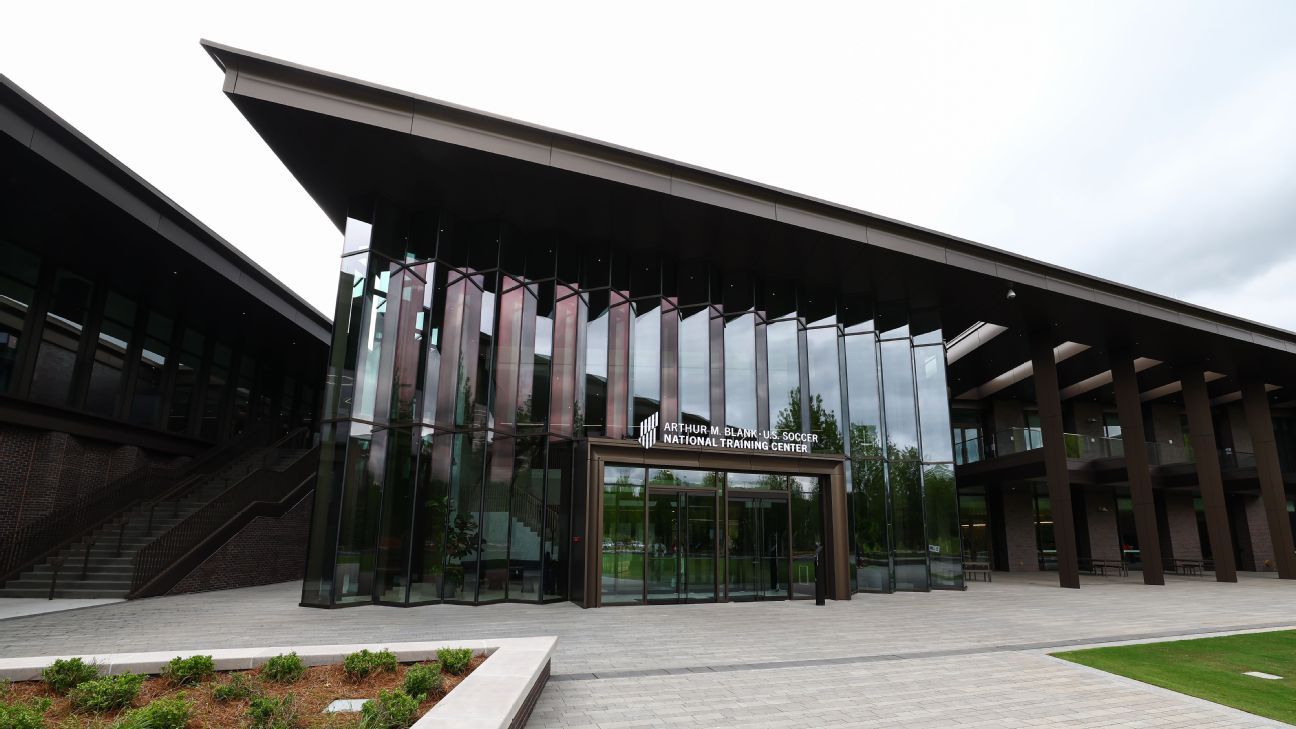
The United States Soccer Federation has unveiled its new home at the Arthur M. Blank National Training Center (NTC), located on a sprawling 200-acre site just south of Atlanta. Officially opened in early May, this facility marks a significant milestone for U.S. Soccer.
Currently serving as the training base for the U.S. men’s national team in preparation for the upcoming FIFA World Cup, the NTC features 17 outdoor fields, 20 locker rooms, 19 meeting rooms, two indoor courts, and a 10,000-square-foot gym. The facility encompasses over 400,000 square feet and houses a dedicated staff to cater to the needs of the players.
In a statement to ESPN earlier this year, then-sporting director Matt Crocker expressed confidence in the NTC, stating, “In my opinion, it’s the best in the world. It will be extraordinary for our national teams, as well as for coach education, officiating, and community use. Our vision is to establish it as the heart of soccer in America.”
The NTC aims to be a “catalyst” for all who visit, from supporting stars like Christian Pulisic in the World Cup to providing opportunities for local organizations that will have access to the center.
To gain further insight into the facility’s operations, ESPN engaged with Crocker and other stakeholders about the establishment of the NTC, its goals, and how it can uplift soccer at both local and national levels.
Establishing Roots in Atlanta
Prior to the NTC’s launch, U.S. Soccer operated somewhat like a “traveling circus,” relying on rented facilities for training and preparation. Although they had a small space in Southern California in partnership with the LA Galaxy, it primarily served the MLS team.
In addition to a similar training facility in Kansas City at Sporting Kansas City, the federation’s former headquarters was based in Chicago.
The NTC’s opening represents much more than a training venue for national team players; it is now a comprehensive headquarters for the entire federation. U.S. Soccer reports that over 350 employees will work there daily.
According to Crocker, “All of our national coaches, high-performance staff, and administrative personnel are now based in Atlanta,” although his successor has yet to be named.
When considering potential locations, several factors favored Atlanta: accessibility via direct flights from a nearby major airport, a strategic East Coast position for international opponents, and favorable year-round weather. A substantial $50 million donation from local NFL and MLS owner Arthur Blank, along with support from corporate sponsors such as Coca-Cola and land donated by Chick-fil-A CEO Dan Cathy, led to the groundbreaking of the NTC in 2024.
With its opening, many have marveled at the spaciousness of the NTC, which vastly exceeds their previous shared facilities in Los Angeles. “It’s massive, just under 400,000 square feet under one roof,” noted NTC general manager Tom Norton. “Even a quick dash down the hall to grab coffee takes some time.”
‘Soccer Will Be Here Almost Every Day’
While the senior men’s and women’s teams garner significant attention, U.S. Soccer encompasses much more than just these two squads. They are part of a broader framework that includes 27 national teams that will utilize the NTC.
“One of the main advantages of the NTC is the ability to host multiple teams simultaneously,” explained Norton. “With 20 locker rooms available, we’ll have soccer activities taking place almost every day.”
Crocker emphasized a commitment to a player-first approach, aiming to leave “no stone unturned” in providing essential resources to all 27 teams.
This vision includes making the NTC accessible to the nine “extended national teams.” The facility has been designed with inclusivity in mind, featuring wheelchair-accessible viewing decks, charging stations for power soccer, customized locker rooms, and tactile audio/visual elements.
Crocker also envisions the center becoming a premier destination for coaching education and officiating. Coaches and referees will have the opportunity to participate in year-round courses, with invitations extended to representatives from state associations and local clubs.
“This will allow us to operate year-round, whether through games, training, or educational opportunities,” Crocker asserted. “We want the facility to buzz with activity continually, not just when national teams are present.”
With all 27 national teams and guests now based under one roof, the days of operating as a “traveling circus” are over.
“Having a dedicated home enables us to achieve more,” said Norton. “It fosters a more comfortable atmosphere, allowing us to concentrate on improving our performance on the field and advancing the game.”
Engaging with the Community
The national implications of the NTC are evident, but its local impact is already being felt.
“The NTC shines a spotlight on soccer in Georgia,” remarked Neil McNab, executive director of Atlanta’s Rush Union Soccer, which runs teams for both boys and girls. “It means that our area will attract the top talent, not just players but also coaches, referees, and the brightest minds in the sport.”
McNab, who recently participated in a “soccer in schools” initiative, shared that local youth players have already been invited for events at the NTC. “There’s a lot of momentum,” he said. “Whether it’s coaching education or resource development, the need for players and coaches to help deliver programs is already in progress.”
Jim Walker, executive director of the Georgia State Soccer Association, highlighted that his organization will hold its semiannual general meeting at the NTC this summer. “We’re eager to take advantage of the facility immediately,” he remarked, “as it presents a fantastic opportunity for our members to experience the NTC firsthand.”
Although specific plans are still developing, Walker noted potential for the organization to host its “State Cup” tournament at the new center. “At the state association level, we have opportunities for the State Cup, Olympic development programs, coaching education, and referee training—activities we typically conduct at local high schools can now take place in a state-of-the-art facility,” Walker added. “It’s like having a real crown jewel that we can utilize.”
While the full impact of the NTC will take time to gauge, both locally and nationally, it is evident that anticipation is building among those who have witnessed this “crown jewel” up close.
“There’s an undeniable energy surrounding the complex,” said McNab. “It’s exciting to think about the future; this is just the beginning, not the end.”