



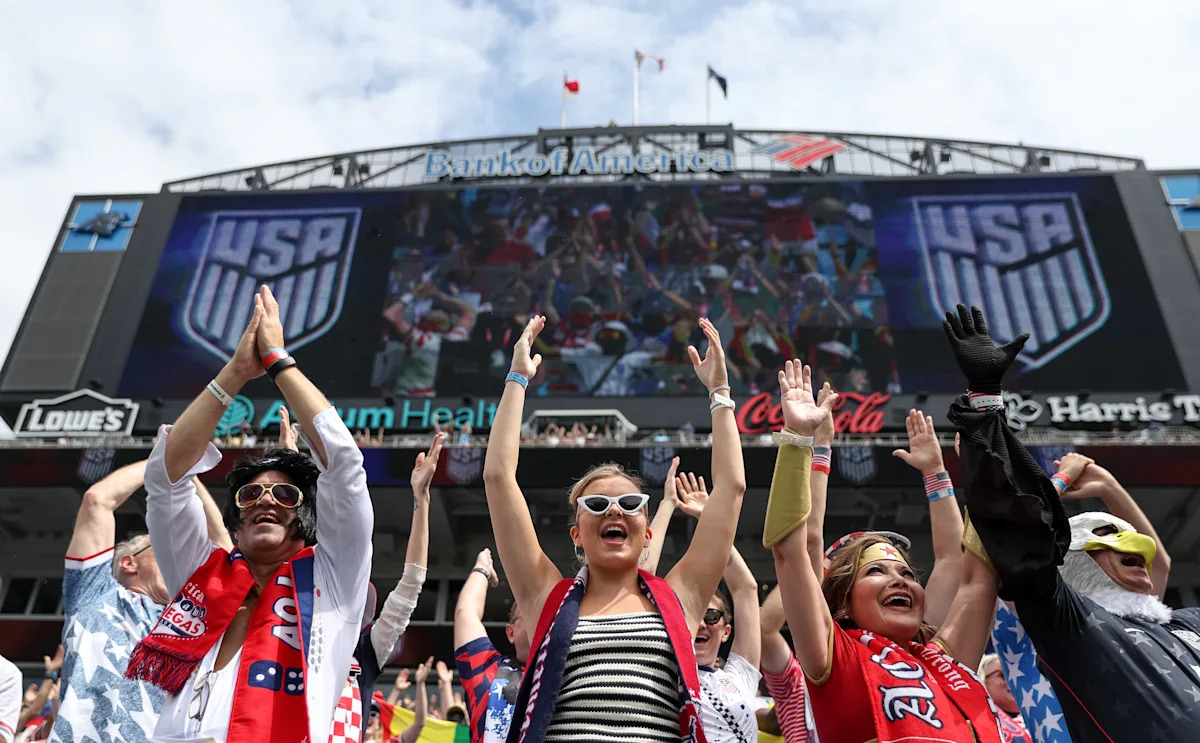
The 2026 World Cup is shaping up to be a historic tournament, kicking off on June 11 across North America. This edition promises a fresh experience compared to previous tournaments, raising the question: can bigger truly be better?
We’re about to find out.
Advertisement
Expanded Host Nation Participation
This World Cup will mark the first time the tournament is hosted by three different countries.
Since its inception in 1930, the tournament has primarily been held in a single nation, although a joint hosting arrangement occurred in 2002, when South Korea and Japan co-hosted games.
While the United States is well-equipped to handle the entire tournament alone, as seen in 1994, CONCACAF opted for a joint bid with Canada and Mexico back in 2016.
The competition to host was quite limited; following the 2018 World Cup in Russia and the 2022 tournament in Qatar, Europe and Asia were disqualified from hosting the upcoming event. This left only Morocco as the only competing bid against North America’s offer.
Advertisement
Join 2026 Soccer Pick ‘Em with FOX One and make your picks for the world’s biggest soccer tournament
The voting outcome was decisive for CONCACAF’s bid, garnering double the votes compared to Morocco at the 2018 FIFA Congress.
When Mexico’s match against South Africa kicks off the tournament in Mexico City on June 11, the nation will officially become the first to host three World Cups. Mexico first hosted the event in 1970, followed by a second time 16 years later. Meanwhile, this will be the second World Cup for the United States, and Canada will host its inaugural game against Bosnia-Herzegovina in Toronto on June 12.
Increased Number of Teams
A major factor behind the tournament’s extended format is the expansion from 2022, increasing from 32 to 48 teams and providing more nations with the chance to qualify.
Advertisement
This enlargement allows for more nations like Jordan, Uzbekistan, Curacao, and Cape Verde to make their World Cup debuts. Additionally, nations such as Scotland and Norway return for their first World Cup since 1998, while Haiti returns after last participating in 1974.
The World Cup has evolved significantly since the first tournament in Uruguay in 1930, which featured only 13 teams. It expanded to 16 in 1934, and although the 1938 tournament had just 15 teams due to Austria joining Germany, the 1950 edition featured only 13 teams after three countries withdrew.
In 1982, it expanded to 24 teams and remained at that size for the 1994 World Cup in the United States. It grew to 32 teams in the subsequent edition.
Advertisement
As the tournament progresses with more teams, it also means an increase in games and revenue for FIFA. Hence, the 48-team format appears to be a permanent fixture, with no intention of reverting to 32 teams for future tournaments, including 2030 or 2034. Additionally, speculation about further expansion in the future may arise.
Increased Knockout Round Matches
In the previous structure of 32 teams, reaching the knockout rounds was straightforward: eight groups of four teams, where the top two teams from each advanced to a 16-team knockout stage.
However, with the increase to 48 teams, the knockout stage now features 32 teams. Overall, there will be 104 total games in this tournament, up from 64 in 2022.
Advertisement
Now, there will be 12 groups each consisting of four teams, and every team will play a minimum of three matches. The top two teams per group will still advance, but the additional eight spots in the knockout round will be filled by the eight best third-place teams from these groups.
This new structure makes it less likely for strong teams like Germany to miss qualifying for the knockout rounds, as they did in 2022. Finishing third in their group with four points and a positive goal differential might be enough to secure advancement in 2026.
With third-place teams now eligible for the knockout stage and goal differential as a critical tiebreaker, expect an increased emphasis on defensive strategies during group play, especially from smaller nations. The disparity in talent between the best and worst teams has widened considerably, but the new system offers more teams the chance to qualify, possibly leading to more cautious game strategies.
More Scheduled Breaks
Given that many games will be played in hot and humid conditions during the summer, scheduled hydration breaks will be implemented.
Advertisement
In an unprecedented move for a sport known for its continuous play, FIFA announced that each half will include a three-minute hydration break, appearing 22 minutes into each half, to prioritize player health.
While hydration breaks are not new in extreme heat conditions, scheduled breaks for games in moderate weather or indoor play is a significant change.
This also presents broadcast partners, like Fox, with more opportunities to air commercials. FIFA guidelines state that networks can air ads during these breaks, starting 20 seconds after the break begins and concluding 30 seconds before it ends, providing roughly two minutes for advertisements and additional opportunities for more 30-second spots.
Advertisement
Expanded VAR Implementation
Hydration breaks won’t be the only delays during matches. The 2026 World Cup will feature enhanced capabilities for Video Assistant Referees (VAR), enabling a wider range of game aspects to be reviewed.
In addition to potential red cards and penalty kicks, officials will now double-check corner kick and goal kick decisions if the mistake is “clear and obvious.” However, the definition of “clear and obvious” often invites debate, ensuring that phrase will be frequently discussed during the tournament.
Advertisement
Moreover, referees will have the option to use the pitchside monitor to review the issuance of a second yellow card, which could lead to a player being sent off and leaving their team with 10 players.