



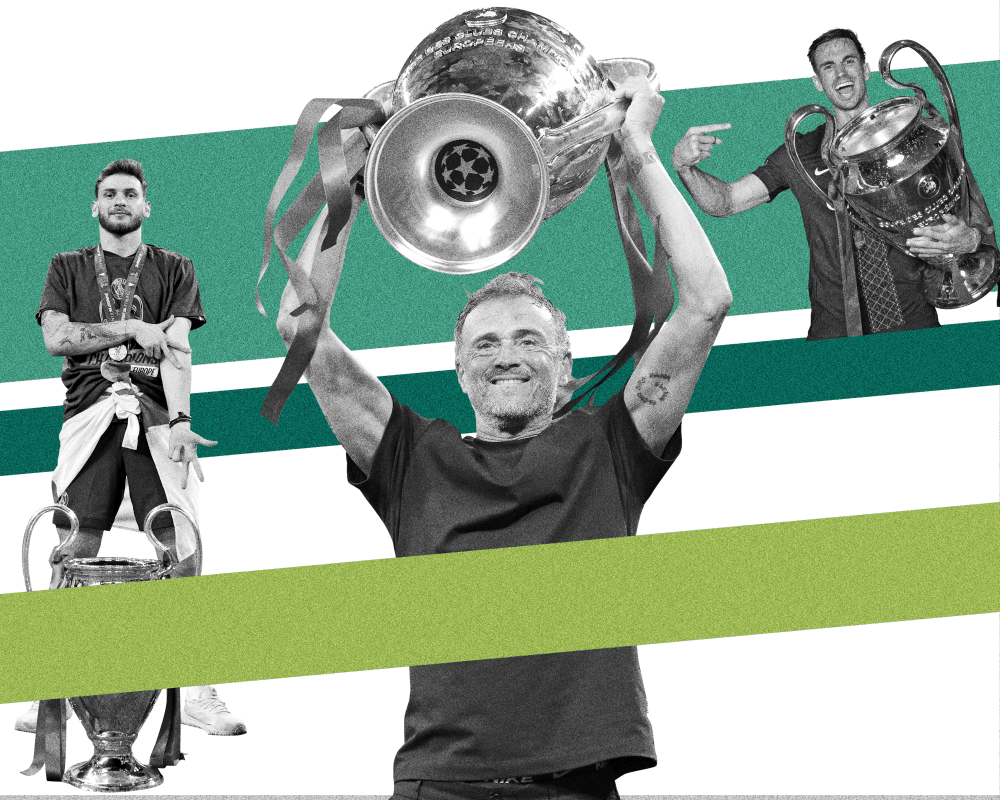
Since 1990, only one team has successfully defended the Champions League title: Real Madrid, who achieved this remarkable feat by winning three consecutive titles from 2016 to 2018. Paris Saint-Germain‘s recent triumph in the final elevates them to a prestigious level in football history. No mediocre team has ever captured the European Cup or the Champions League, but only truly remarkable teams have managed to retain the title.
Arsenal gave them a much stiffer challenge than Inter did when they lost in the previous year’s final. A victory determined by penalties often leaves a slightly unsatisfactory taste, yet the quality of this PSG side cannot be disputed. They overwhelmed Bayern in the semi-finals, scoring six goals, with their dominance far exceeding the one-goal aggregate outcome might suggest. The same was true in the quarter-finals, where a 4-0 aggregate win failed to fully reflect their superiority over Liverpool. Although Chelsea might argue they were unfortunate to lose 5-2 in the first leg of their last-16 tie against PSG, the 3-0 defeat in the second leg was a devastating declaration of authority, with PSG scoring three goals almost effortlessly.
Advertisement
Related: Champions League team of the season: Lamine Yamal, Harry Kane … and a Spurs player
While PSG’s attacking flair is certainly impressive, their midfield, especially with Fabián Ruiz fit, can effectively manage possession and control matches, reminiscent of the dominant Spanish teams of the last two decades. Luis Enrique’s background with the legendary Barcelona team of the late 90s—playing under Louis van Gaal and alongside Pep Guardiola—clearly influences his approach. Today, Luis Enrique is recognized as one of the great European managers; only Carlo Ancelotti has more European Cups or Champions League titles, while Bob Paisley, Zinedine Zidane, and Guardiola have also matched his three titles.
As the football world faces a transition away from the Guardiola model, Luis Enrique seems to have unearthed a promising blueprint for future success. His sides display a thrilling directness on the wings, akin to the contributions of Lamine Yamal and Nico Williams in Spain’s 2024 Euro-winning side. Khvicha Kvaratskhelia has emerged as one of the best players globally based on current form. When given space to run, as Bayern mishandled at times, the outcome is almost predetermined. Arsenal did well to contain him during the final, with Bukayo Saka teaming up with Cristhian Mosquera to double their mark. Still, Kvaratskhelia was influential in PSG’s equalizer, with a minor hesitation and hurried reaction from Mosquera leading to a penalty.
If you choose to go head-to-head with PSG, like Bayern did, players like Kvaratskhelia and Desiré Doué will exploit any space available. Arsenal had no choice but to adopt a more defensive stance, absorbing pressure. While some may find this frustrating, especially those who enjoyed the dynamic match between PSG and Bayern, defending is integral to the game. With more clinical forwards, Arsenal’s strategy might have yielded different results. However, they struggled towards the end, partially because Viktor Gyökeres couldn’t effectively hold the ball, and largely because Noni Madueke couldn’t match Saka’s quality on set pieces. In the end, they were merely a slight misstep away from a 1-0 victory, and their failure to convert two shots in the shootout sealed their fate. The game plan was sound; it was just those few crucial details that let them down.
Advertisement
Nevertheless, despite PSG’s appealing style of play, a few caveats remain. Their players are far less fatigued compared to those of their European opponents, particularly Arsenal. David Raya, Declan Rice, Martín Zubimendi, Gabriel, and William Saliba all logged more than 2,500 minutes in league matches this season, with four others also exceeding 2,000 minutes. In contrast, only Vitinha from PSG’s starting lineup played over 2,000 minutes. Moreover, the Premier League demands a more intense level of play than Ligue 1, where teams like Wolves, Burnley, and West Ham offer a significantly tougher challenge than the bottom three in France, such as Metz, Nantes, and Nice.
PSG’s payroll is approximately double that of the next highest team in France, Marseille, and more than ten times that of Le Havre, the lowest in Ligue 1. This financial dominance has largely undermined competitiveness in the domestic league, and it’s crucial to remember how PSG’s wealth was acquired. It has been fifteen years since Qatar Sports Investment took over PSG. They have finally come to understand that merely having star players doesn’t guarantee on-field success, and now they possess the type of team they’ve always envisioned. All ten outfield players featured in the last two finals, with only two over the age of 30 and five under 25, suggesting they will likely remain successful for many years to come.
However, the underlying question remains: at what cost to the integrity of the French league and to the idea that soccer might still hold some communal or spiritual significance, rather than merely serving as a propaganda tool for an autocratic regime.
-
This is an excerpt from Soccer with Jonathan Wilson, a weekly column from the Guardian US focusing on football in Europe and beyond. Subscribe for free here. If you have a question for Jonathan, email soccerwithjw@theguardian.com, and he’ll respond to the best questions in a future edition.