



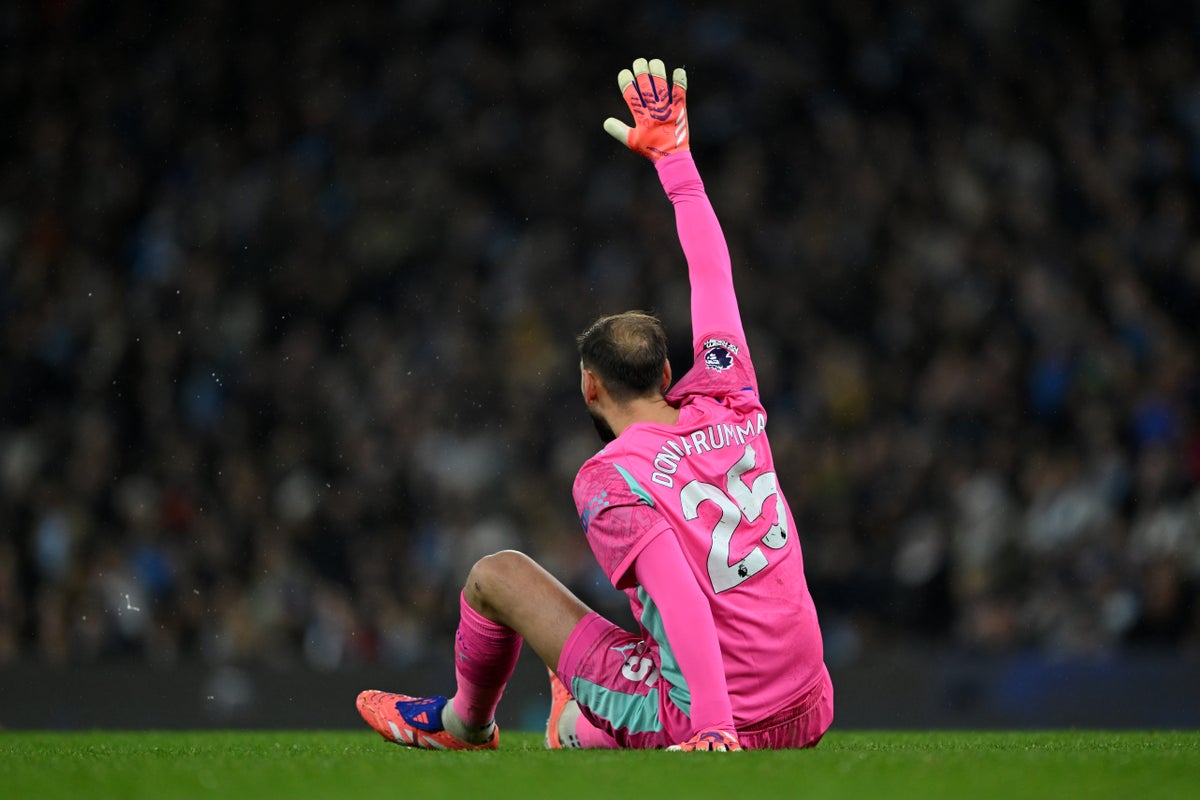
During this summer’s World Cup, players will no longer be allowed to approach the touchline for tactical guidance from coaches while goalkeepers receive treatment for injuries. This decision is part of several new regulations announced by FIFA referees’ chief Pierluigi Collina.
The practice, referred to as ‘tactical timeout,’ where goalkeepers go down for treatment while their teammates rush to receive instructions from coaches, is now prohibited by the International Football Association Board (IFAB).
Examples of this tactic have been evident in various leagues, including a notable incident in November, when Leeds coach Daniel Farke accused Manchester City goalkeeper Gianluigi Donnarumma of feigning injury to disrupt play.

Gianluigi Donnarumma drew criticism from Leeds manager Daniel Farke in November (Getty)
Leagues have been encouraged to conduct trials throughout the 2026-27 season to explore potential solutions. Meanwhile, the U.S. women’s professional league, the NWSL, has already implemented a similar measure earlier this year, which will also be used in the World Cup.
According to the new regulations, players from both teams must either remain in their positions or assemble in the center circle when a goalkeeper is injured, as they will not be allowed to approach the touchline.
While referees are tasked with enforcing this rule, Collina clarified that players attempting to consult with their coaches won’t face yellow cards or disciplinary consequences. However, all participating nations will be informed of this rule.
“We held a workshop with coaches from all 48 teams, informing them that referees will be proactive,” said Collina. “Players will not be permitted to leave the field when a goalkeeper is on the ground injured. The goalkeeper is entitled to be treated for injury, but the players cannot leave the pitch for a tactical timeout.”

Pierluigi Collina explained the new regulations introduced by IFAB for the World Cup (PA)
However, this measure addresses only part of the issue, as it may not prevent goalkeepers from going down simply to disrupt the opposing team’s momentum.
There is debate over the World Cup’s relevance, given that matches will include a three-minute hydration break in each half, which provides a natural timeout for coaches.
“It’s quite strange that only the referee, the physio, and the goalkeeper remain on the field while all the other players leave; it’s not ideal,” Collina noted.
Additional rule changes aim to expedite play and curtail time-wasting tactics, with Collina expressing hope that these adjustments could help reduce the significant stoppage time that was observed in 2022. These rules include:
Throw-in countdown (five seconds): If a player deliberately delays the restart of play, the throw will be awarded to the opposing team.
Goal-kick countdown (five seconds): This applies to deliberate attempts to waste time and may result in the awarding of a corner kick.
Time-limited substitutions (10 seconds): Players being substituted must exit the field within 10 seconds from the nearest point; otherwise, the substitute will be delayed for at least one minute, and the team must continue with only 10 players.
Off-field treatment (one minute): Players requiring physio treatment must remain off the field for a minimum of 60 seconds, with some exceptions for goalkeepers, injuries, and when an opponent is cautioned or sent off.
Players covering their mouths: Any player who covers their mouth during a confrontational exchange with an opponent could face a red card. This is particularly relevant due to a recent controversy involving Benfica’s Gianluca Prestianni and Vinicius Jr during a Champions League match in February. Prestianni’s act of covering his mouth during their confrontation led to accusations of inappropriate behavior, resulting in a six-match ban from UEFA for homophobic conduct. “If the conversation is friendly, there’s no issue,” Collina explained. “But if it turns confrontational, covering your mouth implies wrongdoing, warranting a red card.”

Benfica’s Gianluca Prestianni covered his mouth during a confrontation with Vinicius Jr earlier this season, sparking controversy (AFP/Getty)
The VAR protocols have also been adjusted for the tournament, granting video assistant referees the authority to intervene if fouls are committed immediately before the ball is in play during set-piece situations. This will allow VAR to address clear fouls by the attacking team that have a direct effect on a goal, penalty, or disciplinary measures.
In a statement, IFAB noted: “We have clarified the video assistant referee (VAR) protocol for the 2026 FIFA World Cup concerning clear offences committed by the attacking team before the ball is in play at corner kicks or free kicks, which directly impact a goal, penalty kick, or disciplinary sanction. If such an offence is identified according to the set criteria, the VAR will recommend an on-field review, and should the referee confirm the offence occurred before play restarted, appropriate disciplinary actions will follow and the corner or free kick will be retaken.”