



For passionate soccer enthusiast Paul Marshall, saving for a World Cup is simply part of the experience. He journeyed to Brazil and Russia during the 2014 and 2018 tournaments and spent the entire 2022 competition in Qatar, witnessing the action from the opening match to the final.
In 2026, though, the excitement hits closer to home as the tournament takes place across the U.S., Mexico, and Canada.
Marshall expressed shock at the ticket pricing, noting the new competition will feature 104 matches. “It’s three to four times the previous prices, and for games like the final, it’s even higher—up to eight times more,” he said, emphasizing the steep increase.
On FIFA’s resale platform, ticket prices have skyrocketed into the thousands, with some tickets listed for over $2 million. This pricing strategy risks alienating everyday fans and jeopardizing the tournament’s reputation.
In the United States, lawmakers have scrutinized FIFA’s complicated multi-category ticket sales, prompting a subpoena from the New York and New Jersey attorneys general, who highlighted that ticket costs have far exceeded any previous tournaments, a situation exacerbated by dynamic pricing.
For context, prices during the last World Cup ranged from $70 to $1,600 for tickets.
Initially, the bid proposal from the U.S., Canada, and Mexico presented a more fan-friendly pricing structure, suggesting ticket costs for group matches would range from $21 to $323 (excluding suites), with the final priced from $128 to $1,550. These estimates were based on historical data from prior FIFA World Cups and regional ticket price comparisons.
FIFA confirmed to ESPN that the cheapest tickets were initially offered at $60, making early revenue forecasts seem overly conservative. The organization has touted this price point, claiming, “50% of each [country’s federation’s] allocation (approximately 8% of the total stadium capacity) will fall within this affordable range.”
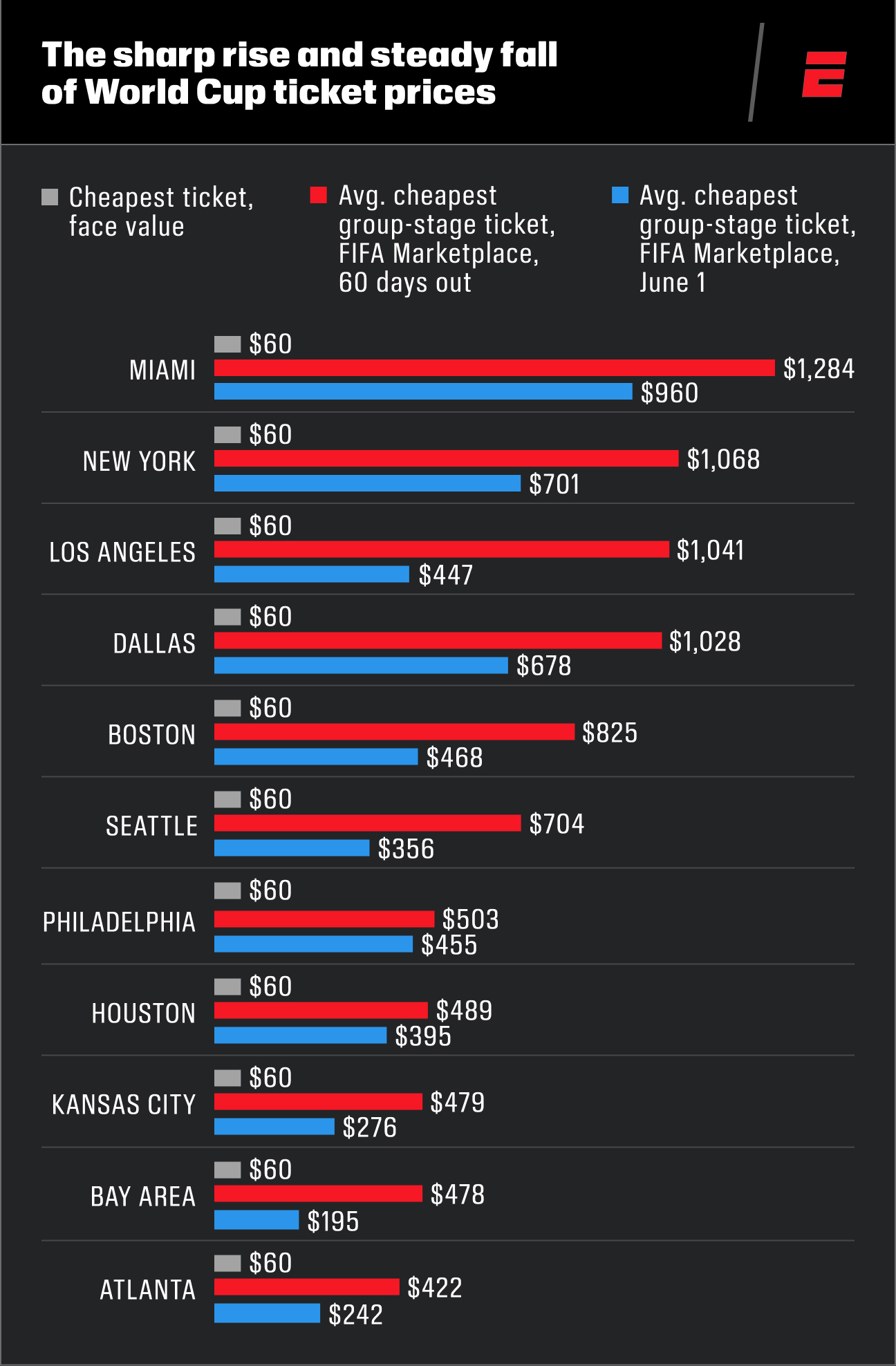
However, reports suggest the availability of $60 tickets could be limited to just hundreds, not thousands. As the tournament nears, average prices for the lowest tickets to group-stage matches ballooned considerably. For example, two months ahead of the event, the average cheapest ticket price in Los Angeles was $1,040.52 on FIFA’s resale market, while in Dallas, it reached $1,028.
To put that in perspective, that’s about twice the monthly grocery spending for the average American.
Even U.S. President Donald Trump weighed in, commenting on the exorbitant prices: “I wouldn’t pay them either, to be honest,” he said regarding tickets exceeding $1,000.
Andrew Giuliani, executive director of the White House Task Force for the World Cup, shared concerns, stating, “I think the prices are too high. I agree with the president—FIFA might be a victim of its own success.”
Back in California, Marshall—who plans to attend 11 games this summer—anticipates spending over $10,000 on tickets alone. “And I’m not even going to the final,” he added with a chuckle. “It’s crazy.”
When comparing the World Cup to the UEFA Champions League final, a premier club soccer event, ticket prices were considerably lower, ranging from $80 to $1,090. Unlike FIFA’s policies, Champions League resale tickets maintained face value without additional fees for sellers.
There could be U.S. fans willing to pay more to watch a World Cup group-stage match in their city than those who traveled across the Atlantic to see club teams like Paris Saint-Germain triumph over Arsenal for European glory.
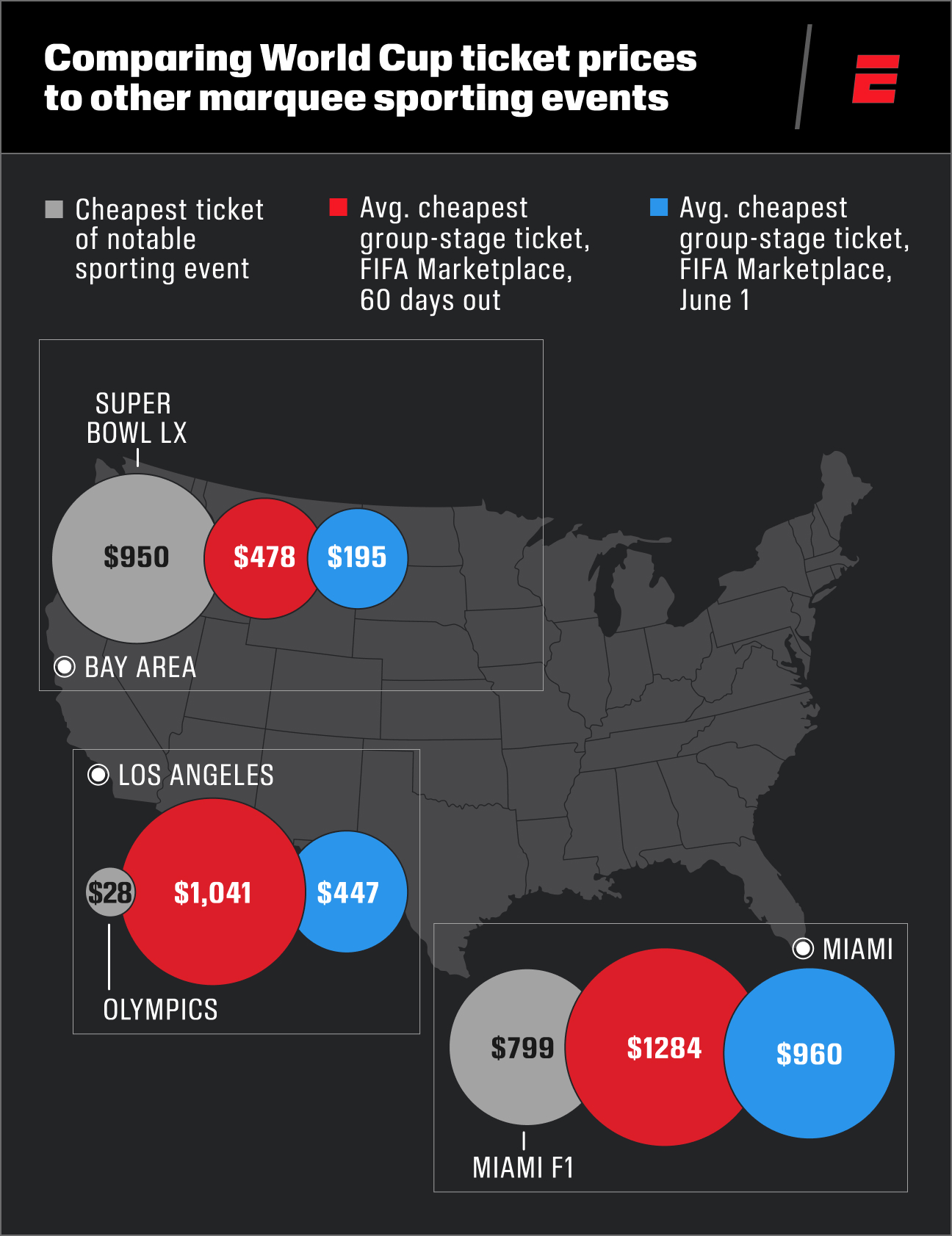
Reviewing average ticket prices as of June 1, the cheapest group-stage tickets were valued at $446.89. For Los Angeles residents, Olympic 2028 tickets could be as low as $28, while in Miami, the average lowest ticket cost was $960.54. That figure surpassed even the cheapest price for the Formula 1 Miami Grand Prix race ($799) and approached the $950 threshold for this year’s Super Bowl.
Furthermore, FIFA imposes transaction fees on the resale of tickets. While the organization does not directly set resale prices, it takes a 15% cut from buyers and sellers for each transaction.
“Modern resale markets shift ticketing economics,” said Pnina Feldman, an associate professor at the University of Virginia’s Darden School of Business. “Instead of uncontrolled resale harming sellers, an authorized marketplace enables them to manage the exchange and maximize revenue.”
From FIFA’s standpoint, the potential for profit is significant, especially with an event likened to “104 Super Bowls.” The organization claims that as a not-for-profit entity, all generated revenue is reinvested to promote soccer’s growth, with expectations to allocate over 90% of its planned investments for 2023-2026 back into the sport.
Nonetheless, there are valid concerns about whether FIFA’s pricing strategies might diminish the tournament’s appeal. “Revenue maximization can detract from the cultural significance of an event,” Feldman warned. “The World Cup is more than just a luxury product; it embodies public and cultural values. If ticket prices rise too high, it could alienate it from the very communities that cherish it.”
This issue may already be manifesting, as just ten days before the tournament begins, ticket prices have noticeably decreased on FIFA’s resale market.
When compared to the prices 60 days earlier, the average cheapest ticket price across all eleven U.S. host cities dropped by 37%. In the Bay Area, the decline reached up to 59% on the resale market, even as FIFA continues to invite bids for new tickets.
Giuliani added, “FIFA is employing dynamic pricing to see how much demand there is. Some tickets are available for under $200, but it’s undeniable that the prices are high.”
This shift is encouraging for prospective attendees, although it poses challenges for those needing to organize travel arrangements. It also raises concerns for FIFA, especially considering last summer’s incidents of empty seats at U.S. venues during the Club World Cup, which similarly applied dynamic pricing.
The Athletic reported that the USMNT’s opener on June 12 in Los Angeles “does not appear set to sell out at current prices.” In an event where there are nearly 350 million potential fans, the idea of empty seats during a World Cup feels unthinkable, but rising prices could lead to some matches playing before less-than-capacity crowds.
“Predicting prices is complicated,” Feldman stated regarding potential future declines. “Ultimately, it hinges on supply and demand dynamics at the time. I expect a split market: Some tickets will reduce in price, while the most coveted matches will likely remain expensive.”
Moreover, tickets represent just a fraction of the overall costs.
If you’re in Los Angeles for the U.S. opener against Paraguay, parking expenses can range from $151 to $300 at FIFA-approved locations. Public transport options might not be any more affordable either.
Although the host countries’ bid document claimed, “Spectators will enjoy complimentary public transportation on match days,” adjustments with cities led to fees being implemented instead. Atlanta, Houston, and Seattle will charge standard fares for rail services, while Kansas City offers $15 shuttles. Miami-Dade County is providing free shuttles, and postgame subway rides in Philadelphia will be complimentary, funded by Airbnb.
In contrast, NJ Transit will charge $98 for transport to MetLife Stadium, and an express bus in Boston is priced at $95.
“I hear from many dedicated fans… they won’t be attending any games, even with matches just up the street in L.A., because the costs are unjustifiable,” Marshall lamented. “Those folks are the ones truly affected by this.”
Welcome to the price shock of the World Cup—at what cost?
Additional reporting by Lizzy Becherano, Jeff Carlisle, and Tisha Thompson.