



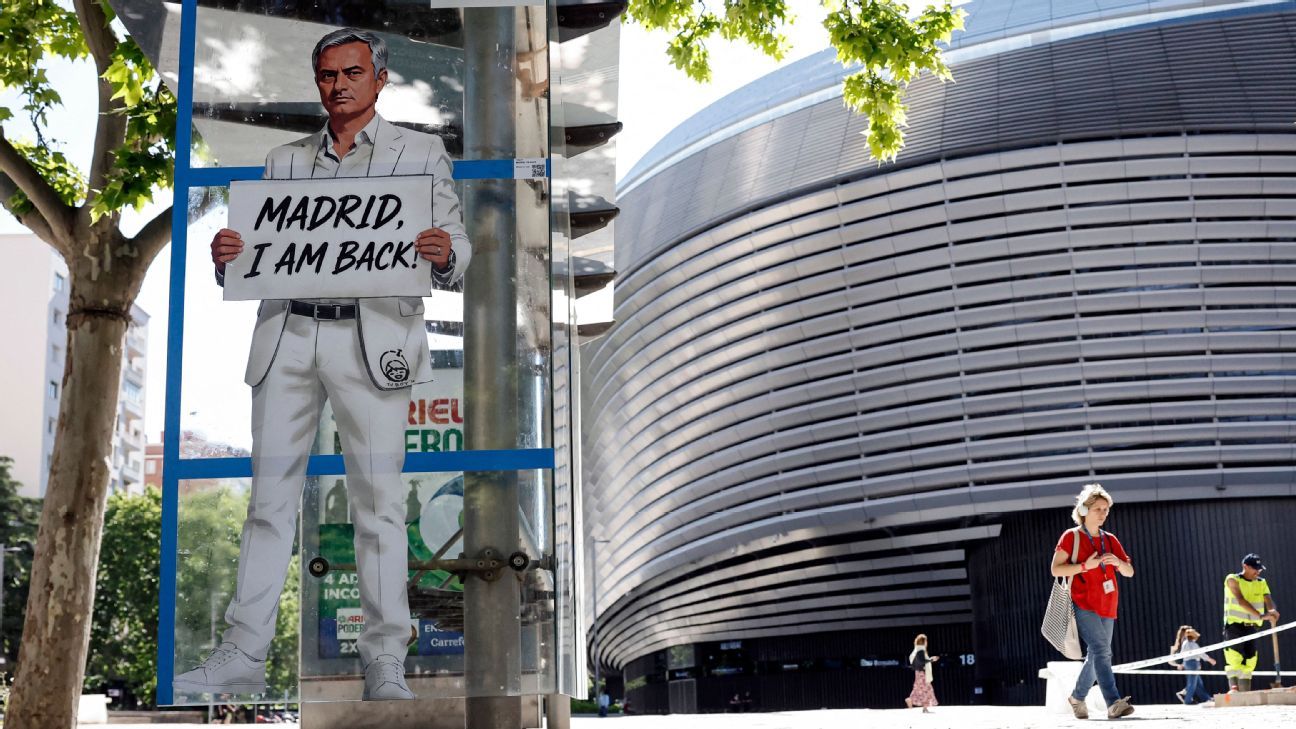
Jose Mourinho’s return to Real Madrid evokes two contrasting emotions that coexist.
On one hand, there’s a sense of nostalgia. Many supporters fondly remember his tenure—battling Pep Guardiola, Lionel Messi, and Barcelona head-to-head, clinching the league with record points and goals—considered by many as a golden era. Despite the fact that the club achieved four Champions League titles within five years after his exit, his three-year period laid the groundwork for a winning mentality that fans yearn to recapture.
The other sentiment revolves around unfinished business. The tumultuous third season—fraught with psychological drama, concluding with a 15-point deficit to Barcelona and an exit after a Copa del Rey final loss to Atlético Madrid—sparks curiosity about what could have been different. Could both parties have managed the situation with more understanding and less animosity?
Both feelings are valid yet potentially precarious, as this iteration of Mourinho and Real Madrid are not the same as before. As Heraclitus noted 2,500 years ago, “No man ever steps in the same river twice; it’s not the same river and not the same man.”
It’s essential to remember that beneath the sentimental haze of Mourinho’s era lies the fact that Real Madrid claimed just two major trophies—a LaLiga title and a Copa del Rey—in three seasons, raising questions about whether it was truly worth the anxiety. The club’s greatest successes since the 1990s have come under coaches like Vicente Del Bosque, Zinedine Zidane, and Carlo Ancelotti, who are known for their calm demeanor and ability to sidestep confrontation.
This isn’t merely about a second chance at redemption similar to a narrative in “Top Gun.” Mourinho’s polarizing nature means many will have formed their opinions before he even arrives at Valdebebas.
His main mandate is to invigorate the fanbase and drive results—something he’s accomplished at nearly every previous stop. Few managers establish a connection with their supporters quite like he does, especially among those who appreciate his candid approach. However, toppling Barcelona’s dominance, as they’ve secured three LaLiga titles in four years, is the minimum expectation.
Though he enjoys the backing of president Florentino Pérez, history shows how quickly that can change; nine of the twelve coaches Pérez has appointed in his two-decade tenure have lasted less than a year.
Mourinho will also step into a squad overflowing with talent but lacking cohesion and morale. Signs of discord—such as players getting into fights—are troubling, as is the behavior of top players who seem distracted during critical times. Fans are frustrated when players take time off for leisure while recovering from injuries.
In contrast, when Mourinho took charge in 2010, he replaced Manuel Pellegrini, who had just finished second with 96 points and orchestrated an extraordinary transfer window that brought in stars like Karim Benzema, Xabi Alonso, Kaká, and Cristiano Ronaldo. Mourinho then added significant talent in his debut season.
Critics argue that Mourinho typically operates by spending heavily on new players. However, he won’t have the luxury of a complete overhaul this time around. While some new faces will arrive, he must enhance the current squad’s dynamics.
Creating discipline and accountability within the team will be vital. Mourinho has demonstrated his capacity for this in recent roles at Benfica, Fenerbahçe, and AS Roma, not through authoritarian measures, but by fostering team spirit.
Despite what critics say about his tactics being outdated, it’s crucial to recognize that Mourinho’s strategic style has evolved. He has often favored defensive organization and counterattacks, especially in high-stakes matches. His philosophy may not thrill neutral observers compared to the spectacular play of clubs like Bayern or PSG, but his focus is on delivering results for Real Madrid and its fans. Given recent struggles, securing victories will likely suffice in the short term. With talents like Kylian Mbappé and Vinícius Júnior at his disposal, exploiting transitions effectively can be a strategic advantage rather than a negative approach.
The question remains: will it be successful? Mourinho has weathered many challenges throughout his career, and as the saying goes, you often gain wisdom from failures. The Mourinho of 2010-2013 was untested in some aspects, but now he arrives with experience from past disappointments, learning and adapting along the way.
Nevertheless, one should not expect a revolutionary shift in philosophy akin to what Xabi Alonso would have brought. Mourinho and Pérez are both at an age where long-term thinking is unlikely. This chapter will not present a long-term vision, but rather a fleeting reunion—two entities rekindling a connection for what may be their final partnership. Perhaps this is exactly what the club needs right now.
Revisiting old ties after many years means recognizing that both parties have changed. While their shared history matters, having spent 13 years apart also influences their present dynamic. Both must strive to start anew and let go of the past—a challenge neither is particularly adept at achieving.
If they can manage that, there’s a chance for this partnership to flourish.