



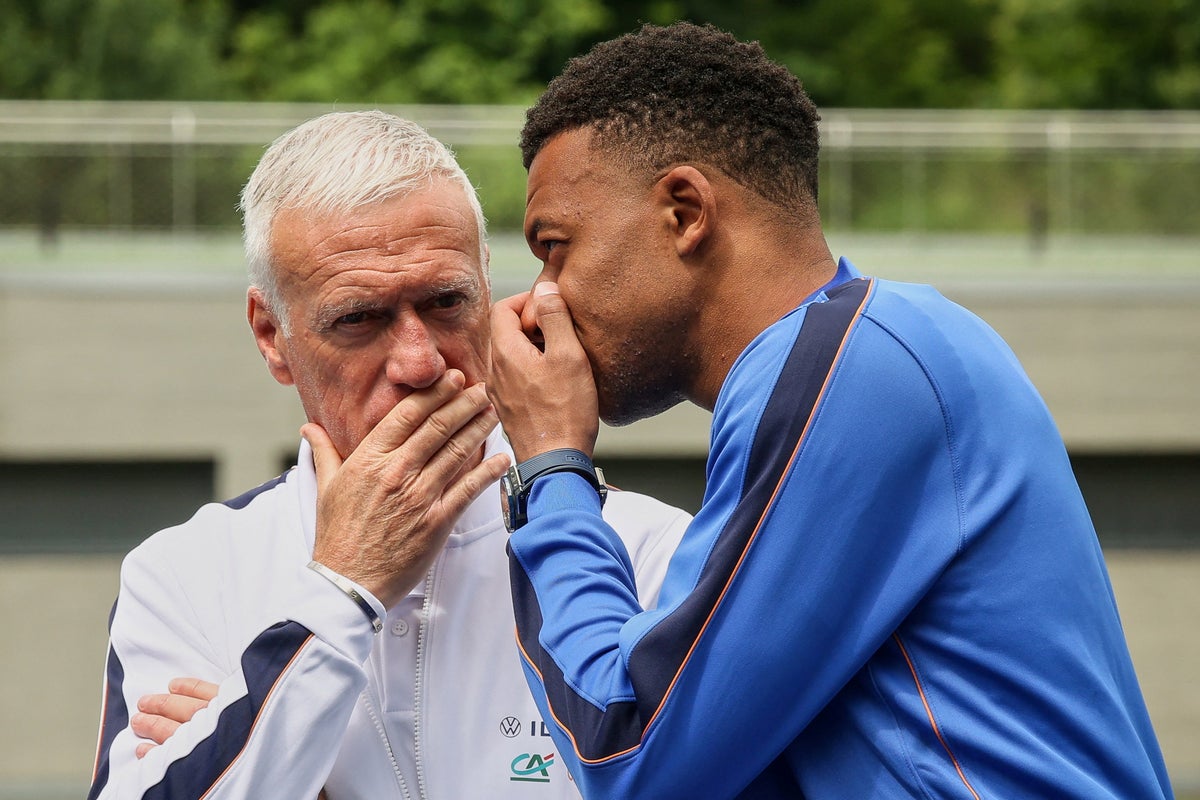
When Didier Deschamps took the helm as manager of France, it was so long ago that José Mourinho was the manager of Real Madrid—in his first tenure, no less. To put it into perspective, Sir Alex Ferguson was still at Manchester United, and Sir Kenny Dalglish had just departed from Liverpool, while Tottenham was turning to André Villas-Boas.
Deschamps has been a significant figure during this time, but he is now approaching the end of an era. After 14 years, he is set to step down, potentially after coaching France in 188 matches if they reach a third consecutive World Cup final or the third-place match. He will fall just short of Joachim Löw’s record of nearly 15 years and 198 matches as a European team manager.
His immediate predecessor, the previous World Cup-winning coach, serves as a point of reference. Löw maintained his position for too long with Germany. Should France underperform in the United States, critics might argue that Deschamps has overstayed his welcome, especially with his former teammate and three-time Champions League-winning coach, Zinedine Zidane, seemingly poised to take over.

(Reuters)
Should Deschamps lead France to victory in New York on July 19, it could warrant claims of him being the greatest World Cup manager. He has indeed had the privilege of coaching exceptional talent, clinching one championship and reaching the final on another occasion. Notably, before he took charge, France’s last World Cup outing in South Africa in 2010 was nothing short of humiliating, marred by player mutinies and an early exit with just a single goal to their name.
After Laurent Blanc stepped down in 2012, appointing Deschamps made sense. He joined iconic company by winning the World Cup as both captain and manager. However, some have criticized him as benefiting from an abundance of talent—his pragmatic coaching style lacking a distinctive philosophy, leading to the absence of something as recognizable as Deschampsball. Yet, no other manager has overseen a team score seven times in World Cup finals.
On the other hand, critics note that Deschamps’ France reached the semi-finals of Euro 2024 without a single open-play goal, relying instead on two own goals, a penalty, and a successful shootout. At that moment, France seemed less than the sum of its parts.
Throughout his tenure, however, Deschamps has often effectively utilized his players to benefit Les Bleus. During the 2018 World Cup, for example, he included Olivier Giroud, who didn’t take a shot on goal but played a vital role in facilitating the play for Kylian Mbappé and Antoine Griezmann. His strategic use of the selfless Blaise Matuidi allowed Paul Pogba more freedom to attack, ensuring the team remained balanced.
In 2022, Griezmann was deployed in a deeper role to adapt to a midfield lacking Pogba and N’Golo Kanté, demonstrating Deschamps’ adaptability. Even with Adrien Rabiot initially sidelined in 2018, he bore no grudge against him. The decision to substitute Giroud and Ousmane Dembélé in the first half of the final might have seemed harsh, but it played a pivotal role in France’s comeback.
While Deschamps can appear unsentimental, he made bold decisions, such as not appointing Griezmann as captain after Hugo Lloris’s retirement, opting instead for Mbappé. This squad boasts young talents like Mbappé—whose international performances have outshone his club career—as well as the current Ballon d’Or winner. Dembélé has contributed less on the international stage, tallying just seven international goals, yet he is part of a remarkable attacking lineup alongside Mbappé, Désiré Doué, and Michael Olise.

(Getty)
Deschamps’ challenge will lie in balancing these players. The profile of the French team suggests they won’t often dominate possession, but their game-changing pace on the counterattack is unrivaled.
This will be essential as they embark on a challenging journey. Their group, featuring Norway and Senegal, is formidable. Winning the group could lead to a last-16 matchup against Germany, while finishing second could pit them against Brazil. A semifinal against Spain looms as a potential rematch of Euro 2024.
Despite the obstacles, Deschamps’ teams historically progress further in tournaments, sometimes at the expense of more celebrated teams. In six tournaments with him at the helm, they have only been eliminated once in the knockout stages—by the eventual winners on two occasions, including a narrow defeat to Portugal in the Euro 2016 final and again in the 2022 World Cup final, as well as a loss to Spain.

(Getty)
As a result, Deschamps has often advanced further in tournaments than some of his more renowned counterparts. Over the course of his career, figures like Luis Enrique, Antonio Conte, and Louis van Gaal have tasted international competition, while now others, such as Thomas Tuchel, Carlo Ancelotti, and Mauricio Pochettino, are stepping onto the stage.
With Deschamps now succeeding Löw as the constant figure in the game, he stands out by having taken over from the German as a reigning world champion. Their paths have bifurcated since as no manager has reached three consecutive World Cup finals yet. As France’s World Cup campaign commences at the MetLife Stadium in New York, it may very well mark the end of Deschamps’ storied tenure.