



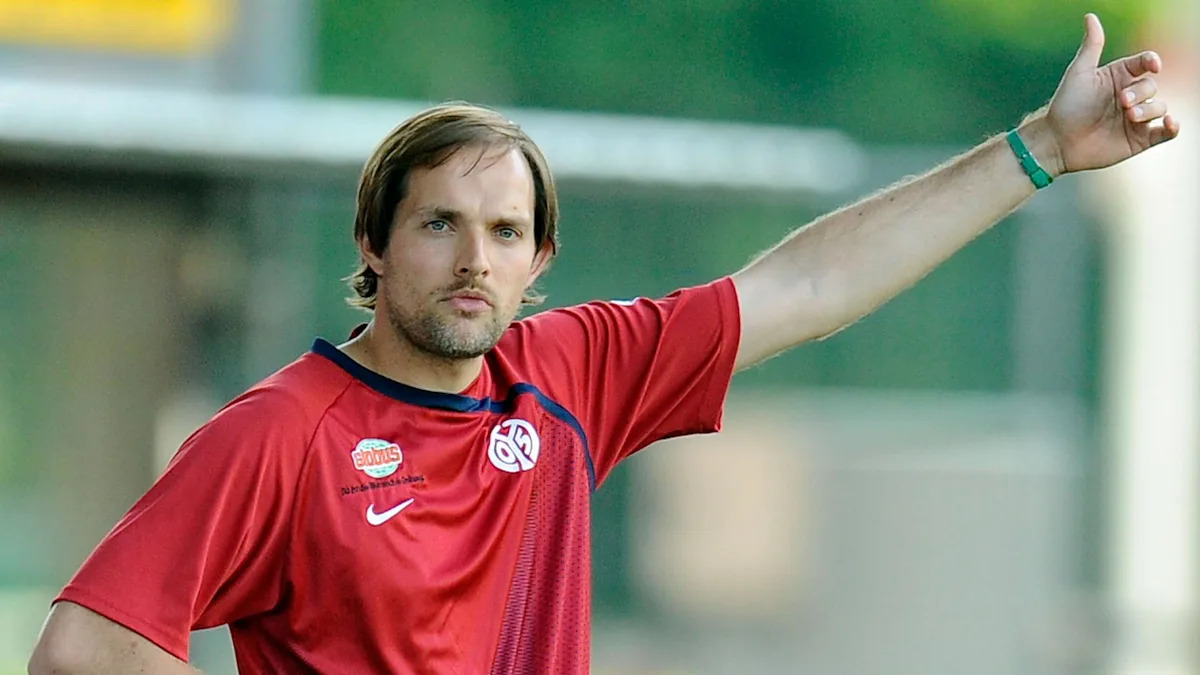
When Glenn Hoddle’s England kicked off their World Cup journey in France in 1998, Thomas Tuchel was still a bartender in Stuttgart.
Fast forward nearly three decades, and Tuchel is now at the helm of the England team, challenged with achieving what Hoddle and many others could not — bringing home the World Cup for the Three Lions.
At 52, the German coach is celebrated as one of the brightest minds in football, known for his meticulous attention to detail and remarkable analytical skills.
It’s astonishing to think that in the late ’90s, Tuchel was amidst Stuttgart’s vibrant nightlife and socializing with some of Germany’s top hip-hop artists.
Ironically, it was during this time, after nearly abandoning his football aspirations, that Tuchel’s path toward World Cup leadership began.
Last year, renowned German coach Ralf Rangnick recounted how he jump-started Tuchel’s coaching career.
“When I learned he was working at a bar in Stuttgart to make ends meet, I was shocked,” Rangnick told the BBC in an interview.
“I called him and asked, ‘What are you doing?’ He replied, ‘I have to earn a living.’ That’s when I suggested he come to Stuttgart to work as a youth-team coach.”
Rangnick and Tuchel had a strong rapport, having played together during Tuchel’s stint at SSV Ulm. Rangnick was instrumental in revolutionizing tactics in German football by introducing zonal marking.
As Tuchel later shared with Sky Sports, Rangnick profoundly impacted the way he perceived the game. Rangnick recognized Tuchel’s potential for coaching early on, noting, “He was always curious about the strategies behind our plays.”
Tuchel’s playing career was tragically cut short due to a knee injury, which caused debilitating pain. After undergoing surgery at 23 to salvage his career, he ultimately came to terms with the decision to retire. This injury dashed his hopes of playing in the Bundesliga and left him financially burdened, as he had been without sufficient insurance for the operation.
Having previously left his studies in sports and English to pursue football, Tuchel found himself starting anew.
“I still had nothing in my bank account. I felt like a professional footballer, yet I was job hunting,” he confessed in a 2017 interview with Die Zeit.
From Glass Collector to Bartender
Tuchel relocated to Stuttgart to study business administration and took a job at a bar. This was not just any bar; it was located in the historic Radio Barth building on Stuttgart’s Rotebuhlplatz.
The property had once been a prominent music store that faced closure due to insolvency in 1995, but before its demolition, it served as a cultural hub for emerging artists.
The Radio Bar, where Tuchel worked, quickly became a hot spot for Stuttgart’s vibrant hip-hop scene.
In an interview from a 2008 student documentary, the bar’s former manager Carlos Coelho reminisced about its popularity: “We had to turn people away because there was no room left. It was beloved.”
Tuchel started by collecting empty bottles and glasses, gradually taking on serving duties, including crafting cocktails. Reflecting on his early drink-mixing skills, he remarked, “I wouldn’t have wanted to sip the cocktails I made initially.”
Still, his time at the bar proved invaluable, helping him build confidence and significant social skills. “Shift by shift, night by night, I learned to ask strangers if they needed help, and I discovered people appreciated me for who I was, oblivious to my past as a footballer,” Tuchel reflected.
During this period, he formed a friendship with Max Herre, a musician who would become one of Germany’s leading rappers. In a 2024 podcast interview, Herre shared how Tuchel became part of his circle and frequently attended his concerts, even traveling to Vienna for a show.
‘The Coach with X-Ray Vision’

Tuchel has extended his contract as England manager until Euro 2028 [Getty Images]
When Rangnick offered him a coaching position, Tuchel was hesitant at first. However, after hearing about his former club Ulm’s promotion to the Bundesliga in 1999 while working his bar shift, he felt a twinge of regret.
“I was really upset because I thought, ‘I always wanted to be in the Bundesliga, and now they are living my dream,’” he recalled. Frustrated, he told his colleagues he needed to leave his job.
The Radio Bar’s loss became VfB Stuttgart‘s gain as Tuchel embraced his new role as a youth coach.
He first worked with the under-15s before becoming assistant to the esteemed youth coach Hans-Martin ‘Hansi’ Kleitsch with the under-19s.
Kleitsch, like Rangnick, played a pivotal role in promoting zonal marking tactics and was known for developing Stuttgart into a powerhouse of youth talent.
Players such as Sami Khedira and Mario Gomez emerged from this system. Khedira, a World Cup champion, was part of the under-19 team that clinched the German championship in 2005, with Kleitsch as head coach and Tuchel as his assistant.
In an interview with Spox in 2020, Kleitsch noted Tuchel’s unique style that resonated with the young players, mentioning his iconic military parka that many players sought to imitate.
Ultimately, what set Tuchel apart was his coaching acumen and extraordinary analytical abilities. Kleitsch referred to him as “the man with X-ray vision,” emphasizing how Tuchel’s game strategies consistently succeeded by breaking down opponents and devising effective solutions.
Amidst recent squad announcements that raised eyebrows, England fans remain hopeful that Tuchel’s sharp analytical skills will prevail.
As he embarks on this demanding journey, three decades since he left behind his bar job to re-enter the football world, Tuchel now confronts what could be the defining challenge of his career: reclaiming the World Cup for England.