



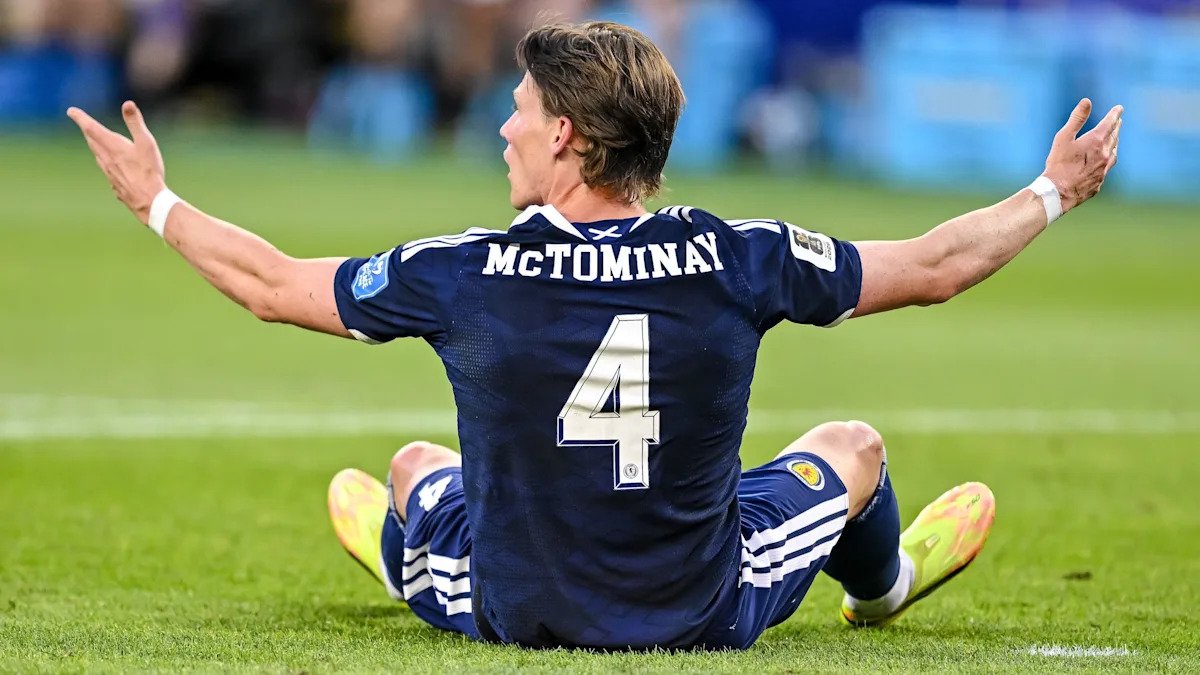
The quality in Boston is on the decline.
The Scotland national team has started their World Cup journey with two matches, but there has yet to be a hint of artistry, like a bicycle kick, on display.
Scott McTominay dazzled fans with a stunning goal against Denmark last November, showcasing the brilliance that has made him a standout performer in Naples.
Advertisement
That highlight fueled Scotland’s magical night in Glasgow, marking their return to the World Cup after 28 years, yet their journey has thus far yielded a narrow victory and a close defeat.
In both games, the nation’s star player hasn’t shone as brightly, raising questions about the 29-year-old midfielder’s influence. Can he be the player to upset Brazil, and is it reasonable to expect him to do so?
McTominay – in sickness and in health
Over his 72 appearances, the Napoli standout has scored 15 goals and provided two assists, but those stats don’t fully capture his contributions.
He has consistently risen to the occasion in crucial matches. His inaugural goal was a decisive strike against Israel in 2021, while his brace famously secured a victory against Spain at Hampden, not to mention his memorable performance against Denmark.
Advertisement
Now, as the World Cup progresses, expectations are high for him to influence matches alongside Tartan Army hero John McGinn, placing immense pressure on him.
In the match against Haiti, McTominay nearly scored a stunning goal, yet the BBC Sport audience rated three players better than him, while against Morocco, he received a rating of 5.09, placing seven Scots ahead of him.
But is this evaluation justified?
In the match against Haiti, McTominay boasted a 93% pass completion rate, the second-highest on the team, dropping slightly to 89% against Morocco, where he held the third highest completion rate.
He recorded two shots on target in both games, one more than he managed back in his heroics against Denmark in November.
Advertisement
McTominay covered over 12 km during the game against Haiti, leading all players in distance run. In the match against Morocco, he only fell short of Lewis Ferguson, who outpaced him by 369 meters.
Despite dealing with an upset stomach before their opening match, McTominay played through it. Did he dominate? Not quite, but he still contributed to a subdued Scotland side that managed a 1-0 victory.
In the game against Morocco, the Scots faced a rapid onslaught from the Africa Cup of Nations champions, which destabilized them early on.
As the match progressed, especially after halftime, Scotland began to assert more control over the game, albeit without creating many clear-cut chances.
Advertisement
How can McTominay be more impactful against Brazil?
It’s clear that McTominay’s strengths lie in attacking positions. It’s been a while since coach Steve Clarke has deployed him as a center-back.
His sharp eye for goal, ability to position himself effectively, and strength to overpower defenders are pivotal attributes.
It’s telling that some of McTominay’s less influential moments occurred during stretches when Scotland struggled defensively.
Throughout much of the game against Haiti, Scotland lacked urgency in their offensive movements and failed to circulate the ball effectively.
Advertisement
They received the ball 77 times in the attacking third, compared to 116 times in their own half.
The accompanying graphic highlights that Haiti consistently took the initiative, particularly towards the end of the match.
The second half against Morocco may be considered Scotland’s most dynamic showing of their three World Cup appearances under Clarke, with McTominay’s involvement increasing during this time.
“I’ve seen a bit of Scott,” remarked former Scotland winger Pat Nevin about McTominay’s performances at Napoli and with the national team. “Scott is not Billy Gilmour. He’s not going to dictate the game or orchestrate play.
Advertisement
“He can pass and do those things, but he won’t be a technical player dictating the tempo. He will, however, excel at timing his runs into the box; that’s where he shines as an 8 or a 10. His work rate is also exceptional.
“So when people say, ‘he didn’t contribute significantly until later,’ it’s tough to impact when the team isn’t pushing forward.”
While the pressure wasn’t consistently maintained during the second half, it’s evident that Scotland became much more threatening as the match progressed.
Advertisement
But what caused this shift in dynamics?
The absence of Gilmour is a critical variable to consider when assessing McTominay’s effectiveness.
Ferguson has stepped in, and arguably has been Scotland’s standout performer across both matches.
Yet, while he has played more of a holding role, his ability to unleash his energy and facilitate plays for McTominay and McGinn has been somewhat restricted.
This changed late in the game against Morocco with the substitution of Kenny McLean, which freed Ferguson to be more dynamic.
Former Scotland international Leanne Crichton commented, “I believe we played with courage, quality, and composure at times, and that’s when Scott McTominay thrives.
Advertisement
“You can witness his abilities; he’s undoubtedly present on the pitch.
“If Scott McTominay is being marked or closely guarded, players need to recognize those moments and make smarter choices with the ball.
“I think that’s a place where we’ve fallen short in critical moments.”
Nevin added: “He’s not a game controller in the way some might expect. Even the best players in the world don’t always fulfill that role.
“In midfield, there are many layers to influence. Scott has an elite specialization, but to maximize his potential, you need to find the right spaces to play.”
Advertisement
“We just didn’t manage to take advantage of those situations, hence stagnation in the final third.
“So, I wouldn’t hold any critique against Scott. He’s putting in a tremendous effort.”