



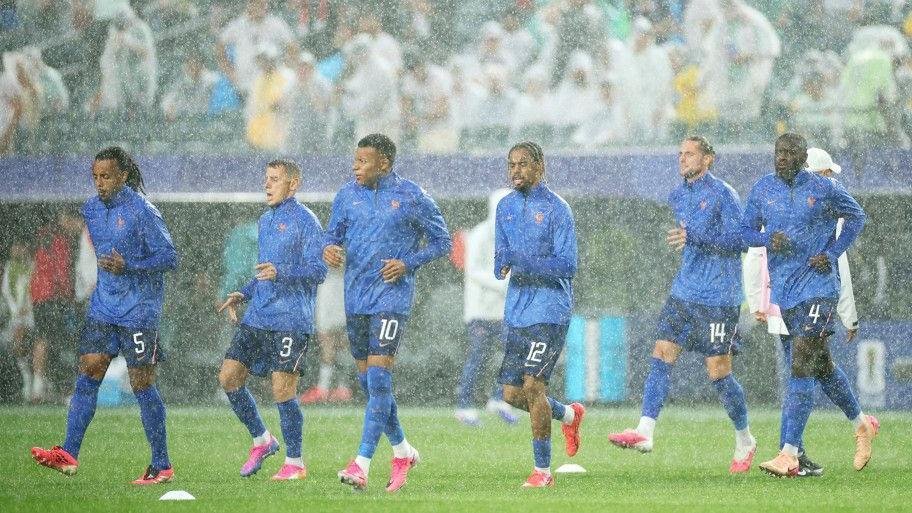
“It’s been a challenging night for everyone,” shouted the stadium announcer as a weather delay stretched over two hours during the match between France and Iraq.
It was a tough experience for the players, coaches, and the 68,344 fans packed into Philadelphia Stadium.
Advertisement
The match, which kicked off at 17:00 local time, finally concluded at 20:47 due to safety concerns regarding severe weather.
Storm clouds were already gathering when Canadian referee Drew Fischer called for half-time at 17:49, with France leading 1-0.
Heavy rain and thunderstorms soon followed.
When officials finally gave the green light to resume, it was 20:00.
Eager to make up for lost time, France scored two additional goals, concluding the match with a 3-0 victory, highlighted by Kylian Mbappe netting twice on his 100th international cap, propelling Les Bleus into the last 32.
No hydration break occurred in the second half, and only two minutes of stoppage time were added at the end.
Advertisement
“It was a very long evening,” remarked Mbappe.
“We had to wait quite a bit. It was emotionally and mentally exhausting, needing to stay completely focused in the dressing room.
“Being in the dressing room for almost two hours while maintaining that focus is tough. It required significant effort from both players and staff.”
What did they do during the delay?
“We played cards,” quipped France coach Didier Deschamps.
“In reality, we were just waiting. Each time we were given a time to start, it got pushed back.
“I enjoyed spending time with my players and having fun.
Advertisement
“Safety comes first. You can’t battle against rain and lightning.
“I’m not annoyed. These are unusual circumstances, and I hope we won’t have to face them again. Prioritizing safety was crucial.”

Kylian Mbappe points out flooded areas of the pitch to ground staff at Philadelphia Stadium [Reuters]
‘First Time I’ve Ever Experienced This’
This was the 42nd match of the World Cup—and the first postponed due to weather.
FIFA is bound by the advice of local authorities regarding adverse weather conditions and does not have autonomy to set its own regulations.
In the U.S., the National Oceanic and Atmospheric Administration (NOAA) guidelines are followed.
According to NOAA, any detected lightning within eight miles of a stadium mandates an immediate game stoppage.
Local cable networks had predicted challenging weather conditions two days in advance, leading up to the game.
Although the sun was shining in Philadelphia just hours before kick-off, storms arrived shortly after half-time.
During the intermission, spectators were directed to seek shelter in the concourse.
Despite the long wait in the concourse, most fans remained in the stadium, which appeared full when play resumed.
Advertisement
The players returned for warm-ups approximately one hour and 40 minutes later, only to face another delay as staff cleared standing water from the pitch.
Once play resumed, Iraq’s error during a goal-kick handed France and Mbappe another goal.
Australia’s head coach Graham Arnold of Iraq felt the lengthy delay contributed to the mistake.
“I told the players the key was who could mentally switch back on. It’s disappointing that the mistake cost us,” he explained.
“Experiencing a two-hour stop was unusual for me as a coach and player.”
Advertisement
Arnold used the downtime to review first-half footage with his team.
“The focus was on relaxing and preparing the players to step out on the pitch once more. It was a unique experience for all of us.”
‘We Did Some Cycling’
Fans were instructed to find shelter during the weather pause.
Announcements provided regular updates, and when it was confirmed that the weather threat had passed, the reaction was one of the loudest cheers of the night.
The atmosphere in the stadium transformed as fans, donning ponchos, danced jubilantly.
Advertisement
“It felt like a new match was kicking off after the interruption,” noted France defender Jules Kounde.
“We did some cycling to keep moving. Then we chatted while we waited to warm up again.”
“We were eager to finish the game and ensure the pitch was in playable condition after the flooding.”
Former Scotland winger Pat Nevin, present for BBC Radio 5 Live, commented that the lengthy break benefited France.
“The delay disrupted the routines players had planned for the next few days, affecting their hydration and nutrition,” he explained.
Advertisement
“Interestingly, the break seemed to favor the French squad, as they returned and dominated the match for the remainder.”
What Do Players Do During a Storm Delay?
Former West Ham assistant coach Edu Rubio provided insight into how teams handle weather delays during matches.
Now an assistant head coach at Sporting Kansas City, he described to BBC Sport the weather delays they faced during pre-season games in Florida two years ago.
“Two out of our four friendlies were postponed due to storms,” he remarked.
“They enforce strict safety protocols here, and rightly so.
Advertisement
“Different cultures and coaching teams have their own strategies.
“It’s essential to adhere to protocols, so we would retreat to the locker room and receive updates every 20 minutes.
“Initially, we allowed the players to relax and change into comfortable clothes—those used for warming up.
“Then they engaged in light cycling, stretching, or even yoga, before we set up football-tennis to keep them entertained and distracted from the weather concerns.”
Advertisement
“We also reviewed brief clips of match footage to remind players about the game plan. Though such delays can be frustrating, we tried to keep things straightforward.”
“I wonder what I’d do if the interruptions lasted longer than 45 minutes,” he concluded.