



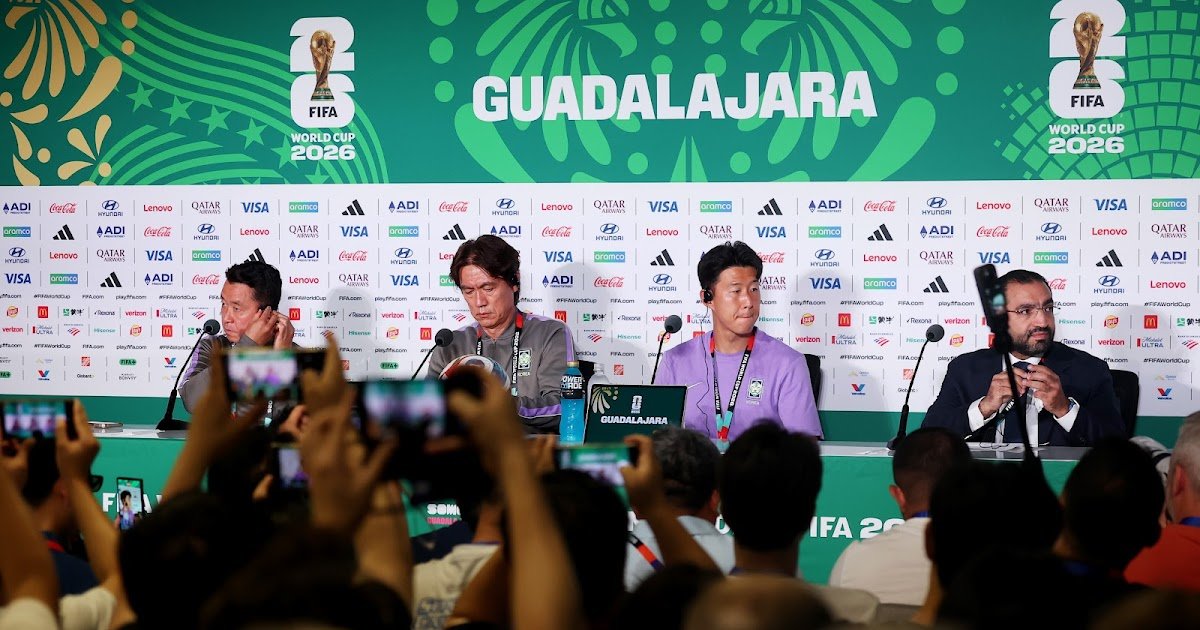
Representing a country at the World Cup extends beyond the players and coaching staff; the media plays an important role as well. Journalists have the duty to depict the spirit, emotion, and ambiance of the event for fans at home, conveying the realities on the ground without compromising the trust placed in them by the players. Park Ju-mi of KBS, South Korea’s national broadcaster, shares her experiences covering three World Cups.
(Photo by Lars Baron/Getty Images)
Advertisement
Park Ju-mi, a seasoned journalist at KBS, has attended three World Cup events: Brazil in 2014, Russia in 2018, and Qatar in 2022. Throughout her journeys, she has witnessed the intense pressures of representing South Korea on football’s grandest stage, capturing the joy, heartbreak, and the delicate balance of providing insights without breaching the confidentiality essential to the players’ wellbeing.
In this extensive interview, Park discusses her experiences, including comparisons to the legendary 2002 South Korean team, the dynamic between the media and the national squad, and much more.
What’s the primary distinction between being a fan of the national team and covering them as a journalist?
When watching the national team as a fan, the emotional investment in the game’s outcome is profound. However, as a reporter at the World Cup, you’re compelled to analyze the situation more intricately and holistically. You start considering questions like: “What led to this outcome?” “What was the players’ mental state?” “What direction is Korean football heading?”
Advertisement
From the pre-tournament preparations to the determination captured in players’ expressions, you focus on underlying dynamics that often go unnoticed. You not only engage with their performance but also the palpable atmosphere surrounding the team, understanding that the World Cup encapsulates a unique confluence of national emotions. This awareness amplifies journalists’ responsibilities to convey the significance of these moments rather than merely sharing excitement or disappointment.
How evident is the pressure to represent the entire nation within the team?
The pressure felt by the national team is far more intense than commonly perceived. Players often express that they aren’t just playing a sport; they carry “the hopes of the entire nation.”
Advertisement
For instance, in the past, the team has held send-off events at Gwanghwamun Square, symbolizing the seriousness of their mission. Ahead of the 2014 World Cup in Brazil, players arrived at their first training camp dressed in suits, demonstrating their commitment to the tournament.
Korean players are acutely aware of the weight that comes with donning the Taegeuk badge. Unlike the Olympics, where public support is less visible, during the World Cup, fans gather en masse to cheer for the national team, regardless of the time of day, underscoring the unique fervor associated with the tournament.
Players track real-time reactions via social media, amplifying the pressure. Football is a fast-paced sport in Korea, and public sentiment shifts rapidly. During the World Cup, even minor actions can attract significant scrutiny, putting immense psychological pressure on the players.
For example, during the 2018 World Cup match against Sweden, after conceding a penalty, players Kim Min-woo and Jang Hyun-soo faced harsh criticism online. Consequently, the Korea Football Association made an unusual request to reporters to avoid publishing certain pieces to protect the players’ mental health.
Advertisement
These athletes contend not only with the match itself but also the psychological impacts of external pressures. I recall seeing Kim Min-woo in the mixed zone after the match, and he looked utterly devastated, apologizing repeatedly to supporters and visibly emotional.
Witnessing such moments makes you reflect as a human being: Why do these young players have to endure such tremendous pressure? It’s truly disheartening.
Do players cope with this pressure differently?
Players who manage pressure effectively typically share two attributes: experience in high-stakes situations and emotional regulation. While technical skills are crucial at a tournament like the World Cup, maintaining composure is paramount.
Advertisement
Players such as Park Ji-sung, Park Chu-young, and Son Heung-min have shown the ability to stay composed and stabilize their teammates. Experience against elite opponents contributes significantly to this mindset, allowing them to withstand pressure.
Conversely, less experienced players, particularly during their initial World Cup, may feel overwhelmed, not just by the competition but by the enormous atmosphere of the event itself. In such scenarios, the influence of seasoned leaders becomes vital.

Park Ju-mi at the Qatar World Cup
Advertisement
Do you feel pressure to accurately capture significant World Cup moments as a reporter?
Indeed, reporters experience a similar kind of pressure. At the World Cup, a single moment, interview, or remark can define a player’s career. Thus, we hold the duty to accurately convey the essence of these moments, avoiding exaggerated portrayals.
In South Korea, World Cup coverage tends to resonate for years, which makes us extra vigilant. We meticulously consider every word, opting for positive expressions over negative ones. For instance, instead of saying: “Player B failed to stop world-class player A, leading to a goal,” we might articulate: “Player B tried to halt world-class player A, but A’s movement created the opportunity.”
A standout performance in the World Cup can mark a pinnacle in a player’s career, while careless reporting can negatively impact their trajectory. This understanding adds to our responsibility with every word we write.
Advertisement
What is something Korean viewers might not fully grasp about the World Cup environment?
For viewers, the palpable tension of being present on the ground during the World Cup can be challenging to fully appreciate through a screen.
Even before kick-off, the atmosphere morphs dramatically in the host city during the tournament. Around team hotels, media centers, and mixed zones, tension is palpable and shifts dynamically. Especially after a loss, the silence and expressions in the mixed zone reveal sentiments that television cannot authentically convey.
Do you feel a similar sense of accountability as a journalist representing Korea internationally?
To a degree, yes. While the roles of players and journalists differ, covering the national team overseas instills a sense of representing Korea as well.
Advertisement
During the last three World Cups (2014-2022), I noticed South Korea’s rising football profile through the increasing interest of foreign journalists in training sessions. For instance, at the Qatar World Cup, I saw banners featuring Son Heung-min alongside global icons like Cristiano Ronaldo, with many reporters eager to cover players like Kim Min-jae as well.
In conversations with international journalists, I often find myself explaining aspects of Korean football culture and player backgrounds, adding to the sense of responsibility beyond mere reporting.
Can you recount a moment where you felt the emotional impact of the national team firsthand?
One of my most poignant moments occurred after South Korea’s victory over Portugal at the 2022 Qatar World Cup. Post-match, players embraced and shed tears. As a broadcast reporter conducting on-field interviews, the emotional atmosphere was undeniable, transcending pure victory.
Understanding the arduous journey those players undertook, witnessing them defy expectations and create a miraculous team achievement was incredibly stirring. In such moments, reporter objectivity can blur as the emotional weight becomes palpable, challenging one’s ability to maintain composure while covering events.
Do players express themselves differently in interviews during the World Cup compared to regular international fixtures?
Definitely; the atmosphere is distinctly heightened at the World Cup. Players exhibit more caution in their responses, acutely aware of how a single remark can have far-reaching implications.
Conversely, there are times when players become more sincerely emotional, particularly after positive outcomes.
Advertisement
Since the World Cup is the pinnacle of their careers, players often engage more openly and honestly than they typically would. I’ve witnessed many players become tearful during interviews, and these moments resonate with me on an emotional level as well.

Park Ju-mi reporting from Qatar
How has the media’s relationship with the national team changed over time?
The relationship has arguably shifted, with a growing distance between media and the national team compared to earlier times.
In the past, interactions felt more relaxed and personable. Nowadays, media relations are more structured, with a greater focus on protecting players.
Advertisement
In our social media-driven world, interview comments can be instantaneously amplified or misinterpreted, leading players to exercise more caution. Additionally, media access has become more restricted to prevent tactical and injury-related insights from falling into opponents’ hands.
What is the atmosphere among Korean media when the national team secures a significant World Cup victory?
The environment among Korean journalists post-major victories is exhilarating. It feels like a rush of euphoria. Physically drained but mentally elated, the moment feels historic.
While journalists typically strive for composure, during the World Cup there’s a shared sense among the Korean press corps that they are witnessing a pivotal moment in football history. My first thought in these instances is: “This scene will be etched in the annals of Korean football.”
Advertisement
It’s chaotic yet joyous. After a long day, enjoying a cold beer feels remarkably restorative. Despite demanding schedules that require reporters to prepare multiple versions of their reports in advance, the challenges are accompanied by a fulfilling sense of achievement.
Do you think the media is fair in its reporting and critique of the national team?
In general, I believe the Korean media is often quite critical of the national team, influenced by high expectations and intense public interest. While criticism can sometimes be excessive, this passionate engagement also fuels Korean football’s momentum.
However, there has been a trend toward more superficial criticism, often lacking a deeper grasp of the team’s context. I wish for more analytical coverage focusing on structural issues, existing tactical challenges, and player welfare rather than surface-level results.
Advertisement
Are Korea’s teams still compared to the 2002 squad?
Absolutely. The 2002 team remains the gold standard. Following that World Cup, reaching the Round of 16 almost became an expectation.
The remarkable run to the semifinals in 2002 set a bar for future generations. This achievement brought about increased interest in Korean football, investment, and participation, leading to a significant rise in players transferring to elite European leagues.
Advertisement
It also instilled a sense of confidence that Korea could compete globally. However, while the capabilities of players and fans have advanced significantly, structural growth in the football system has not kept pace, limiting the full realization of potential.
There has been a lack of thoughtful reflection on aspects like coaching development. Additionally, there exists frustration that Korea may be lingering too long on its past accomplishments without acknowledging that other nations continue to progress. Yet, I am optimistic that systemic updates will eventually align with the talent and enthusiasm of players and fans.
Do you think the media contributed to those heightened expectations?
Yes, I believe the media played a significant role. In 2002, the nation’s collective enthusiasm for the World Cup was amplified by the media, creating a cultural frenzy surrounding the event. Today, the World Cup is perceived not merely as a sports competition but as a collective national accomplishment, perpetuating those expectations to this day.
Still, this phenomenon wasn’t solely a media creation; it was a cultural phenomenon produced by Korean society as a whole.