



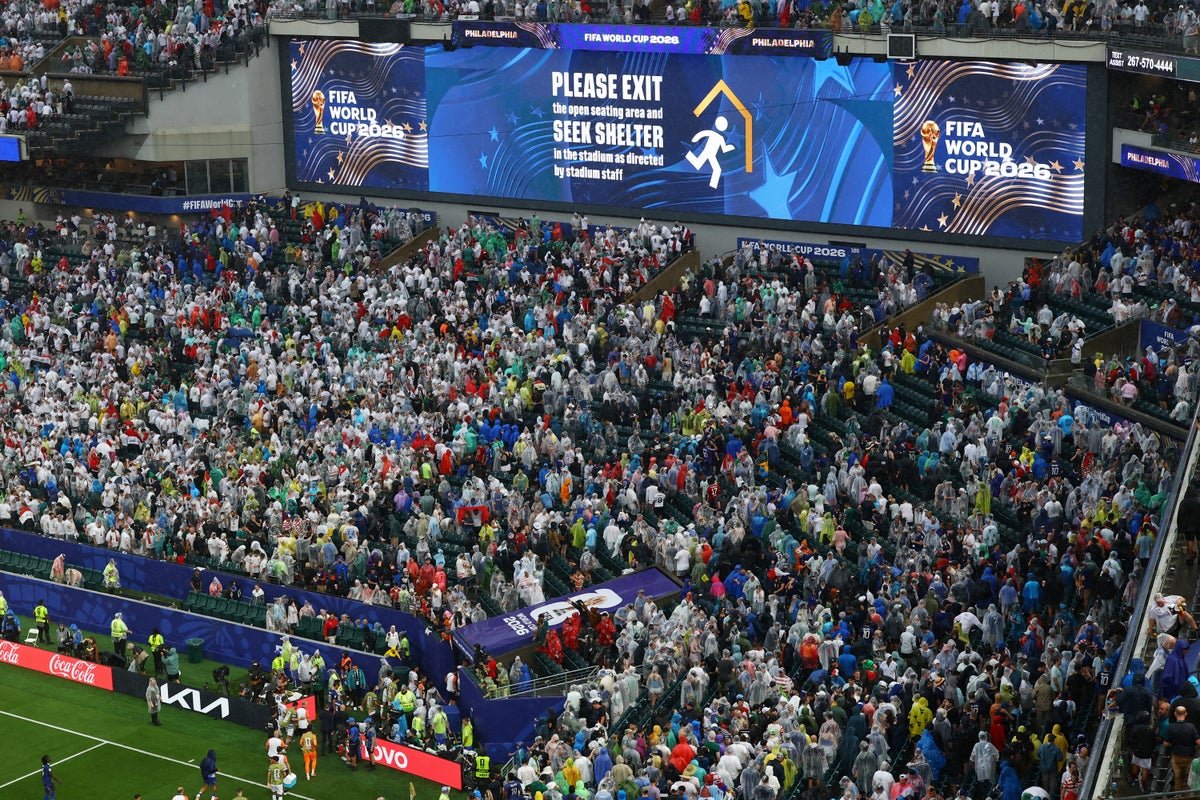
The match between France and Iraq in the group stage of the World Cup 2026 experienced a delay due to lightning, prompting the activation of FIFA’s weather protocol.
Following a period of heavy rainfall, marking the wettest half of football at this tournament, lightning struck during halftime in Philadelphia, requiring both players and spectators to seek shelter indoors.
FIFA is complying with local guidelines during the tournament, which state that if lightning is detected within an eight-mile radius of a stadium, the game must be halted, as advised by the National Oceanic and Atmospheric Administration (NOAA).
When lightning is detected, a 30-minute countdown begins, reset with each subsequent strike. Once the timer concludes, players are given a 15-minute window to warm up before resuming play.

Fans were forced into the concourses after a storm arrived in Philadelphia (Reuters)
The game at Lincoln Financial Field was postponed for nearly two hours due to ongoing lightning activity. FIFA released a statement saying: “Due to adverse weather and lightning risks near the stadium, the match between France and Iraq has been suspended. A 30-minute break has been announced, but the situation is being monitored for possible further delays. FIFA prioritizes safety, adhering to local authority guidelines, and the match will resume when conditions are safe. We appreciate the understanding and cooperation of all fans.”
This incident highlights the potential for matches in the World Cup to face significant weather-related delays, especially during thunderstorms near the venues.
The tournament is co-hosted by the United States, Canada, and Mexico, during a peak thunderstorm season in certain regions, enforcing strict lightning safety protocols.
Weather conditions, particularly lightning, affected tournament preparations, as seen with England’s friendly against Costa Rica, which was delayed by an hour due to heavy rain and lightning prospects in Orlando.
Similarly, New York City witnessed torrential rain, thunder, and lightning less than 24 hours before Brazil faced Morocco in New Jersey.
Similar scenarios were observed during last year’s Club World Cup in the US, where six matches were halted due to electrical storms, including a match between Chelsea and Benfica, which ultimately concluded four hours and 38 minutes after its commencement.

A warning for lightning strikes appears on the big screen as heavy rain falls prior to the International Friendly match between England and Costa Rica at Inter&Co Stadium (The FA via Getty Images)
Stadiums in the Gulf Coast and southeastern United States are especially vulnerable to thunderstorms, with FIFA assessing each match’s situation individually if play is interrupted.
Challenges may arise if severe storms develop during the last group-stage matches. The kick-off times for the two matches in each group are synchronized to prevent any team from gaining an unfair advantage based on knowledge of what they need to achieve, although weather-related delays could complicate this.
If conditions become significantly hazardous, leading to match abandonment, FIFA regulations stipulate that the game will be rescheduled, resuming from the minute it was interrupted, and finishing the remaining time.