



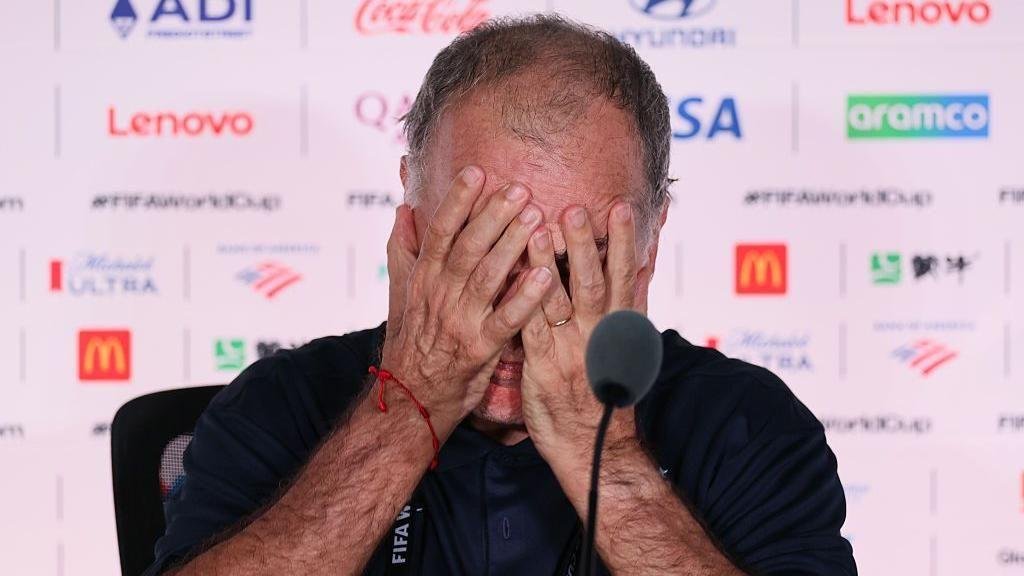
The conclusion of Marcelo Bielsa’s time as the manager of the Uruguay national team felt appropriate, especially given the context of his half-time substitution of a national hero followed by a candid self-assessment.
The team’s 1-0 loss to Spain in Guadalajara marked a disappointing exit for the two-time World Cup champions, epitomizing Bielsa’s challenges as head coach.
Advertisement
Following draws against Saudi Arabia and Cape Verde, which left Uruguay needing a win against the European champions, Bielsa took responsibility for the shortcomings.
“I am accountable for this disappointment,” said the 70-year-old, who had previously described himself as “toxic.”
“There’s no need to define this performance… in reflecting on my tenure with the national team, it’s a period marked by a lack of impact.”
“I leave nothing beneficial for Uruguayan football; any contributions I might offer after three years will not take hold without positive results.”
Advertisement
Perhaps the defining moment of Bielsa’s three-year leadership will be the substitution of iconic goalkeeper Fernando Muslera, following his error that led to Spain’s opening goal.
The 40-year-old goalkeeper returned from international retirement when Bielsa requested him, but notably became the first goalkeeper to commit three mistakes leading to goals in a single World Cup.
Bielsa mentioned, “Muslera chose to come off at half-time,” and also clarified that he substituted captain Federico Valverde in the second half to add physicality to the attack.
“I made this decision not to compromise Muslera’s confidence, but to safeguard it.”
Advertisement
Muslera, a key figure in Uruguay’s journey to the 2010 semi-finals, made his 137th and potentially final appearance for the national team.
Bielsa, now at 70, may be approaching the conclusion of a vibrant coaching career. His tenure with Uruguay does little to bolster his reputation, highlighting a notable performance crisis.
Nevertheless, flashes of quality occasionally surfaced, showcasing a level of play above what had been achieved in the past two years.
Initially, things looked promising. After the Qatar World Cup, Bielsa took over a team in dire need of generational renewal and, similar to his tenure with Chile, inherited a group well-suited to his attacking philosophy.
Advertisement
Uruguay began their World Cup qualifiers in South America with strong performances, including victories against Argentina and Brazil, scoring almost double the goals of any other team after six matches.
However, the situation began to deteriorate during the 2024 Copa America. Although Uruguay started strong, they quickly encountered a slump from which they never recovered.
In November, they faced a humiliating 5-1 defeat to the USA and Bielsa’s former pupil Mauricio Pochettino. When they managed a draw against England at Wembley in March, they struggled to advance beyond the halfway line — an unthinkable scenario for a Bielsa-led team.
Has Bielsa Become Predictable?
So, where did it all go wrong?
Advertisement
Part of the answer appears to be outside the coach’s control. Many Ecuadorian players have failed to develop their careers at the club level. Federico Valverde’s tournament performance was disappointing, despite his success at Real Madrid.
Others, such as Rodrigo Bentancur, Manuel Ugarte, Facundo Pellistri, and Darwin Nunez, appear to have stagnated or regressed.
Even so, Bielsa would have hoped for greater returns from the talent available to him.
Has his tactical approach become too predictable? His high-pressure, relentless style, once groundbreaking, has now become quite common.
Bielsa himself has voiced uncertainties. Uruguay opted to skip warm-up matches leading into the World Cup, focusing instead on the implementation of a new tactical setup — Valverde operating wide on the right with two strikers. This approach faltered in the match against Saudi Arabia and subsequently reverted to a conventional 4-3-3 formation, bringing some improvement.
Advertisement
Post-break, Uruguay managed to create opportunities, especially in the 2-2 draw against Cape Verde, where otherwise they would have advanced to the next round well ahead of schedule if not for self-sabotage on two occasions.
Yet tactical issues may not lie at the root of the problem; personal dynamics within the squad likely play a significant role. A month spent together during the 2024 Copa America seemed to drain team spirit.
Luis Suarez publicly expressed such sentiments upon retiring from international duty, criticizing Bielsa for what he perceived as a lack of warmth, poor treatment of players, and a tense atmosphere within the team.
Importantly, none of Suarez’s teammates attempted to disagree with his assessment.

Luis Suarez was in the stands during Uruguay’s 2-2 draw with Cape Verde [Getty Images]
Winger Agustin Canobbio, who was sent off during the defeat to Spain, reportedly had a heated clash with Bielsa, stating that tension escalated when the coach criticized his posture during a meeting.
Advertisement
Following the US defeat, Bielsa candidly acknowledged his struggles in connecting with others, referring to himself as a “toxic perfectionist.”
This situation raises the question of whether his characteristic eccentricity is becoming less effective with modern players, who often desire a more genuine connection with their coach.
Bielsa, ever contemplative, reflected that beyond advancements in sports science, the enthusiasm among players is key to fostering cohesiveness within a team. Unfortunately, he has not managed to instill enough enthusiasm during his tenure.
At times, he has also appeared out of sync with contemporary football. His remarks against the hydration breaks, a staple of Bielsa’s philosophy, indicate his belief that they disrupt the game’s cultural flow. He remarked that they “add nothing…”
Advertisement
Additionally, he declined to participate in an official World Cup photoshoot, stating, “I’m not a model,” with his gaze fixed on the ground when his picture was taken.
Although Bielsa was known to step down after this tournament, the prospect of his departure failed to invigorate the dressing room.
Uruguay, a nation whose contributions to global football are disproportionate to its small population of 3.4 million, will undoubtedly return to the international stage.
As for Bielsa, it seems one of football’s most intriguing managerial careers might be coming to a close.