



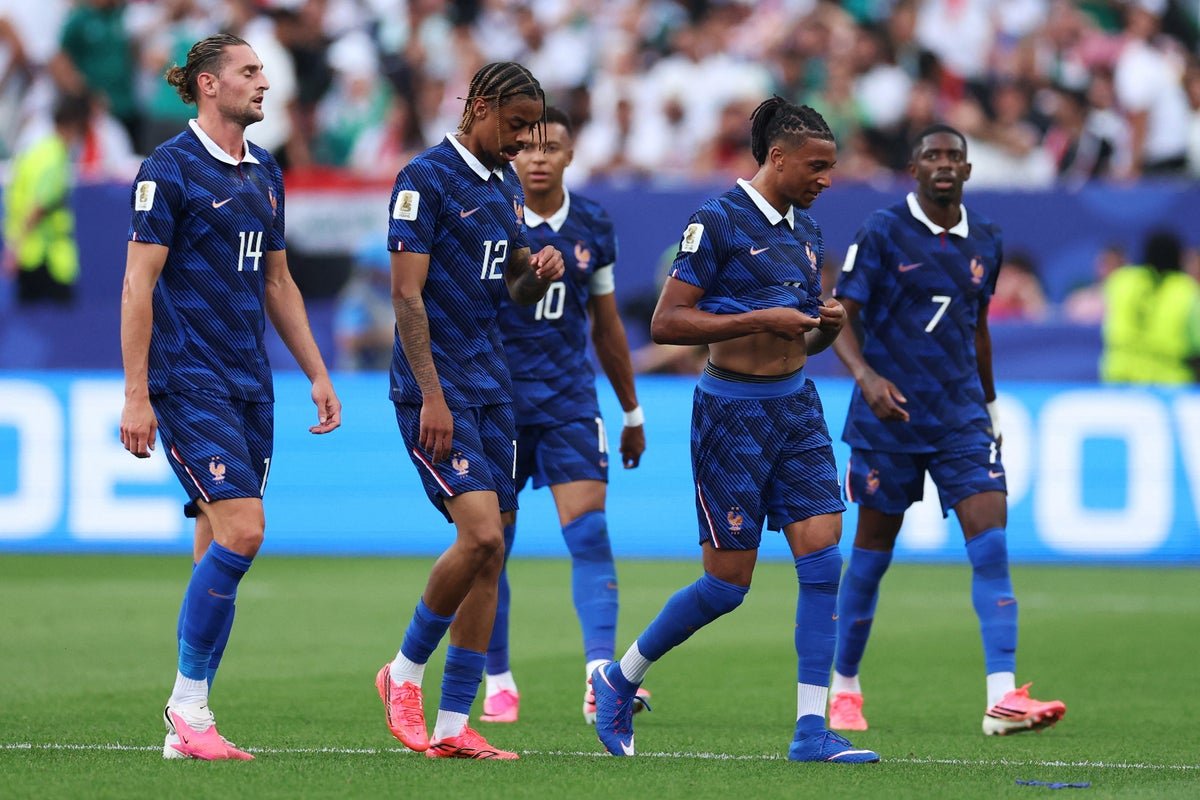
This Saturday, a critical knockout match in the World Cup between France and Paraguay is poised to be one of the tournament’s most intense matches, with significant health risks looming for players, tens of thousands of fans, and the surrounding region.
This event coincides with a severe heatwave affecting the eastern and central United States. The forecast predicts alarming heat indices ranging from 100°F to 115°F (37.78°C to 46.11°C), as stated by the National Weather Service. The high overnight temperatures will provide little relief, potentially leading to record-breaking heat.
As the tournament progresses, worries about extreme heat have grown, especially after French players utilized sprinklers to cool off during their prior match against Sweden in New Jersey, where the temperature soared to 90°F (32.22°C).
Experts have increasingly criticized FIFA’s heat safety guidelines as insufficient and “impossible to justify,” even for athletes accustomed to heat, cautioning that audiences might witness less dynamic gameplay.

Fifa has faced criticism for having ‘inadequate’ heat safety guidelines (Getty)
The ongoing heat crisis correlates closely with climate change. The planet has warmed by about 1.26°F (0.7°C) over the past thirty years, as reported by climate monitoring organization Berkeley Earth.
This increase in global temperature leads to more frequent and severe heatwaves and weather events. Scientists from the World Weather Attribution group announced that the current humid heat affecting parts of the US and Canada would have been “virtually impossible” without climate change.
This isn’t the first time that extreme temperatures have affected football’s premier tournament. The 2022 World Cup in Qatar was controversially moved from summer to winter due to severe heat concerns, and last year’s Club World Cup also faced soaring temperatures.
The global union for professional footballers has consistently warned that extreme heat will likely become an even larger issue in this and future World Cups, recalling the 1994 World Cup match in Orlando, Florida, where temperatures reached 110°F (43.33°C).
Heat poses serious risks to athletes, affecting them both from external conditions and their bodies’ internal temperatures during exertion.
This dual challenge makes it harder to cool down in hot and humid weather, as explained by Bharat Venkat, director of the Heat Lab at UCLA. He noted, “When you’re exerting yourself on an intensely hot day, the chances of experiencing heat-related illness or even death significantly rise.” Intense exercise in extreme conditions can result in severe fatigue, reduced performance, headaches, irritability, nausea, dizziness, cramping, and dehydration – all symptoms of exertional heat illness.
Exertional heat stroke, which requires immediate medical attention, ranks as the third leading cause of death among athletes.
Ryan Calsbeek, a professor of biological sciences at Dartmouth College, points out that when the wet bulb globe temperature (WBGT)—a measurement that takes into account temperature, humidity, cloud cover, and wind—exceeds roughly 95°F (35°C), individuals lose their ability to cool down swiftly, and “the physiological mechanisms just break down.” He added that heat-induced confusion could impair a player’s decision-making, potentially affecting the outcome of a match.
FIFA’s existing heat safety protocols, which include mandatory three-minute hydration breaks midway through each half, have come under scrutiny. While these breaks aim to protect players and referees from heat-related illnesses, some argue that they disrupt the game’s rhythm and provide tactical advantages to coaches.

Concerns have been raised for the welfare of fans attending the match (Getty)
On the other hand, some scientists argue that these breaks are too brief for players to adequately cool down and rehydrate in such extreme conditions.
Moreover, while outdoor matches during peak heat hours have been restricted, and those scheduled in warmer periods are prioritized for covered stadiums, FIFA’s threshold for postponing a match—only if the WBGT reaches 89.60°F (32°C)—has been widely contested.
Douglas Casa, CEO of the Korey Stringer Institute at the University of Connecticut, emphasized that this temperature threshold is “so extreme that in the military, at our basic training facilities in America, if it reaches 32, all training must be canceled.”
With temperatures predicted to surpass 100°F (37.78°C) for Saturday’s game, the players’ union Fifpro and the American College of Sports Medicine have urged for matches to be postponed at a safer threshold of 82.40°F (28°C).
In spite of these challenges, teams are employing strategies to minimize heat stress. Guilherme Passos, a sports scientist with the Brazilian Football Federation, is preparing Brazil`s national team for coping with intense heat.
He has advised against exposing players “straight to the hottest time of the day” to preserve training quality, and recommends the use of saunas or hot baths for heat acclimatization during the tournament.
Passos noted that during the 2014 World Cup in Brazil, players covered less ground and reduced high-speed running, prioritizing technical and tactical precision instead. Calsbeek emphasized how football players’ blend of endurance, speed, and critical decision-making abilities are severely compromised by high temperatures.
Nonetheless, the risks extend beyond the field. Many fans, often consuming alcohol, will be watching the World Cup under these hazardous conditions.
Cities and stadiums are increasing availability of shade, cooling areas, water stations, and deploying medical personnel at FIFA Fan Festivals and throughout the venues. Yet, Calsbeek warns, “People are going to be dehydrated, extremely excited, and unwilling to leave the match. In those extreme temperatures, spectators are likely to suffer as well.”