



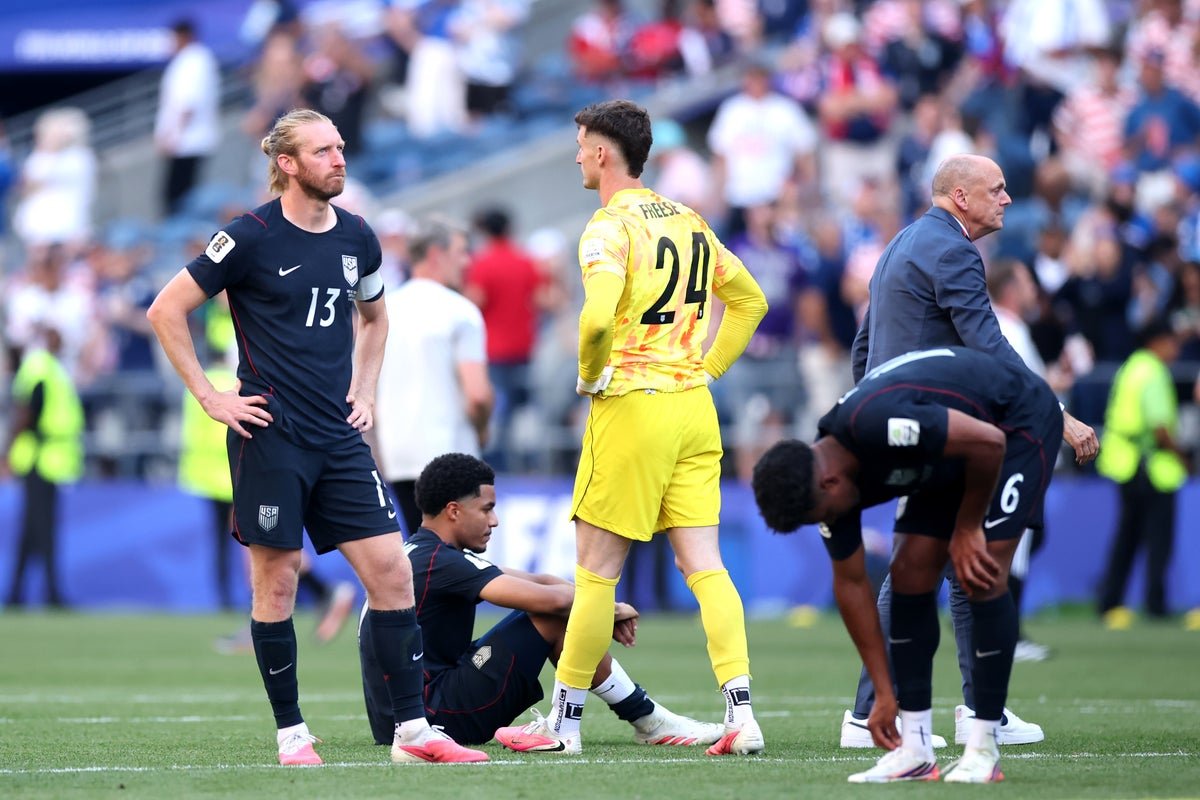
While football emerged as the true victor, both Gianni Infantino and Donald Trump certainly faced defeat. The notion of American exceptionalism took a new twist when the U.S. performance against Belgium was anything but exceptional. Just 48 hours after America’s birthday, Mauricio Pochettino’s aspirations came to a jarring halt. Football is often heralded as a unifying force—an idea frequently echoed by pundits during the jingoistic coverage on Fox—but in reality, it underlined division as many rallied behind Belgium.

The United States were knocked out of the World Cup by Belgium (Getty)
The World Cup campaign for the United States, initially hopeful and endearing, concluded on a disappointing note. The effort to leverage the bully pulpit for Folarin Balogun’s suspension—facilitated by FIFA’s typical sycophantic response—proved ineffective as Belgium dominated with a 4-1 victory. “Overturn this,” declared their FA through a pointed social media post.
Advertisement
Pochettino and his squad faced setbacks not only from defensive blunders but also from the ongoing intertwining of sport and politics; a reality too clear to ignore in these turbulent times. The Trump administration consistently portrayed a message suggesting they were above reproach; however, history shows that a convicted felon has granted pardons for transgressions far worse than Balogun’s. Nevertheless, there can be limitations to American influence. The swagger demonstrated off the field did not translate into success on the pitch. Rather than Sleepless in Seattle, it was more like hopeless in Seattle.

Arrogant off the pitch, impotent on it – the USA exited the World Cup at the round of 16 (Reuters)
Pochettino posed the question, “Why not us?” in a rallying cry that encouraged America to set high goals. However, the response became evident: even against a Belgian team pondering its transitional phase post-golden generation, they simply fell short. Their initial 4-1 victory against Paraguay had initially showcased the characteristics of a Pochettino team—featuring pace, pressing, and fluid movements. Players like Balogun, Malik Tillman, and Alex Freeman showcased individual talent. Yet, ultimately, their victories came against teams ranked 28th, 34th and 61st globally.

Folarin Balogun impressed for the USA before becoming unfortunately embroiled in a political storm (Reuters)
Even with home field advantage—alongside other questionable benefits that left FIFA struggled to explain their decisions—the U.S. reached the same stage as they had in 2022, under the less celebrated Gregg Berhalter, and during both 2010 and 2014. Pochettino’s squad seemed more talented, yet that perception might be tainted by a favorable draw and the various advantages granted to the U.S., which could seem dubious to some.
Advertisement
The U.S. has not made it to a quarter-final since 2002, and despite football’s varied rankings, that absence may reflect an ongoing underachievement. A simple explanation arises: the players may not be good enough. In Seattle, Pochettino lamented the lack of quality and, in light of Belgium triumphing 5-2 over the U.S. in March, suggested that America lacked any players in the top 100 of the world. The rematch only further reinforced that sentiment, especially following Matt Freese’s significant error contributed to Hans Vanaken’s goal, highlighting America’s lack of a top-class goalkeeper since the days of Tim Howard, Brad Friedel, and Kasey Keller. Mistakes from players like Tim Ream and Chris Richards further demonstrated deficiencies in their defense.

USA goalkeeper Matt Freese’s error helped Belgium to victory in Seattle (Reuters)
Despite initial optimism in the World Cup’s early stages, a fixation on Christian Pulisic—who has prominently profited during this World Cup financially—suggests a perception of him as a superstar. While he had an impressive showing against Paraguay, misfortune from an injury hampered him. However, in the crucial match against Belgium, Pulisic’s impact was minimal. His background with clubs like Borussia Dortmund, Chelsea, and AC Milan cannot overshadow what appears to be exaggerated hype from his fans.

Christian Pulisic was heavily hyped but did not deliver when it counted (Getty)
Pochettino’s role may not have fulfilled the transformative expectations. While he enhanced the team, he did not provide the breakthrough they needed. Despite being offered an extension until 2030, he has refrained from disclosing his future intentions. A super challenging foreign World Cup looms ahead, and Pochettino seems aware that aligning himself with an objectionable regime poses significant concerns. During Trump’s pre-tournament call with Pochettino, the captain, Ream, appeared visibly uncomfortable. It may be wise for the Argentinian to distance himself from such affiliations, especially if rumors about his desire to return to European club football are accurate.

Mauricio Pochettino could now return to the European club game (AP)
Consequently, the U.S. finds itself in a familiar position: waiting for a breakthrough on an international stage. After a month where a likable team generated increasing goodwill, they have once again fallen into a familiar pattern. For parts of the last month, football had overshadowed the unsavory reality of Trumpism, a stark contrast to the treatment of the Iran team or the Somali referee, Omar Artan. The inevitable chaos returned thanks to his remarkable ability to wreak havoc.
Advertisement
Public sentiment shifted, with support for Belgium growing outside the U.S. Inside the country, the reaction is harder to gauge. The American narrative often casts them as the heroes; is the public aware or concerned that, due to Trump’s actions, they were perceived as the antagonists? This disconnect is further evident in the coverage from Fox, which failed to mention the growing global outrage regarding the favoritism shown to the host nation.

(Reuters)
Jurgen Klopp encapsulated the sentiments of those outraged by Infantino and Trump: “This is our game, not theirs,” . Following the course of the tournament, corrupt regimes have attempted to exploit the World Cup for their ends, which isn’t something to lay at the feet of Pochettino or the U.S. team. Nevertheless, Belgium’s resounding triumph carried a potent message to the new world of football: it remains our game, not theirs.