



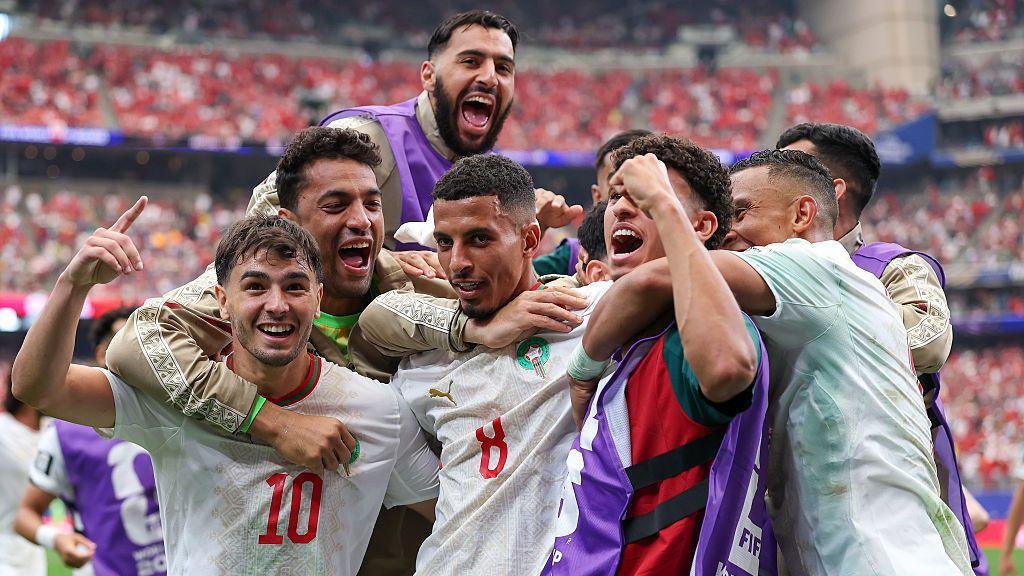
“Morocco has the ability to emerge as a dominant force in global football.”
This assertion may seem audacious, but Neil Ward from Wales has personally experienced the fervor and ambitions driving the nation.
After serving as the chief executive of the Football Association of Wales Trust, Ward relocated in 2020 to become the director of technical operations at the Royal Moroccan Football Federation (RMFF).
He was present in Rabat when Morocco made history by becoming the first African country to reach the World Cup semi-finals just a couple of years later.
Ward observed how the city was electrified by the achievement, “it took over the entire city and continued celebrating until the early hours, even with the king joining in the festivities.”
The Atlas Lions were eventually defeated by France, yet they are poised to make history again as they face Les Bleus once more on Thursday at 21:00 BST for a chance to reach the last four.
No matter the outcome at Boston Stadium, it feels like the co-hosts for the next World Cup in 2030 are far from done.
Another Brit, Simon Jennings, understands this landscape better than most.
Alongside his roles in delivering UEFA Pro and A-licences as a coaching educator, he was in charge of youth development across Morocco from 2020 to 2024.
“This progression is no accident,” he stated. “It stems from a clear national ambition.”
‘These individuals are committed to achieving success’
Such ambition has been fueled from the very top levels of leadership.
Substantial investments have been made in football, receiving robust backing from King Mohammed VI.
Considerable funds have been funneled into constructing a state-of-the-art training facility, a national academy, regional training centers, stadium upgrades, and numerous amateur pitches.
“We need top-tier facilities, especially for players accustomed to them in Europe,” Ward explained.
“When you see a training center of such high quality, it underscores that these people are serious and aim for success.”
Youth activists have demanded that such funds be allocated towards education, healthcare, housing, transport, and job creation.
In response, the royal palace committed £11.2bn in the 2026 budget to health and education— a 16% increase from the previous year.
For Ward, who worked with the RMFF from 2020 to 2024, the motivation behind Morocco’s investment in football is evident.
It seeks to harness the country’s passion for the sport while utilizing “soft power on the global stage” by demonstrating their competitive capabilities.
A notable shift in mindset has occurred in this regard.
Before the 2022 World Cup, Morocco had only reached the knockout stage once, making it to the last 16 in 1986.
However, before playing their first match in 2022, former coach Walid Regragui made it clear to the players that their ambition was not just to participate in group games in Qatar, but to achieve significant milestones.
Morocco was equipped with the talent to achieve this, fueled in part by their diaspora as well as homegrown players.
The ministry of foreign affairs estimates that over five million Moroccans live abroad.
Morocco has actively identified and sought out promising players with such backgrounds early on, employing full-time scouts across France, the Netherlands, Spain, Germany, Norway, Sweden, and Denmark.
Jennings noted that these players are “embraced as Moroccans.”
“There is no sense that they are considered anything less than Moroccan,” he stated. “Their passion and pride in their nationality are palpable.”
The results of this approach have been notable.
Nineteen out of the 26 players in Morocco’s current World Cup squad were born abroad.
Among these are six who were also eligible to represent their quarter-final opponents, France, including highly regarded midfielder Ayyoub Bouaddi from Lille.
Although the 18-year-old played for France at various youth levels, he has always taken pride in his Moroccan heritage.
Spain’s rising star Lamine Yamal, who has a Moroccan father, has also maintained a strong connection to his roots, with the RMFF even reaching out to his family.
Ward emphasized that “no effort is spared” in talent scouting, even if it doesn’t always succeed.
“I remember discussions about Yamal, a huge talent when he was just 12 or 13 at Barcelona,” he recalled.
‘This momentum is rapidly accelerating’
Looking ahead, Morocco aims to cultivate more senior international players through its domestic ranks.
Chris van Puyvelde, who served as technical director of the RMFF from 2022 to 2025, noted that the goal for the next World Cup is to achieve an equal representation of Moroccan-born players and those raised abroad.
However, he cautioned that “the overall organization in the country requires improvement.”
Finding the right equilibrium is crucial, especially given the increasing pressure for results.
Morocco’s manager Mohamed Ouahbi previously faced similar challenges when his under-20 team missed out on the Africa Cup of Nations (AFCON) in 2023.
Yet, with renewed support and some patience, Ouahbi’s under-20 team clinched the Under-20 World Cup title in 2025.
He quickly moved up to the senior team management position after Regragui stepped down following setbacks in AFCON 2025.
With the next World Cup on the horizon, the RMFF is also focused on the future, securing Ouahbi’s contract until 2030.
It seems Morocco is genuinely building towards something significant as they prepare to co-host the next World Cup alongside Portugal and Spain.
“They are constructing new stadiums while equally establishing robust foundational structures,” Van Puyvelde remarked.
“Once Morocco gained that little bit of momentum, similar to what was experienced in Qatar, you can see that momentum is spreading quickly throughout the country.”