



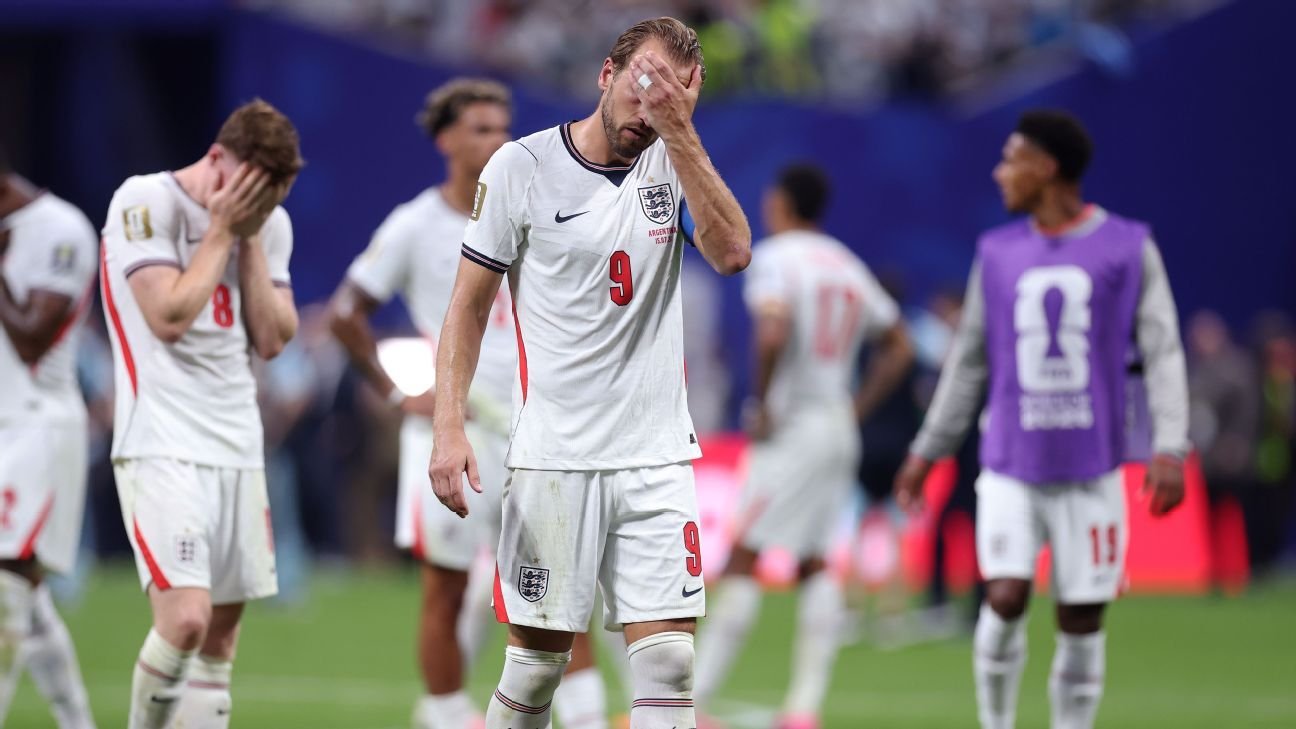
ATLANTA — Long-term pain often leaves behind lasting scars. As England awakens on Thursday, it faces the stark reality of 62 years without a major men’s championship title—a legacy of hurt that continues to linger.
The anguish feels unending, the suffering relentless. Each tournament exit seems to reinforce a barrier that England struggles to surpass.
Thomas Tuchel appeared destined for greatness at this World Cup, only to fall into the same patterns as his predecessors. He made effective alterations in the opening Group L match against Croatia, and again when Congo DR threatened to cause an upset in the round of 32. Tuchel’s switch to a back five also effectively thwarted Mexico at Azteca Stadium and Norway in Miami.
– Argentina proves their mettle with remarkable comeback
– Player ratings: Messi shines with a 9/10 as Argentina defeats England to secure a spot in the final
– Messi cradles Yamal as a baby—setting the stage for their next meeting in the final
This tactical approach aimed solely for positive outcomes. Tuchel appeared somewhat philosophical when confronted with the feedback that his previously praised in-game management had shifted harshly to criticism after he seemed to relinquish control against Argentina through overly cautious substitutions.
“Once you lose, criticism follows,” he noted after England’s 2-1 semifinal defeat. “No one can predict how things might have changed with different decisions.”
While there is truth to this, Tuchel was expected to be the game-changer for this tournament, yet it was hard to discern much difference between him and Gareth Southgate in Atlanta.
Southgate struggled to clinch vital victories, a challenge Tuchel faced as well. In 2018, England led Croatia in the World Cup semifinals only to falter in extra time, and in the final of the 2020 European Championship, they lost to Italy in a penalty shootout after taking an initial lead.
During this World Cup, England produced commendable defensive performances to hold leads against Mexico and Norway, but perhaps they should have played with greater ambition against a superior attacking team.
Argentina, facing a game that England had controlled for 55 minutes, capitalized on the Three Lions’ retreat into a defensive shell after Gordon’s goal. This allowed Lionel Messi the opportunity to shine once again, continuing to perform at an extraordinary level at 39 years old.

1:23
Leboeuf: Tuchel is accountable for England’s semifinal defeat
Southgate’s conservative approach stemmed from the reality that, despite England’s illustrious football history and the Premier League’s stature, the national team has often struggled against top-tier competition in tournaments.
In the last eight World Cups dating back to 1998, England has invariably exited at the hands of the highest-ranked opponent encountered, with one exception.
That lone instance was against Croatia, when Luka Modric demonstrated a level of midfield control that England has lacked historically. Other teams like Andrea Pirlo in 2014 and Jorginho and Marco Verratti succeeded in the same regard in 2021. In 2024, Spain clinched the Euro final partly due to an outstanding performance from Martín Zubimendi, showcasing ball control that England could not match.
Although England attempted to transition into a more technically skilled side under Southgate, they fell short of achieving the fluidity characteristic of winning teams in international competitions.
Another obstacle involves player fatigue, rooted deeply in English football’s intense club schedules. While Harry Kane and Bellingham represent players often competing overseas, many within this squad, who primarily play in the Premier League, have reached Champions League or Europa League finals, all while battling in one of the world’s most competitive leagues. Furthermore, England had the most congested schedule of any side making it to the last four, and compounded the challenge by opting to train in Kansas City rather than in a city aligned with their group stage matches.
Tuchel acknowledged that fatigue played a role after encounters with Mexico and Norway. However, a shift to a back five appeared more of a conscious choice than a reaction to exhaustion, isolating Kane and limiting counter-attacking opportunities.
This also underscores a fundamental mentality challenge. Lionel Scaloni, victorious coach against England alongside Messi and now on the verge of becoming only the second coach to win the men’s World Cup twice, had a telling take after the match.
“There was blood in the water, and we pounced,” he remarked.
What led to Argentina’s success?
“The players approached it with the mindset of young children,” Scaloni elaborated. “They weren’t preoccupied with the consequences of missing. Winning, drawing, or losing—there’s no time for anything beyond that. If things didn’t go their way, they still performed what they knew how to do.”
Can England truly claim the same? In the 21st century, they are the only team to have opened the scoring in a World Cup semifinal and subsequently lost twice.

1:19
McManaman: England bears responsibility for their loss to Argentina
Tuchel recognized that England struggled to maintain possession and compete effectively in duels as the match wore on, controlling just 12% of the ball in the 37 minutes between Gordon’s initial goal and Lautaro Martínez‘s dramatic winner in the 92nd minute.
“I do not subscribe to the notion of a curse or history repeating itself in football,” Tuchel stated confidently. “Each scenario involves different coaches, players, circumstances, and opponents. What cost us today was simply not being active enough throughout the match.
“By ‘active’, I mean we failed to engage in duels or display the necessary activity. We couldn’t close gaps or challenge for the ball when it mattered.”
This issue has historical roots. Sven-Göran Eriksson, who managed England from 2001 to 2006, famously reflected on their tournament performances: “First half good, second half not as good.”
Every subsequent manager has grappled with this same challenge. Tuchel’s critique of England’s inconsistent performances under Southgate, particularly in their journey to the Euro 2024 final, was telling.
When asked about what was lacking, he noted: “The identity, clarity, rhythm, repetitive patterns, player freedom, individual expression, and hunger. They seemed more concerned about the fear of elimination than driven by the excitement and desire to win.”
He spoke the truth, and this sentiment remains evident today. These enduring scars are emblematic of England’s footballing journey, and overcoming them represents Tuchel’s most significant challenge by 2028.