



The FIFA World Cup final stands as the most-viewed sporting event globally. Approximately 1.5 billion viewers tuned in to the 2022 final in Qatar, and this Sunday’s showdown between Spain and Argentina in New Jersey is expected to surpass that figure.
While crowds will gather in homes, bars, and outdoor screenings in major football cities like London, Paris, and Buenos Aires, many fans will enjoy the match from the most unexpected locations.
Among the billions tuning in are dedicated football fans watching from some of the world’s most remote areas.
– Spain’s victory over France puts an end to an impressive World Cup final streak
– The media buzz around World Cup hydration breaks
– Introducing a soccer team that schedules all their games for tomorrow
Rothera: Bringing the World Cup Experience to Antarctica
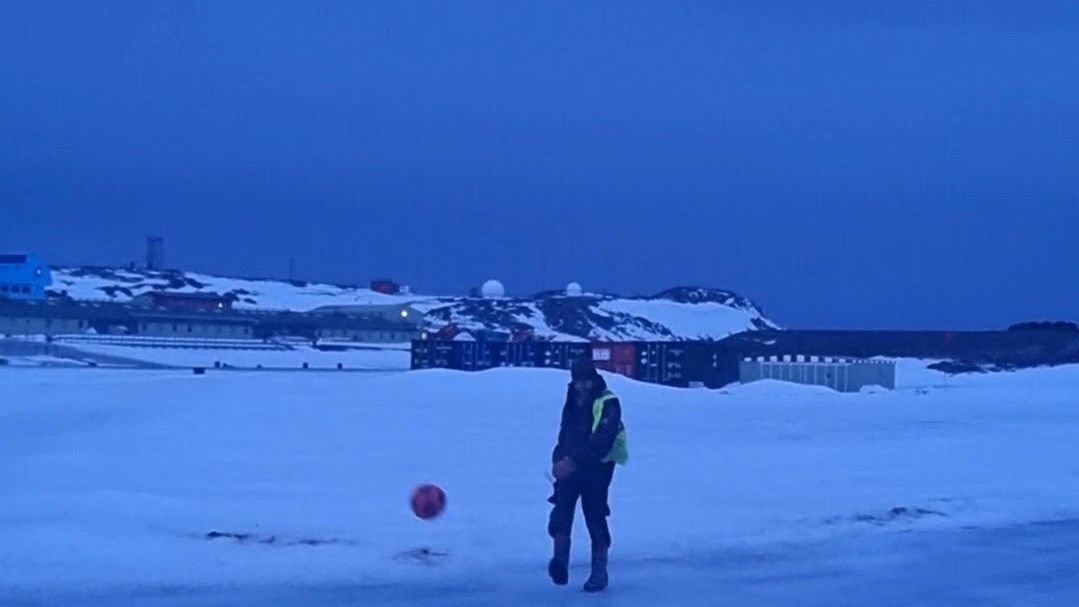
Located in Antarctica, Rothera Research Station is one of the loneliest places on Earth, with less than 1,000 inhabitants spread across a vast 5.48 million square miles, including just 26 individuals who endure months of perpetual darkness.
The World Cup has provided a needed connection for these hardy residents. They congregate around a projector and TV to watch the matches, and while some have tuned in for nearly every game, the most significant turnout happens for the games featuring Scotland and England.
“It’s like a home away from home,” said Martin Kibble from the British Antarctic Survey. “You can count on two hands the number of die-hard fans who come to every game and help create a great atmosphere; it’s like recreating a pub environment from back home.”
Although Kibble struggles with being away from his children during the tournament, the World Cup has served as an important bonding experience for those in Rothera, where loneliness can often loom large.
“My two boys FaceTime me after the England games, and when we win, I wish I could be there to celebrate with them,” Kibble shared. “But football really helps unite everyone here; it’s become a vital part of our daily life.”
For Scott Kelly, a Scotland supporter, watching his nation’s first World Cup in 28 years from this isolated location was both exciting and bittersweet.
“I would have definitely gone to the World Cup,” Kelly expressed. “I promised myself I would be there the next time we qualified. Interestingly, the job offer came before Scotland qualified, but I think it’s best this way because I wouldn’t want to miss this unique experience.”
“What a story it will be to share with my family and future children that I watched a World Cup match from this remote point on Earth.”
Kelly recognizes that the World Cup has significantly helped foster community bonding as fans often engage in activities emulating stars like Lionel Messi. The Rothera base even boasts an aircraft hangar that doubles as a venue for five-a-side matches. Following England’s triumph over Mexico, the residents even held an impromptu soccer game outside in the deep snow.
“During the harsh winter months, it’s easy to feel trapped in your own building, but the World Cup encourages us to gather in communal spaces, watch the matches, and share our daily experiences,” Kelly noted. “It’s a fantastic remedy for the winter blues.”
As the World Cup final approaches, plans are already underway in Rothera to celebrate the occasion.
“One of the guys made a 3D print of the World Cup trophy,” Kibble shared. “We’ve put up bunting, and there will be traditional British pub fare. It promises to be a special celebration.”
Ascension Island: Viewing the World Cup from “Mars”
Ascension Island, located in the South Atlantic Ocean, is a tiny volcanic island situated between Africa and South America, roughly 1,000 miles from the nearest land. It hosts a British Royal Air Force base and is often referred to as “The Mars of the Mid-Atlantic” due to its stark, red volcanic terrain.
Its resident population of about 800 to 1,000 includes passionate football fans like Tristan Hudson, an Arsenal supporter who actively participates in local tournaments.
“I’m fortunate to catch the games here since we can receive BBC and ITV, the UK’s leading channels for World Cup broadcasts,” Hudson explained to ESPN. “Some people opt to watch together at bars or the NAAFI [Navy, Army and Air Force Institutes] complex. Many are supporting various teams with a particular focus on England, Portugal, and Brazil.
The NAAFI complex, featuring a bar that serves British snacks, is expected to host a live viewing of the World Cup final, located over 5,000 miles away from the live action. This promises to be one of the most remote public watch parties for the World Cup final, but not the most secluded.
Tristan da Cunha: The World’s Most Isolated World Cup Viewing Party
Located 2,300 miles south of Ascension Island lies Tristan da Cunha, a British Overseas Territory recognized as the most remote inhabited archipelago in the world.
With no airstrip available, access to the island is limited to boats that arrive roughly once a month. These vessels embark on a week-long, 1,750-mile journey from Cape Town, South Africa, and may face docking challenges due to weather.
The island’s tiny population of just over 200 primarily watches the World Cup matches from their homes, as the island’s only bar, the Albatross Bar, closes at 9 p.m. (5 p.m. ET) before many games even start.
Despite the settlement being named “Edinburgh of the Seven Seas,” strong allegiance to England prevails among the residents.
“Most folks are supporting England,” islander Leon Glass revealed to ESPN. “But there’s also support for Scotland, Brazil, and the Netherlands. Had Italy qualified, I’m sure they would have garnered some support as well.”
There is hope that the islanders will gather at the Albatross Bar for the final, particularly if England is playing. However, a recent powerful storm impacted the island with hurricane-force winds, causing significant damage that necessitated repairs. Moreover, issues with the British Forces Broadcasting Service streams present the risk of unexpected outages during crucial moments.
Watching the world’s biggest football tournament from an island where the nearest humans are often astronauts orbiting 250 miles above in the International Space Station adds to the challenge.
Svalbard: Hosting the World’s Most Northerly World Cup Viewing
Longyearbyen, situated in the Norwegian archipelago of Svalbard, ranks among the northernmost inhabited areas in the world. Renowned for housing the Global Seed Vault—a reserve of crops in case of a global crisis—the region’s polar bear population requires residents to carry firearms when exploring the island.
Even in this extreme environment, the World Cup has captivated the local community, buoyed by Norway’s impressive advance to the quarterfinals. The restaurant Tio Monchos in Longyearbyen has been showing the matches, drawing increasingly larger crowds, with around 400 spectators watching Norway’s defeat against England.
“Longyearbyen boasts a diverse international community, making gatherings to watch football special,” shared restaurant owner Andreas Styrsell with ESPN. “Everyone knows each other, transforming the experience into watching a match among friends rather than a commercial event. The celebrations post-Norway’s victories were truly unforgettable. Many international attendees rallied behind Norway as their team during the tournament, uniting us all.”
Though Norway has been eliminated, Tio Monchos plans to host a World Cup final event, potentially making history in the process.
“We’ll be screening the final on Svalbard’s largest screen,” Styrsell stated. “We aim to create one final grand football celebration for the whole community, likely the northernmost public screening of a World Cup match anywhere in the world—something we are incredibly proud of.”
Kiribati: Connecting Through Football on Pacific Atolls
The Republic of Kiribati, consisting of 21 inhabited islands and atolls in the Central Pacific, is often listed among the least-visited countries worldwide. It is highly vulnerable to climate change, facing threats from rising sea levels and extreme tides.
In terms of football, Kiribati remains one of the few nations not affiliated with FIFA, though it does hold associate membership with the Oceania Football Confederation. Nonetheless, the passion for football is palpable, particularly during the Te Runga Games, a multi-sport event akin to the Olympics held every four years where teams from various atolls compete. While Kiribati doesn’t yet participate in World Cup qualifying, the tournament’s excitement still resonates throughout the nation.
“Everyone is following the World Cup on their phones,” shared Eriati Reebo, president of the Kiribati Islands Football Federation, with ESPN. “Thanks to Starlink, we can stream the World Cup, even from the most remote atolls.”
The arrival of Starlink in Kiribati in 2025 has transformed how residents engage with the World Cup. There’s also a movement to enhance the communal aspect of viewing.
“The Kiribati Islands Football Federation and the Ministry of Sport are collaborating to ensure that from the quarterfinal stage onward, matches are screened on a large screen at the Betio Sport Complex in Tarawa, adjacent to the president’s office,” Reebo remarked. “And if any national teams wish to challenge our Kiribati squad, we are prepared!”