



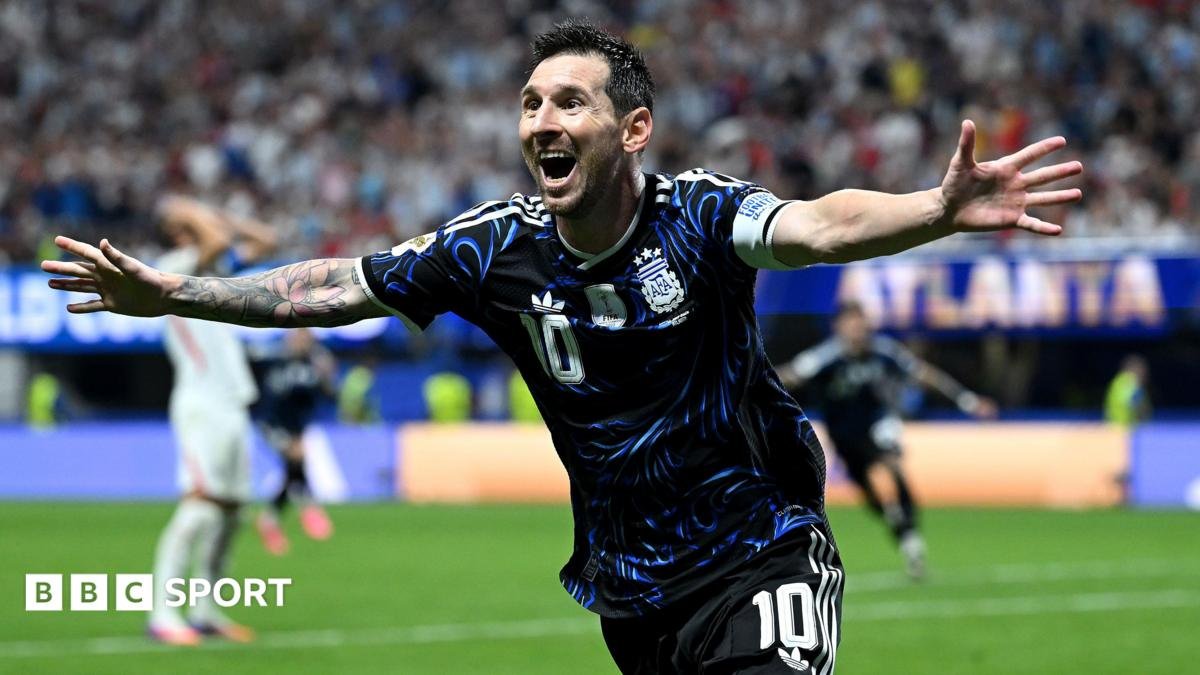
It’s easy to forget that in 2016, at 29 and still with Barcelona, Messi actually quit international football.
By then he had lost the 2014 World Cup final to Germany and three Copa América finals.
After changing his mind, he went on to win the Copa América twice.
When Messi—then at PSG—lifted the World Cup in Qatar in 2022, it felt like the final piece of his career puzzle clicked into place.
For many, that was the last missing element in the greatest-of-all-time debate, long led by fellow World Cup winners Pelé and Diego Maradona.
Before the 2022 final, he said he was delighted to end his World Cup journey on the biggest stage, calling it deeply satisfying to play his last game in a final.
He added that the next tournament was a long way off and he doubted he would make it, saying that finishing this way would be brilliant.
And when he left Europe the following year to join Inter Miami in MLS, it seemed he was easing into the twilight of his career.
Even during last year’s FIFA Club World Cup, which he took part in, it wasn’t clear whether he’d feature this summer.
Yet here he is, still looking unstoppable—even if his style has evolved.
Before facing England, 47% of the ground he covered in the tournament was at a walking pace—the highest share among outfield players.
Spanish journalist Guillem Balagué, Messi’s biographer, says he has reinvented himself tactically at least five times.
Messi has now either scored or assisted in 13 straight matches for Inter Miami and Argentina.
If he has a hand in a goal in Sunday’s final against Spain, he’ll match his 2011 record of 14 in a row.
He would also become only the second player after Cafu to appear in three World Cup finals.
Surely that would be his last World Cup appearance—he’ll be 43 in 2030.
But perhaps it’s time we stopped assuming anything about the eight-time Ballon d’Or winner.