



-

Beth Lindop
Multiple Authors
The question lingering on everyone’s mind: Is Jürgen Klopp retired? This inquiry reached Klopp himself back in January 2025, a year after he dramatically declared his decision to depart from his role as Liverpool manager, culminating a remarkable nine-year term at Anfield.
“Certainly not,” he replied, as his response was shared in a video with his 6 million Instagram followers. “I’m not a football manager anymore. Now, I’m the head of global football at Red Bull. So, not retired, just a career change.”
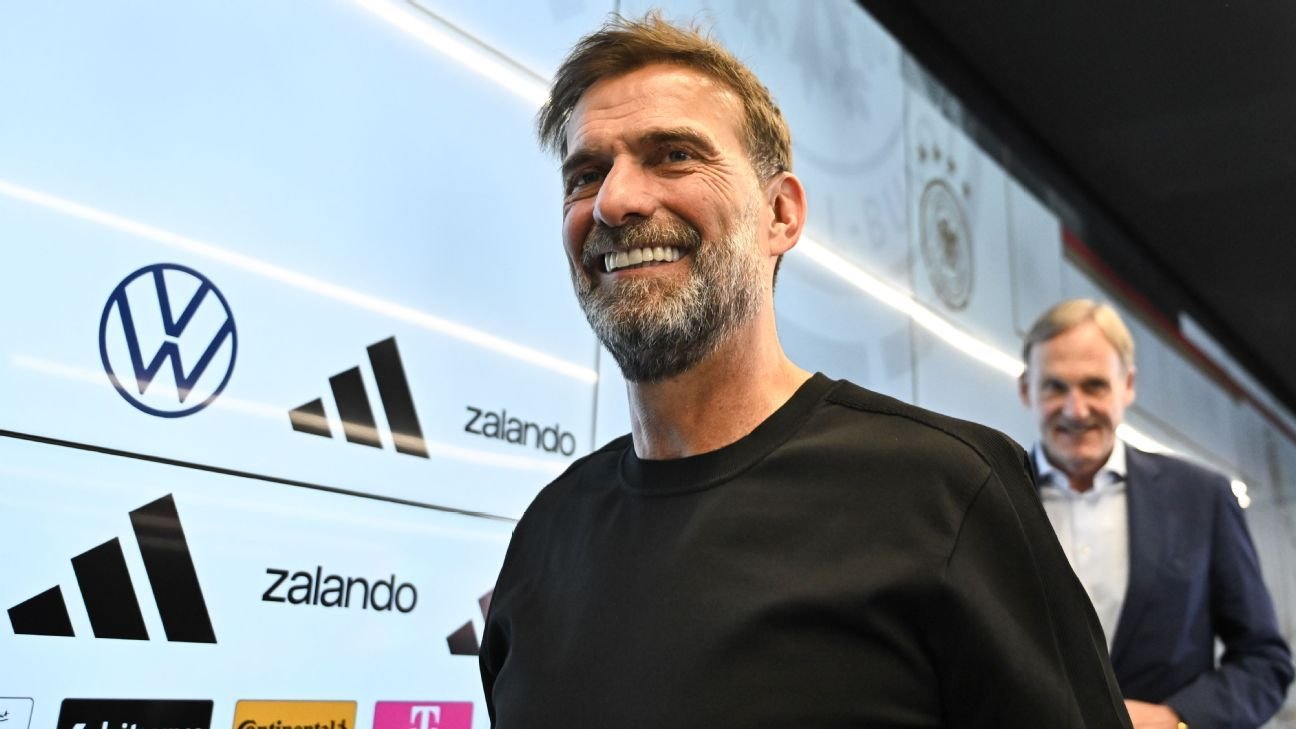
Yet, fast forward to now, and Klopp is set to return to the touchline, with an official announcement made on Friday confirming him as the new Germany national team manager under a four-year contract leading up to the 2030 World Cup.
Throughout his two-year break, Klopp, now 59, was linked to numerous coaching opportunities, including speculation about taking over as Real Madrid‘s coach this summer. However, it has long been believed that managing Germany was the only position compelling enough to draw him out of semi-retirement at Red Bull.
Germany’s continued struggles in major tournaments post their 2014 World Cup victory meant that pressure was mounting on manager Julian Nagelsmann and his squad. Their shocking elimination via a penalty shootout against Paraguay in the round of 32 left Nagelsmann’s future in jeopardy, leading to Klopp’s emergence as the preferred successor.
During the recent World Cup, Klopp’s role as a pundit for German broadcaster MagentaTV allowed him to witness his country’s latest disappointment firsthand, intensifying interest in his potential appointment.
“About two years ago, I stepped away from Liverpool, stating I didn’t have the energy for another job or another year with them,” Klopp expressed earlier this month. “Since then, I’ve recharged completely. I’m ready.”
This statement likely resonated with many fans back home, particularly after yet another disappointing tournament performance. But could Klopp be the right choice for this new role?
Is Germany the Right Job for Klopp?
This summer’s World Cup saw Klopp as one of the notable winners off the pitch. While stars like Lionel Messi, Kylian Mbappé, and Jude Bellingham dazzled fans during matches, Klopp engaged them through his relaxed yet charismatic presence, delivering punditry and appearing in major brand commercials like Budweiser and Trivago.
His interactions during the tournament, such as catching up with former Liverpool target Mbappé and parading in a cowboy hat with Germany legend Thomas Müller, kept him in the spotlight, reinforcing his status as one of soccer’s most cherished figures.
Klopp’s demeanor appears significantly improved compared to the final months of his Liverpool tenure, when he publicly confessed to feeling “drained” from the rigors of elite management.
“I understand that I cannot just keep doing this job over and over,” Klopp expressed to Liverpool fans in January 2024. “After all the times we shared and everything we went through together, my respect and affection for you grew, and the least I can offer is honesty—and that’s the truth.”
Staying true to his word, Klopp has, until now, declined offers from various clubs, choosing instead to prioritize family time. His role at Red Bull allowed him to serve as the face of their soccer operations while stepping back from daily club management.
His engagement with social media provided fans a glimpse into his leisure activities, from playing padel to enjoying a “bucket list” visit to the Winter Olympics in Milan-Cortina earlier this year.
1:41
Does German soccer have a talent crisis?
When Real Madrid presidential candidate Enrique Riquelme suggested he would hire Klopp as manager should he win the election, Klopp’s agent, Marc Kosicke, swiftly responded to dispel such rumors.
“It’s unfortunate,” Kosicke said. “Jürgen Klopp is content with his role at Red Bull and has no desire to return to club coaching.”
Looking back, that statement had deeper implications. Klopp may not seek the demands of club management any longer, but the opportunity to guide a national team could provide him with a balanced coaching role.
“This arrangement fits Klopp perfectly,” Dan Clubbe of the popular Liverpool fan channel The Redmen TV shared with ESPN. “While his nature as a coach suits daily, hands-on management, the emotional toll from his previous roles was considerable. This position allows him to stay engaged without overwhelming stress, maintaining his passion for the game.”
Can Klopp Leverage His Personality in International Management?
Klopp’s transformative impact on teams has been evident for over two decades. After a successful player career at German club Mainz, he became the manager in 2001, leading the club to its first-ever promotion to the Bundesliga.
After that success, forward Conor Casey, who previously played under Klopp, shared insights on Klopp’s vibrant personality. “He was different from any coach I had known in Germany; his positive energy was unmistakable. It was hard to believe initially, but his authentic enthusiasm had a profound effect on the players throughout the season,” Casey said.
This unique approach made Klopp a cherished figure at Mainz and subsequently led Borussia Dortmund to recruit him in 2008. Klopp orchestrated two Bundesliga championships and played a pivotal role in nurturing emerging talents like midfielder Ilkay Gündogan.
“That’s one of Klopp’s greatest strengths,” Gündogan reflected when discussing his man-management skills. “His ability to connect with players and staff fosters trust, which is essential for a successful relationship.”
Klopp’s direct and straightforward manner has shaped his approach on the pitch. While his “heavy metal football” evolved during his nine years at Liverpool, his commitment to dynamic, high-energy play has been a cornerstone of his coaching philosophy.
“At Mainz, his early coaching days focused on sheer effort—getting everyone to press and regain possession as quickly as possible,” Casey recalled. “The simplicity of his message was refreshing and transformative.”
Why Klopp is the Right Choice to Transform Germany
German soccer desperately needs a cultural shift, and Klopp emerges as the ideal catalyst for such change.
“I know him well,” Gündogan shared. “Having spent four years with Klopp at Dortmund, I believe he possesses the ability to re-energize and unite the country behind football, especially after the recent heavy defeat against Paraguay.”
Amid a squad featuring promising talents like Liverpool’s Florian Wirtz and Bayern Munich‘s Jamal Musiala, Klopp will face challenges in guiding Germany toward success at Euro 2028 and the 2030 World Cup.
However, Klopp possesses a talent for fostering an underdog mentality, reminiscent of his initial challenges at Liverpool in 2015.
0:52
Gundogan: Klopp appointment would unite Germany
“There are clear parallels between these situations. Liverpool needed to reconnect with its identity, and I sense Germany is in a similar predicament,” Clubbe from Redmen TV elaborates. “Klopp inherently understands the weight of the task he’s taking on, and he’ll rally the nation similarly to how he did at Liverpool. His history of turning skepticism into belief makes him uniquely qualified for this role.”
Despite the history of success at Liverpool, particularly in cup competitions, Klopp also has experience reshaping underperformers in critical moments—an invaluable trait in international management.
Klopp may need to adapt to the international milieu after two years away from coaching. Recently, he expressed disdain on air regarding a reported interference in a World Cup red card issue involving U.S. players, emphasizing that “this is our game, not theirs.” However, now in his capacity with the German Football Federation, such remarks may necessitate a more diplomatic approach.
While he enjoyed some personal liberties in the past couple of years, Klopp is now back in the spotlight and will need to be cautious about how he presents his private life. His prior affiliation with Red Bull, which has faced criticism in Germany for its ownership model, may also complicate matters as he works to win back the trust of some fans upset by his association.
Nonetheless, given his emotional intelligence and connection with players and fans, Klopp is well-positioned to mend fences with critics.
“In terms of culture and personality, he’s the ideal choice,” Casey asserts. “He’s capable of maximizing the potential of every player. Transitioning to international management presents its unique challenges, but he is adaptable, and I’m confident he’ll find a strategic way to guide Germany.”
Klopp will need to find answers quickly, with his first international squad gathering slated for September when Germany begins its UEFA Nations League campaign against the Netherlands.
“It’s a complex task,” Gündogan remarks. “Following the recent disappointing performances – not only in World Cups but also the Euros and Nations League – Jürgen has a significant challenge ahead. The priority is to strengthen unity and rekindle the faith in the national team.”
Revitalizing a nation’s spirit is no small feat, but given his track record of transforming doubt into confidence at Mainz, Dortmund, and Liverpool, Klopp is poised to embrace this challenge once again.