



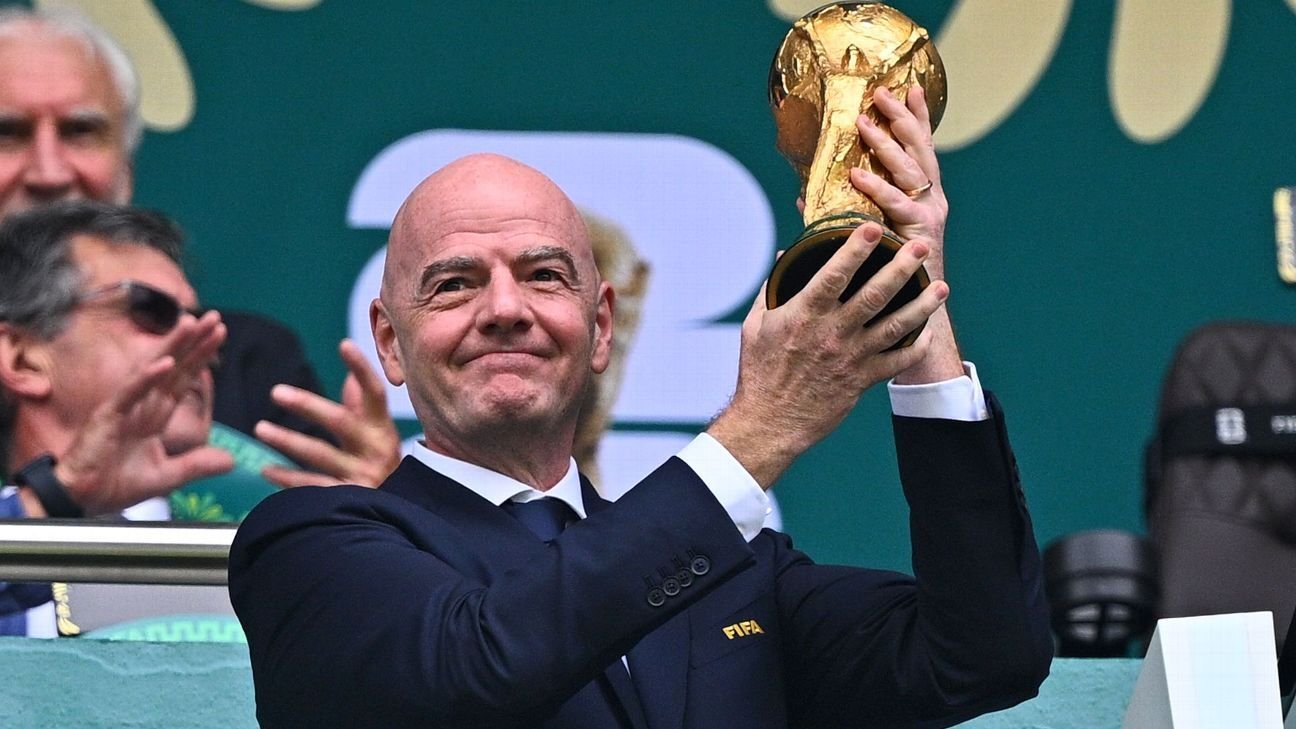
FIFA President Gianni Infantino has set a deadline of September 19 for the 211 national federations to approve his controversial private investment proposal, which could provide each association with access to $40 million in funding.
The announcement comes in the wake of significant backlash, with reports from ESPN indicating that UEFA is contemplating measures, including a potential boycott of the World Cup, due to what they describe as insufficient consultation and governance in the decision-making process.
In his letter to the federations, Infantino explained that the approval of the plan would unlock a $10 billion funding package, while rejecting it would limit funding to $2.7 billion.
The proposal aims to establish a $20 billion FIFA subsidiary, with private investors owning 20% of the entity, which would oversee FIFA’s competitions, including the World Cups.
This initiative is backed by Thrive Capital, the investment firm founded by Joshua Kushner—brother of Jared Kushner, who is a son-in-law to former U.S. President Donald Trump.
“It is my duty and responsibility as FIFA president to present such transformative opportunities to you, our members,” Infantino remarked in the letter, as reported by The Associated Press.
The funding package would consist of up to $20 million in one-off Fast Forward funding and an additional $20 million in FIFA Forward development funding over the 2027-30 cycle.
Infantino’s proposal, unveiled this week, has ignited immediate outrage from UEFA officials, who argue that the World Cup “is not FIFA’s to commercialize.” UEFA plans to convene an emergency online meeting of its 55 member federations, likely to occur on Thursday.
European soccer now faces the possibility of threatening a boycott of FIFA competitions, a strategy successfully employed in 2021 to halt Infantino’s plan to expand the World Cup to every two years instead of the traditional four.
On Wednesday, UEFA President Aleksander Čeferin held a video conference with representatives from its five member federations with the most prominent leagues: England, Spain, Italy, Germany, and France.
“President Čeferin expressed his opposition to this [FIFA] initiative,” noted Giovanni Malagò, the newly appointed president of Italian soccer, during the introduction of new Italy coach Roberto Mancini. “The situation is entirely at odds.”
Within women’s football in England, FIFA’s proposed initiative has been described as “unconscionable,” with fears that profit-driven decisions could adversely impact the women’s game and player safety.
These sources are also anxious that a UEFA boycott might be seen as sacrificing women’s football, particularly with the next World Cup set to focus on women’s competition in 2027.
There are rising concerns that a boycott of the women’s World Cup could be used as leverage in negotiations to prevent a boycott of the men’s tournament, potentially jeopardizing the women’s game in the interim.
Concerns regarding this plan, which had been previously kept under wraps, were voiced on Wednesday by continental bodies from Asia and North America (Concacaf).
“We are deeply troubled by the apparent lack of due process,” Concacaf stated.
The Asian Football Confederation, based in Kuala Lumpur, expressed disappointment that a matter of such magnitude became publicly known before it could be thoroughly examined and discussed within the AFC community.
The European Football Clubs group, which has a joint venture with UEFA for managing the Champions League, stated it “learned about this proposal like most global football stakeholders—without prior warning and through media channels.”
The plan has also prompted backlash from UK Prime Minister Andy Burnham, whose government is backing England, Scotland, Wales, and Northern Ireland’s bid to host the 2035 Women’s World Cup. FIFA is set to confirm the sole bid for the 2035 event during an online meeting in November.
“Football does not belong to investors,” Burnham, a lifelong soccer enthusiast, declared in an Instagram video. “Once you sell a portion of [the World Cup], you have essentially sold out. Football belongs to the fans—it always has and it always will.”
This private equity proposal marks another significant initiative during Infantino’s 11-year presidency, during which he has frequently appeared to act as an executive leader without consulting football’s core stakeholders.
Lack of transparency remains a significant concern regarding Infantino’s latest move.
Previous controversial initiatives included the establishment of a FIFA Peace Prize—awarded to Trump at the World Cup draw in December—and a secretive attempt for a $25 billion private equity investment in 2018 to expand men’s competitions, which was met with resistance from UEFA.
This report includes contributions from The Associated Press, PA, ESPN’s Mark Ogden, and ESPN’s Emily Keogh.