



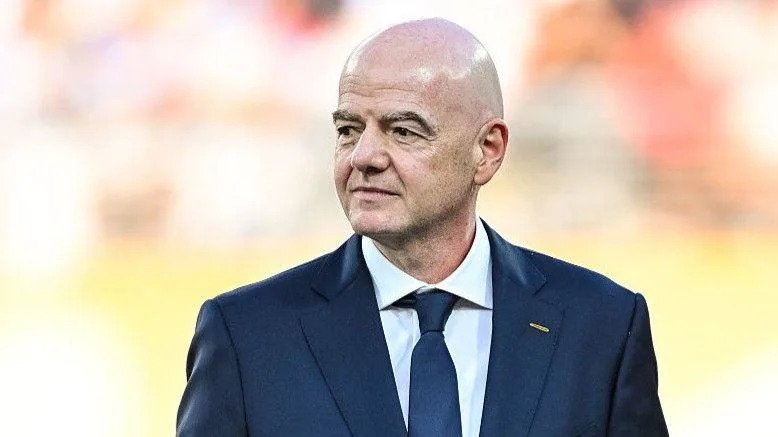
Any hopes Gianni Infantino had of quietly stepping back from the fallout of his World Cup private investment fiasco without significant damage to his reputation vanished on Saturday.
Uefa, the governing body for European football, launched a direct attack on the head of global football, stating it had “lost confidence” in his leadership.
Advertisement
This marked one of the most severe criticisms ever directed at someone in his position.
Words like “shabby” and “secret schemes” conveyed everything needed.
The backlash followed an intense five days in football, reminiscent of the European Super League (ESL) controversy in 2021.
The ESL was a breakaway league created by 12 of Europe’s biggest clubs, including six from the Premier League.
Former England defender Gary Neville described it as “pure greed.” It quickly unraveled.
Infantino’s private investment initiative lacked a catchy name but lasted an impressive two days longer than the ESL.
Advertisement
Despite Fifa announcing the withdrawal of the proposal on Saturday, its negative implications are expected to persist far longer than the brief project itself.
At the elite level, football operates as a massive profit-driven enterprise, with player and executive salaries far beyond those of ordinary fans.
Yet, have we reached a point where a fundamental boundary has been breached?
A critical question needs addressing
AFC president Sheikh Salman bin Ibrahim al-Khalifa (left) – with Gianni Infantino in 2023 – was among those to voice concerns over the Swiss’ plans [Getty Images]
The primary question surrounding Infantino’s scheme revolves around its underlying motives, entwined with fundamental aspects of this week’s upheaval.
Fifa is a not-for-profit entity with substantial financial reserves exceeding $2 billion (£1.48 billion) and is projected to announce record revenues around $15 billion (£11.13 billion) from this summer’s World Cup.
Advertisement
In light of this context—and considering that many nations did not require the additional $40 million (£29.67 million) offered for football development programs contingent on signing Infantino’s plan by September 19—questions arose about the necessity of private investment.
This was a crucial question that, curiously, was not raised publicly or, it seems, within Fifa’s inner circles.
Many of Fifa’s senior officials—from vice-presidents to special advisors—were not even aware the plans were in the works, leaving them without opportunities to voice concerns.
Uefa firmly opposed the proposed plans from the outset. When they were rescinded, its response was scathing.
Advertisement
“The current Fifa leadership has not only lost Uefa’s confidence but also that of many other members of the football family,” its statement said.
“When Gianni Infantino sought the trust and votes of Fifa’s member associations to become president in 2016, he emphasized that ‘Of course we must be transparent.’
“He stated to the gathered stakeholders: ‘The money of Fifa is your money. It does not belong to the Fifa president. You, as national associations, should have this money serve football development and not anything else.’
“On both these commitments, he has failed to deliver.”
Advertisement
This isn’t the first time Infantino’s lack of transparency has been called out.
Sheikh Salman bin Ebrahim Al Khalifa, president of the Asian Football Confederation (AFC) and one of Fifa’s vice-presidents, echoed similar sentiments, insisting that any future initiatives impacting global football should be presented to stakeholders “in a timely, transparent, and meaningful way.”
“The future of global football must always be shaped through proper consultation, collective dialogue, and respect for the established governance structures of our game,” he declared.
Football Australia chair Anter Isaac remarked that trust is built not simply through sound decisions but also through the integrity of the processes leading to them.
Advertisement
“Football has never been stagnant, nor should it be,” he noted.
“However, certain principles must remain unchanged: Integrity. Independence. Good governance. Transparency. Meaningful consultation. Due process. These are not constraints on progress.”
Echoes of the European Super League?
With the ESL, it was the fans who drew the line, supported by the Premier League, the Football Association, and even Prince William.
The 2021 proposal would have permitted participating clubs to remain in their national leagues while competing against each other in a new midweek European tournament, set to rival the Champions League.
Advertisement
Critics claimed it aimed to allow clubs to enrich themselves within a closed league that would boost their commercial and broadcasting income while undermining the domestic football pyramid.
After 72 hours of backlash, the plans collapsed. In the aftermath, it was said that clubs failed to present a well-rounded argument because the plan had leaked to the press, resulting in a fierce reaction that overshadowed any opposition.
This week mirrored that event—this time, however, it was the football community itself that took a stand.
The only notable difference was that Fifa attempted to present a counterargument in the early hours of Friday, claiming its “planned consultation process was disrupted by erroneous media reports.”
Advertisement
However, by that point, the sentiment had solidified and the momentum could not be reversed.
With opinions so strongly against the initiative, a damning statement from Fifa’s respected chief operating officer, Kevin Lamour, added insult to injury.
He characterized the contentious plans as “the project of one person” and asserted that Fifa’s administration had been “deceived.” BBC Sport has reached out to Fifa for comments.
Lamour acknowledged his duty to be loyal to his employer but also to adhere to “certain values” and support his colleagues.
Advertisement
“Our mission—the mission of the hundreds of dedicated and exemplary Fifa employees—is to serve football,” he articulated.
“If that means I lose my job, then so be it. I will accept that decision.
“At least I’ll be able to sleep well at night.”
Infantino’s strained relationships—what’s next?
Fifa president Gianni Infantino (left) with US president Donald Trump during the World Cup presentation [Getty Images]
Infantino has cultivated a close relationship with US President Donald Trump, and the two recently helped present the World Cup to Spain.
However, when Infantino sought Trump’s input regarding the plans for the first time on Friday, he received no support. Trump stated he hadn’t discussed the plans with Infantino.
A report from the New York Post, which first reported the withdrawal of the plans, cited an unnamed source saying the situation had become a “brand nightmare” for Joshua Kushner, Trump’s son-in-law Jared’s brother.
Advertisement
Kushner founded Thrive Eternal, the American venture capital firm that was set to lead the proposed investor group had Infantino’s plans proceeded.
In the end, Infantino, like with the ESL, had no choice but to retract the idea.
Now he must navigate the aftermath and attempt to mend relationships, even as support for his re-election as Fifa president in March appears to be dwindling.
Before Uefa’s statement on Saturday, vice-president Laura McAllister spoke on BBC Radio Four’s Today program.
“All confederations will be weighing options now,” she predicted.
“I’m certain there will be moves to encourage candidates to come forward, but it’s still early days.
Advertisement
“The key development this week was uniting to defeat this proposal, and that’s exactly what we’ve achieved.”
Once again, football has demonstrated its willingness to adapt to many things—though there are some boundaries that simply cannot be crossed.