



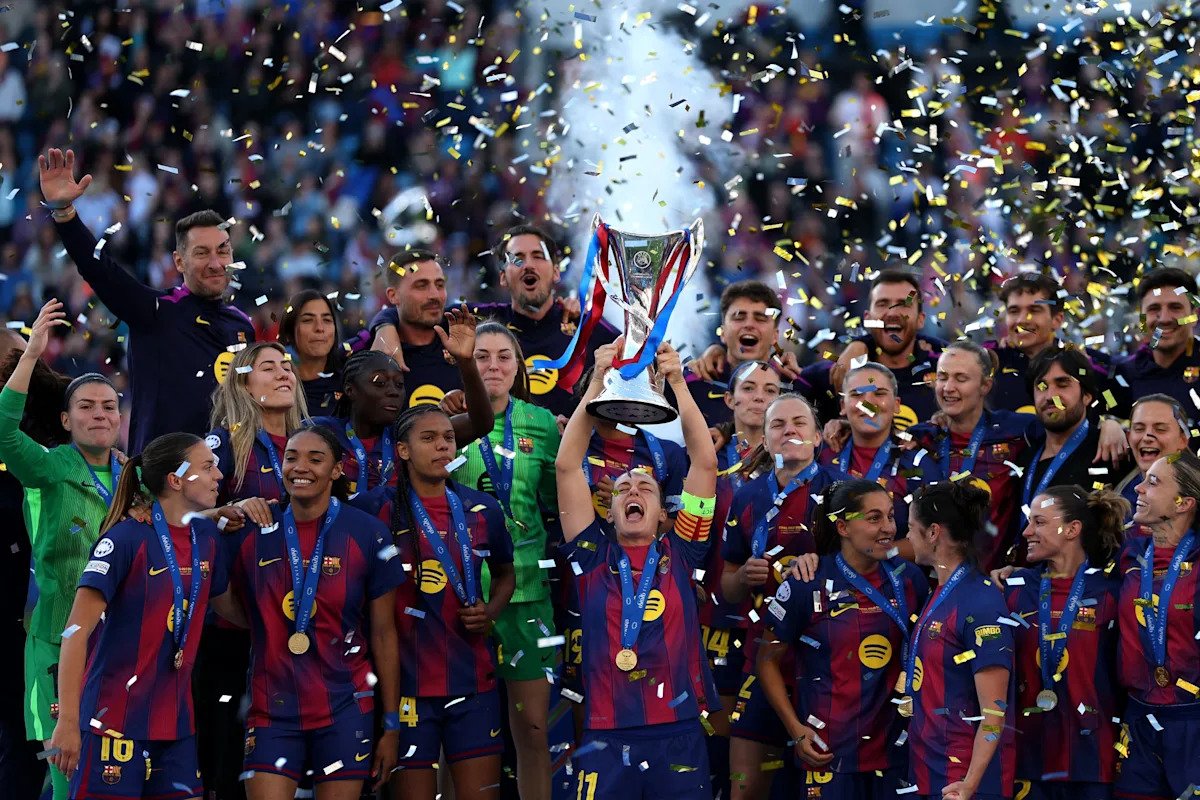
The UEFA Women’s Champions League final transcended the usual discussions about legacies and dynasties, ultimately presenting a narrative that was far more intriguing than mere confirmation.
Barcelona didn’t just dominate OL Lyonnes in Oslo; they initially withstood their challenge.
Advertisement
The final score of 4-0 will be remembered as yet another commanding victory for Barcelona, signifying a phase of dominance that seems more structural than cyclical. However, anyone who tuned in knows this was not a night underscored by immediate control or an inevitable outcome. For significant portions of the match, particularly in the early stages, Lyon demonstrated why they were once synonymous with this competition.
This underlying tension made the eventual outcome even more captivating.
Barcelona didn’t win by merely replicating their previous European success; they triumphed by showcasing their evolution.
The narrative leading into the final necessarily focused on Barcelona’s fight for another European title, further defining the era of women’s football. Beneath this headline, however, lay quieter stories that added deeper emotional resonance to the night.
Advertisement
One such story involved Alexia Putellas.
While there was no grand farewell or public announcement, questions regarding her future loomed large, hinting this could have been her last European match in Barcelona colors. Considering this possibility changed the lens through which one watched her play.
Putellas is not just one of Barcelona’s standout players; she embodies the club’s transformation.
She was part of the journey long before the stadiums were filled, long before European success became an expectation. Having first experienced what it meant for the women’s team to navigate uncertainty, she marked her legacy not merely through trophies but as the face of the club’s ambitious project.
Advertisement
In her post-match reflections, Putellas acknowledged the complexity of her emotions, stating, “I feel very proud; I don’t have words to describe what I’m feeling. It’s happiness, pride, and also emptiness because we’ve achieved what we were working for all season, so incredible.”
This response felt revealing rather than sentimental. While Barcelona may appear to be on an inevitable trophy path from the outside, Putellas’ sentiments hinted at something else: a peculiar emptiness that sometimes follows achievement.
Advertisement
Standing across the pitch was another player with her own historical legacy.
Lindsey Heaps entered the match with a chance to become the first American player to capture the UEFA Women’s Champions League title twice. This storyline perhaps deserved more attention given the rarity of sustained success in European football and Heaps’ role in Lyon’s contemporary identity.
Nevertheless, finals seldom reward narratives merely for their existence.
Lyon’s Brave Bid to Unearth Barcelona
The opening minutes were dominated by Lyon.
Barcelona approached the match with warranted confidence, fresh off another impactful domestic season where their attack overwhelmed opponents. Yet, Lyon quickly disrupted their rhythm.
Advertisement
They pressed with aggression but also with precision, their attacking transitions were incisive, and they sought gaps in Barcelona’s defense, forcing uncomfortable decisions instead of waiting for opportunities.
For the first time in this European campaign and since their last final against Arsenal, Barcelona appeared unsettled.
Lyon thought they had taken the lead during a dominant spell only for VAR to rule the goal out. Such moments can be tough to quantify statistically, but they are crucial psychologically. While it didn’t entirely stop Lyon’s momentum, it momentarily interrupted a phase where the game felt increasingly in their favor.
Rather than panic, what stood out in this phase was Barcelona’s composure.
Advertisement
There was no hasty tactical overhaul or visible urgency. They maintained their structured approach.
That confidence leaned significantly on Cata Coll.
Goalkeepers rarely take center stage in narrative arcs of straightforward finals, yet Coll’s contributions were pivotal, as they afforded Barcelona the opportunity to regroup and stifled Lyon’s offensive momentum. Finals often pivot on moments that precede goals, and Barcelona stayed alive because their goalkeeper performed admirably.
This stability allowed the match to shift towards areas where Barcelona heightens its threat.
Advertisement
Caroline Graham Hansen’s display encapsulated an essential facet of Barcelona’s strategy in Oslo.
She was a constant threat, often without needing to be the main catalyst, navigating the match with a patience best suited for finals rather than forcing misguided opportunities.
Hansen later reflected on this approach, saying, “I just tried to stay locked in, as they say, and enjoy the experience of a final because you work all year for this and have to appreciate those moments.”
Advertisement
That calmness became evident in Barcelona’s second-half performance. There was no sense of urgency despite early pressures. The players were confident that chances would arise.
As the first half transitioned into the second, possession began to take on a different significance.
Barcelona might not have controlled the ball more than Lyon, but they had a stronger grip on the game’s direction.
The distances tightened, their passing sequences quickened, and the movements around the penalty area began to appear. Once that evolved, breaking the deadlock felt less a matter of if and more a matter of when.
Barcelona’s first goal was the result of several plays that began to exploit more space in the wide areas, where Graham Hansen is exceptionally difficult to defend.
Advertisement
Asked about her consistent ability to find dangerous crossing opportunities, she highlighted decision-making over technique, stating, “I don’t know, it’s just intuition. I always say that football is 90 percent played with your head, so confidence plays a vital role in that. At this level, everyone’s so skilled, but what sets us apart is our decision-making. For me, it’s about keeping confidence high. I know what I’m good at and just tell myself: next one. Over the years, you hone that and persist.”
Ewa Pajor Secures First UEFA Women’s Champions League Title
Advertisement
Ewa Pajor’s goal represented more than just the opening tally.
Pajor arrived in Barcelona from Poland, carrying the unusual distinction of being one of Europe’s most prolific forwards without possessing a Champions League winner’s medal to match her performance. Previously, she had experienced finals without any rewards.
Her strike in Oslo changed that narrative.
Instead of immediately pushing forward after gaining the lead, Barcelona adopted a composed approach marked by methodical buildup.
Pajor’s second goal shifted the atmosphere entirely; the scoreline suddenly felt imposing, even if the gameplay itself remained close.
Advertisement
This quality is a hallmark of Barcelona: they can transform matches that appear evenly contested into one-sided affairs within minutes as their attacking prowess capitalizes on any slight lapse in concentration from their opponents.
Lyon, however, did not crumble. That’s an important distinction despite what the score may suggest. They continued to forge opportunities and pressed forward; unfortunately for them, Barcelona had entered a game state they understood intimately.
This was when Salma Paralluelo made her entrance. Her first goal felt like a confirmation, while her second carried symbolic significance.
Advertisement
This was not a reflection of Lyon deserving a four-goal defeat, but rather a testament to the emergence of Barcelona’s younger generation precisely as the narratives of the older ones fade.
The Rise of Barcelona’s Next Generation
Paralluelo’s late goal while Putellas observed the game’s progression toward another European celebration created an image rich with interpretation.
This was not about replacement; it was about continuity.
Putellas echoed that notion when she spoke about Barcelona’s younger players, advising them not to change their approach for such matches.
“Don’t alter anything. It’s just another football match, similar to last week. The responsibility of us seasoned players is to play as we know and support the younger ones. But they are so talented that they may not need much protection. I’m thrilled for them because they must keep pushing. When you win everything at 18 or 19 in your first professional season, you need to keep striving for longevity in your career ahead.”
Advertisement
That might ultimately encapsulate what Barcelona has excelled at more than anyone else.
Lyon pioneered the modern dynasty in women’s club football through elite recruitment, unwavering standards, and an ingrained expectation of victory. Barcelona has adopted those principles and adapted them into something distinct: a strong football identity that can withstand transitions.
Players leave, others mature, and new stars emerge. Yet the team remains distinctly recognizable. This brings us back to Putellas.
When queried about where this latest European title ranks among her Champions League successes, Putellas refrained from making comparisons.
Advertisement
“Every title is special. Naturally, the first one holds a unique significance because it came in an empty stadium due to Covid. The second was La Remontada [the comeback]. Then, of course, Bilbao was packed with Culers. This one is undoubtedly special due to its recency and the quadruple.”
Each title told a different chapter of Barcelona’s story: from empty stands to comebacks, to bustling finals, and now another quadruple achieved.
Putellas humorously noted her immediate plan was simple: to enjoy a long summer break before returning to her continuous pursuit of excellence next season.
Her closing message to Barcelona supporters was succinct yet heartfelt, simply expressing ‘muchas gracias’ to those who traveled and supported the team throughout another remarkable journey.
Advertisement
If this marked her final appearance for Barcelona, it was not a farewell like those typically seen. She didn’t dominate the match or deliver a decisive play. Perhaps this is fitting, as her legacy transcends individual games; it’s about establishing the circumstances where a 4-0 Champions League final victory feels routine.
Ultimately, Putellas left the future open-ended, opting to concentrate on celebration instead of speculation.
For Heaps, history remained unfinished. The match might have closed the door on her possibility of becoming the first American to win the UEFA Women’s Champions League twice, but it heralded another chapter.
Advertisement
After the match, Heaps revealed this had been her final Champions League appearance. When questioned about her feelings, her answer reflected disappointment intertwined with perspective.
“It’s unfortunate, a lot of disappointment but also a lot of pride. It’s a little emotional because it’s my last Champions League game, but I think we performed well. We executed many aspects of our game and stayed competitive until the very end, but unfortunately didn’t finish our chances, and they did — they are a very strong team, and I have tremendous respect for them.”
This reflection was crucial, as the score could oversimplify what Lyon represented in this final.
Advertisement
They weren’t overwhelmed throughout the entire match. They stayed engaged for substantial periods and crafted opportunities that, on a different day, could have altered the course of the evening.
Heaps Passing the Torch at OL Lyonnes
For Heaps, this perspective extended beyond a singular match. Reflecting on Lyon’s journey to Oslo, she articulated their journey to the final as something earned, not taken for granted.
“Looking back on our path to this point, we recognize it hasn’t been easy. We prevailed against Wolfsburg and Arsenal. It’s not straightforward; teams are improving each year. I think about Jule and Melchie scoring crucial goals, and I will hold Wendie and Ada in my heart for a very long time.”
Advertisement
This was a reminder of what women’s football increasingly demands.
Dynasties are no longer unchallenged. The margins are narrowing, and the teams in pursuit are consistently improving. This might explain why the defeat felt deep rather than purely frustrating.
Heaps also turned the discussion toward the players who will persist after her departure. When asked what she hoped someone like Lily Yohannes would glean from experiences like this, her response resonated with the weight of accumulated wisdom.
“They will win trophies, they will. This defeat will sting; we’ve experienced this before. I’ve faced it with both the national team and Lyon, but it’s a motivator. Every great player’s journey is filled with highs and lows. It requires time, patience, and perseverance.”
Advertisement
This insight fittingly contrasts with Putellas’ earlier reflections.
One describes the necessity of sustained success while the other speaks of enduring disappointment. Both articulate careers as narratives longer than single finals.
When asked what she cherishes most about her time in Europe, Heaps’ response was unexpectedly simple.
“Playing with this team, training with them day in and day out.”
While finals can mold narratives, they do not encapsulate careers. What this final unequivocally illustrated was not that Lyon’s era is concluded or that Barcelona is invincible; rather, it revealed a more nuanced truth.
Advertisement
Barcelona no longer require absolute perfection from the outset to secure European acclaim. This may be the most significant indication yet that this era is not fading; it is becoming firmly established.
Related articles from Her Football Hub:
-
UWCL: OL Lyonnes vs Barcelona is ‘one of the best games you can watch’, says Damaris Egurrola
-
Cherry Bombs FC: How Portland’s USL W Club embodies community, identity, and intentional football branding
-
ÖFB Frauen Cup: FK Austria Wien lift first-ever trophy on milestone 50th Cup Final