



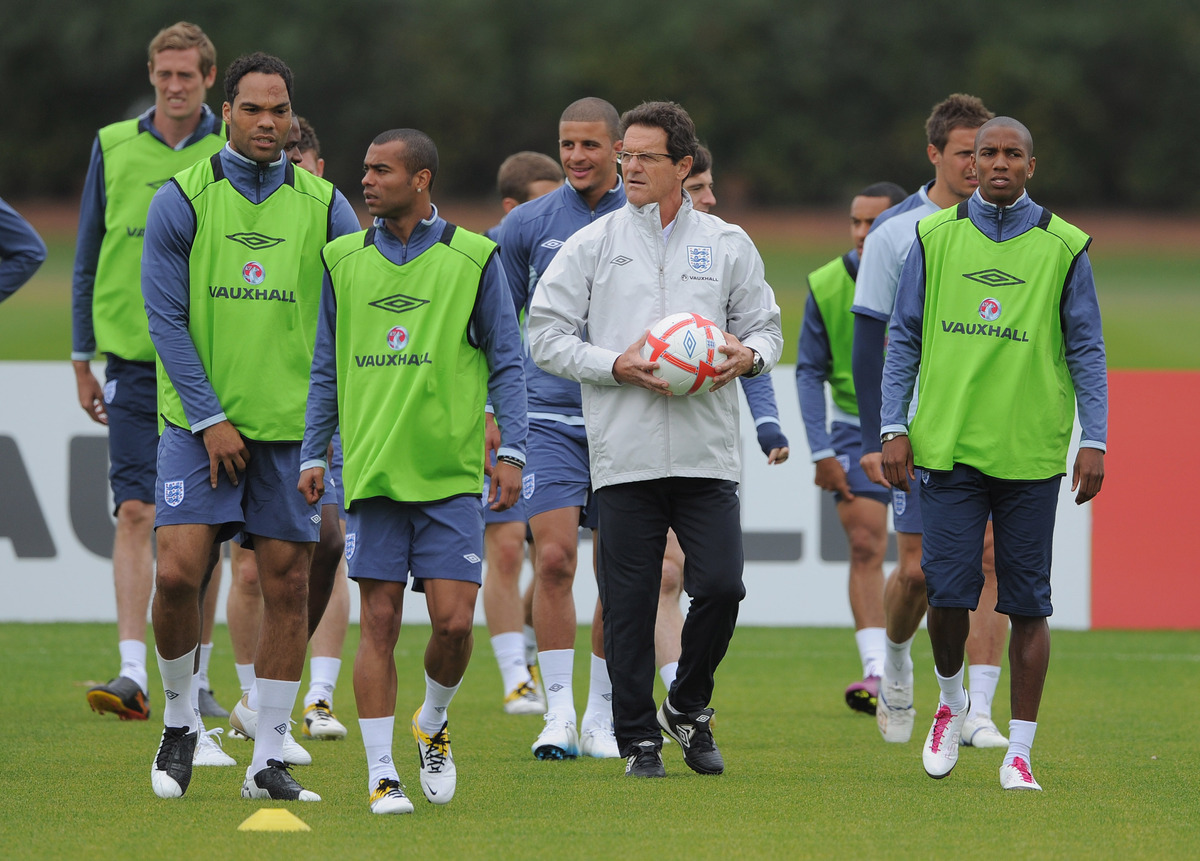
Fabio Capello has expressed his support for Carlo Ancelotti’s Brazil in the upcoming 2026 World Cup, while reflecting on his lingering disappointment over Frank Lampard’s disallowed goal in 2010: “We can only wonder how things might have turned out.”
The highly anticipated 2026 World Cup is approaching, yet unfortunately, Italy will miss out on the tournament for the third consecutive time.
Advertisement
In a recent interview with Gazzetta, Capello shared his thoughts on which team he would support this summer, as well as who he believes are the top contenders for the trophy.
“I’m backing Carlo Ancelotti’s Brazil; he’s a remarkable leader who adapts seamlessly to any situation, and that’s no easy feat in Brazil,” stated the former Italian coach.
“The main contenders are likely to be France or Spain, as they possess the highest quality and players capable of making decisive contributions. The tournament will be challenging due to the high temperatures, making skill crucial.”
Ancelotti is among three Italian managers participating in the World Cup, alongside Vincenzo Montella (Turkey) and Fabio Cannavaro (Uzbekistan).
Advertisement
“Montella has an intriguing team; they play with confidence and character,” Capello noted.
“Players like Calhanoglu is vital, and Yildiz can be a game-changer on the pitch.”
Capello managed England during the 2010 World Cup, where they were eliminated in the Round of 16 following a 4-1 defeat to Germany.
Capello’s team had equalized with a goal from Lampard, but the referee did not see that the ball had fully crossed the line, rendering the goal invalid due to the absence of goal-line technology at that time.
“I still can’t come to terms with it. We changed football as a result; goal-line technology was implemented afterward,” Capello reflected.
Advertisement
“We could have pulled ourselves back from a two-goal deficit, and we were starting to play better. The uncertainty of what might have happened still haunts me.”

DNEPROPETROVSK, UKRAINE – OCTOBER 09: (L-R) Steven Gerrard, captain John Terry, David Beckham, and Frank Lampard listen to manager Fabio Capello during an England training session at the Dnipro Arena on October 9, 2009 in Dnepropetrovsk, Ukraine. (Photo by Michael Regan/Getty Images)
“I’m also intrigued to see how England and Germany perform in this World Cup,” Capello added.
“It will be interesting to determine whether England still possess the physical and mental fortitude required for the World Cup. If they do, they can be exceptionally dangerous.”
Advertisement
Italy has appointed Silvio Baldini as interim coach for their matches against Luxembourg and Greece.
“All the players are rather young. I have a good rapport with Baldini; I know him personally,” Capello remarked.
“We need significant improvement in various aspects, especially in intensity and passing. While we don’t have severe issues in attack and midfield, our defense is lacking. Historically, we’ve prided ourselves on our strong defense; we built our legacy on it, and now we’re falling short. It is essential to seek out some robust Italian defenders.”
Italy last participated in the World Cup in 2014, which marked Capello’s presence in the competition as the head coach of the Russia national team. What steps can Italy take to recover?

ZENICA, BOSNIA AND HERZEGOVINA – MARCH 31: Haris Tabakovic of Bosnia and Herzegovina scores a crucial equalizer during the FIFA World Cup 2026 European Qualifiers play-off match between Bosnia & Herzegovina and Italy at Stadion Bilino Polje on March 31, 2026 in Zenica, Bosnia and Herzegovina. (Photo by Getty Images/Getty Images)
Advertisement
“First and foremost, we must implement long-term plans. In youth sectors, the focus should shift from tactics towards refining technical skills, as we have weakened in that area,” Capello advised.
“The emphasis should also be on moving the ball swiftly, raising intensity, and adopting a more assertive playing style, transitioning forward more often.”
“Many teams still rely on lateral or backward passes. They could take cues from Fabregas’ Como, whose style exemplifies great football through ball retention and forward movement.